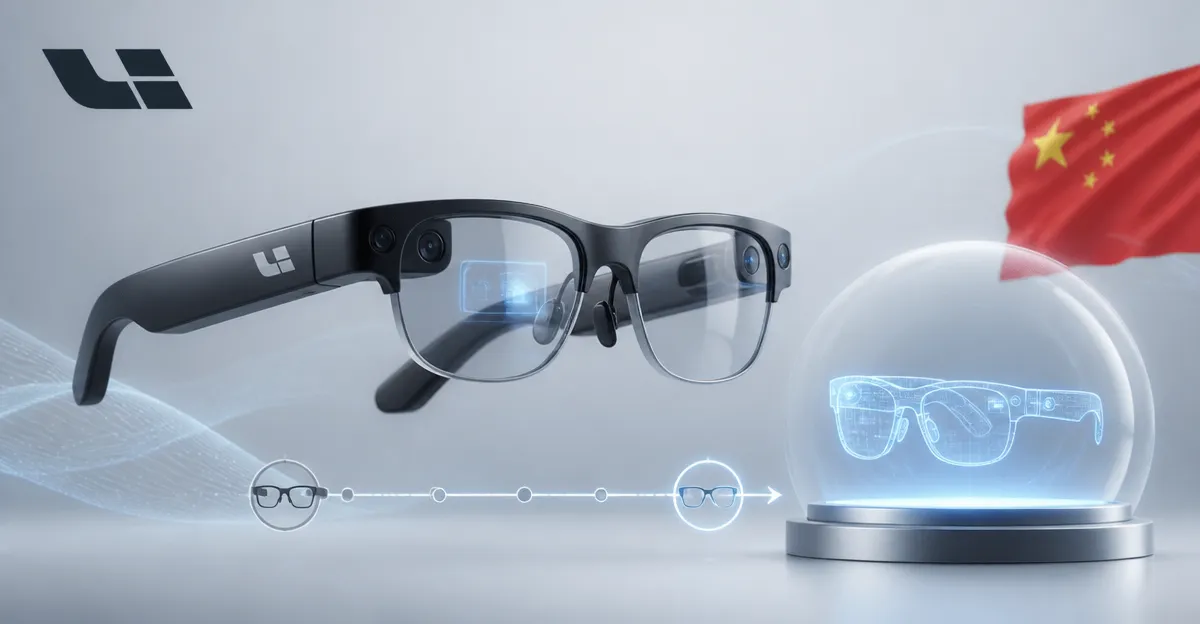
August 11, 2026, (Inside AI) — Chinese electric-vehicle maker Li Auto has confirmed its second-generation Livis AI glasses are slated for release in the second half of 2027, signaling an accelerated push into wearable AI hardware beyond its core automotive business.
The Beijing-based company, known for its extended-range EVs, is evaluating advanced lens-based display technologies in collaboration with German optics giant Zeiss. The partnership aims to solve the persistent challenge of embedding high-resolution micro-displays into lightweight, everyday eyewear.
Li Auto also revealed that the Livis product line will expand vehicle model compatibility over time, though it did not specify which current or future models will gain integration. The glasses are being positioned as a connected companion device, extending the in-car experience to pedestrians and cyclists.
The move places Li Auto in direct competition with Meta and Xiaomi, both of which have launched AI-powered smart glasses. However, Li Auto’s automotive pedigree could give it an edge in seamless vehicle-to-wearable data handoffs, a feature none of its rivals have fully realized.
Read: Apple’s New Mac Mini and Mac Studio Target On-Device AI Workloads
HarmonyOS Compatibility Opens a Strategic Front
In a notable shift, Li Auto is developing native compatibility with HarmonyOS, the operating system from rival Huawei. This cross-platform move is unusual in China’s fiercely competitive EV market, where ecosystem lock-in is the norm.
Huawei’s own automotive unit has positioned HarmonyOS as a key differentiator for its AITO branded vehicles. By embracing HarmonyOS, Li Auto could tap into Huawei’s vast smartphone user base, potentially expanding its addressable market beyond its own vehicle owners.
The decision also raises questions about Li Auto’s relationship with other Chinese tech ecosystems. The company has not disclosed whether the glasses will support Xiaomi’s HyperOS or OPPO’s ColorOS, leaving a fragmented landscape for developers.
Why Wearables Now? The Battle for Contextual AI
Industry analysts see the Livis glasses as a play for contextual AI dominance. Smart glasses can capture real-world data that feeds into large language models, enabling proactive assistance that smartphones cannot match.
Li Auto’s first-generation Livis glasses, launched in 2024, were primarily a heads-up display for navigation and notifications. The second generation is expected to incorporate on-device AI for real-time translation, object recognition, and health monitoring.
Read: NVIDIA Announces Jetson Orin Nano 2 Robotics Computer for Entry-Level Edge AI
The Zeiss collaboration is critical. Lens-based displays, unlike waveguide or birdbath optics, promise a more natural form factor but have historically suffered from low brightness and limited field of view. Solving this could leapfrog current market leaders.
Yet challenges remain. Battery life, heat dissipation, and privacy concerns have plagued every smart glasses entrant since Google Glass. Li Auto has not disclosed how it plans to address these, nor has it confirmed pricing or manufacturing partners beyond Zeiss.
The second-generation timeline also depends on supply chain stability. Advanced micro-LED and holographic optical elements are still nascent, and any delay could push the launch into 2028.
Li Auto’s move mirrors a broader trend of automakers investing in AI wearables. Nio and Xpeng have both filed patents for AR glasses, but neither has announced a commercial product. Li Auto’s explicit timeline gives it a first-mover advantage in the Chinese market.
As the lines between automotive, consumer electronics, and AI continue to blur, the Livis glasses represent more than an accessory. They are a bet that the next computing platform will be worn on the face, not held in the hand.