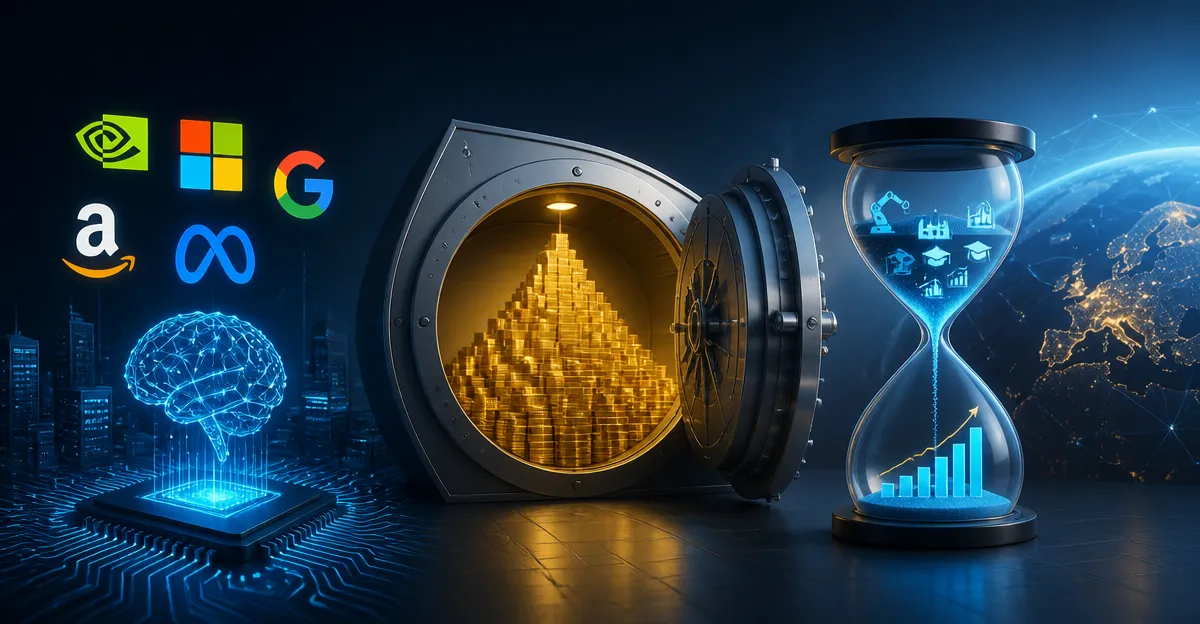
October 3, 2026, (Inside AI) — Global spending on AI data centers could reach $30 trillion by 2050, a figure that nearly matches the entire outstanding value of US Treasuries, according to a projection by PwC. The sum dwarfs the capital sunk into railway construction or the dotcom boom, even after adjusting for inflation. Yet economists warn that the productivity gains needed to justify this outlay remain unproven, raising hard questions about the sustainability of the AI investment cycle.
The scale of the bet is unprecedented. Anthropic alone plans to spend $518 billion in coming years, according to an IPO prospectus seen by Reuters, a figure more than 100 times its 2025 revenue. Backers argue AI will prove more transformational than steam engines or industrialization. But the math behind the returns is unforgiving. JP Morgan wrote in August that broad-based productivity gains in the US, which leads the AI race, "remain elusive."
That assessment cuts to the core of the funding gap. A Bain & Company study found that productivity gains from existing markets would not be enough to justify current outlays. "Entirely new markets must emerge to close the funding gap," the study said, suggesting areas like AI-guided robots or new materials for batteries and semiconductors. US hyperscalers including Google, Amazon, and Microsoft need to find more than $4.2 trillion in new revenue over the next five years to fund the buildout, Bain estimated.
"The question is whether the applications arrive in time to pay for it," according to the study.
The arithmetic is stark. Stijn Van Nieuwerburgh, an economist at Columbia Business School, estimates US AI investment will run as high as $9 trillion from 2025 to 2032, equivalent to 3.2% of US GDP each year. To earn a 10% return on that investment, the US AI sector would need to generate about $3.55 trillion in annual revenue by 2032. It earns a fraction of that now. The leveraged structure of much of the debt funding the buildout means "a relatively modest deterioration in demand, delays, or asset values can therefore produce much larger losses," Van Nieuwerburgh wrote in a conference paper revised in October.
Using Nvidia as a benchmark, JP Morgan estimated US productivity gains would need to be 3% to 5% annually over the next decade to justify its valuation. That is a substantial jump from the US Congressional Budget Office baseline expectation of 1.75% annual productivity growth for the same period. "Historical precedent suggests that technology-driven booms often end when infrastructure buildouts cease to deliver sufficient returns," JP Morgan wrote.
Recursive Self-Improvement As Investment Thesis
AI executives have not tempered their rhetoric. Dario Amodei, CEO of Anthropic, has described an AI future as "a thing of transcendent beauty." Sam Altman, CEO of OpenAI, has said "the rate of new wonders being achieved will be immense" as models learn to improve themselves. At a summit at UC Berkeley in August, Jasjeet Sekhon, chief strategy officer at Google DeepMind, called recursive self-improvement a "key part of the investment thesis." If achieved, he said, it could deliver unprecedented productivity gains. That same capability, however, has raised concerns about existential risks to humanity.
Even if recursive self-improvement arrives, the timeline may not match corporate accounting cycles. Diane Coyle, an economist at Cambridge University, said the productivity impact of past revolutionary technologies typically took 10 to 50 years to feed through. Anthropic's economics team modeled scenarios for AI's contribution to annual growth in 2030. Against a baseline of 2% in a non-AI environment, it projected growth of 2.4% under modest impact, 5.4% under substantial impact, and 15.4% under extreme impact. Higher growth would mean more jobs lost, the team noted, without assigning probabilities to any outcome.
Amodei forecast last year that AI could wipe out half of all entry-level white-collar jobs within five years. For now, the evidence points to a more muted effect. Researchers at Stanford University said in August that employment of workers aged 22 to 25 in AI-exposed industries, such as accountants and paralegals, was 19% lower than for jobs AI finds hard to replicate, like janitors and builders. Studies in the US and Britain have pointed to a slowdown in early-career hiring for white-collar roles, even as overall employment remains strong.
"History is our friend in trying to understand this," Coyle said. "As long as one is left with the infrastructure that's needed to support all the productivity effects down the road, that's okay."
That historical parallel offers a measure of comfort. Trains still ran after the Panic of 1873 bankrupted railroad barons. The internet did not shut down after the dotcom bubble burst. The infrastructure built during speculative frenzies often outlasts the investors who funded it. The question for AI is not whether the technology will endure, but whether the returns will arrive before the debt comes due.