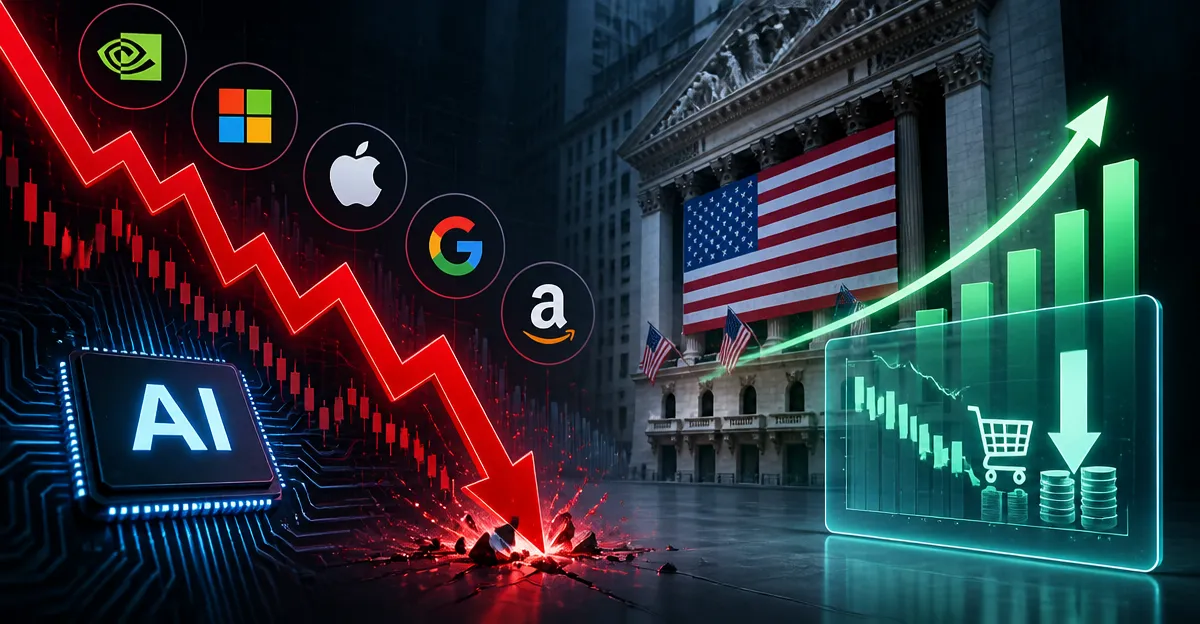
July 18, 2026, (Inside AI) — A punishing technology selloff ripped through Wall Street in the week ending July 17, erasing billions in market value as investors fled semiconductor stocks and questioned the durability of the artificial intelligence spending boom. The rout came despite fresh evidence that U.S. inflation is cooling, a rare bright spot that failed to calm a market gripped by fear of an AI bubble.
The technology sector tumbled 5.9% for the week, its worst performance since March 2025. The iShares Semiconductor ETF, a bellwether for AI-linked equities, sank 19% month to date, putting it on pace for its steepest monthly decline since November 2008. The selloff was sparked by twin anxieties: signs that hyperscaler AI investment may be cresting, and the disruptive threat of low-cost Chinese AI models that could gut pricing power for U.S. chipmakers.
At the epicenter of the carnage was IBM, which suffered a historic collapse. Shares cratered 25.2% on Tuesday, July 14 — the single worst trading day in the company’s history, eclipsing even Black Monday 1987. The plunge followed a pre-announcement of second-quarter revenue of $17.2 billion, missing consensus by roughly $700 million. Adjusted earnings per share came in at $2.93, below the $3.02 estimate.
CEO Arvind Krishna attributed the shortfall to a late-quarter budget shift, with clients redirecting spending toward AI hardware — memory chips, servers, storage — at the expense of IBM’s software and infrastructure. The explanation did little to reassure investors already rattled by broader sector weakness.
Memory chip stocks were hit especially hard. SanDisk and Western Digital both fell more than 20% on the week. The trigger came from Seoul, where South Korean brokerage KIS published a second-quarter estimate for SK Hynix that was 8% below consensus, citing slower-than-expected shipments of next-generation HBM4 memory. SK Hynix shares collapsed 15% in Asia on Monday, July 13, their worst day ever, and its newly launched U.S. ADR closed its first week of trading in the red.
The selloff is not happening in a vacuum. For months, Wall Street has debated whether the AI capital expenditure cycle is sustainable. Recent earnings from cloud giants have shown only modest revenue uplift from AI, while the emergence of efficient, low-cost models from Chinese firms like DeepSeek has raised fears that demand for premium U.S. chips could soften. These structural worries are now colliding with profit-taking after a record-breaking rally.
Amid the turmoil, macroeconomic data offered a rare piece of good news. Consumer inflation cooled in June from 4.2% to 3.5% year-over-year — the first decline of 2026. On a monthly basis, prices dropped 0.4%, the sharpest fall since April 2020. Producer inflation also plunged, reinforcing expectations that the Federal Reserve will hold rates steady at its July meeting.
Consumer sentiment added to the positive signals. For a second straight month, the University of Michigan Consumer Sentiment index jumped 10%, reaching its highest level since February, buoyed by easing gas prices. Year-ahead inflation expectations ticked down from 4.6% to 4.2%; long-run expectations held at 3.3%.
However, survey director Joanne Hsu cautioned that the recovery may prove fragile.
“Over 70% of interviews were conducted before U.S. strikes on Iran resumed on July 7 and gas prices began climbing again,” she said.
The disconnect between improving economic data and a panicked tech selloff underscores a market in transition. For years, AI hype propelled valuations to dizzying heights. Now, with concrete evidence of slowing demand and competitive threats, investors are reassessing risk. The coming weeks will test whether this is a healthy correction or the start of a deeper unwind.