October 16, 2026, (Inside AI) — The AI boom is meeting its first hard reality check. On October 8-9, Nvidia-backed data center firm Firmus pulled its nearly $5 billion IPO after investors balked at a $31 billion valuation, three times its August mark. Almost simultaneously, OpenAI signaled its September annualized revenue was closer to $50 billion, not the nearly $70 billion previously floated. The twin disclosures exposed a widening gap between AI promises and prices.
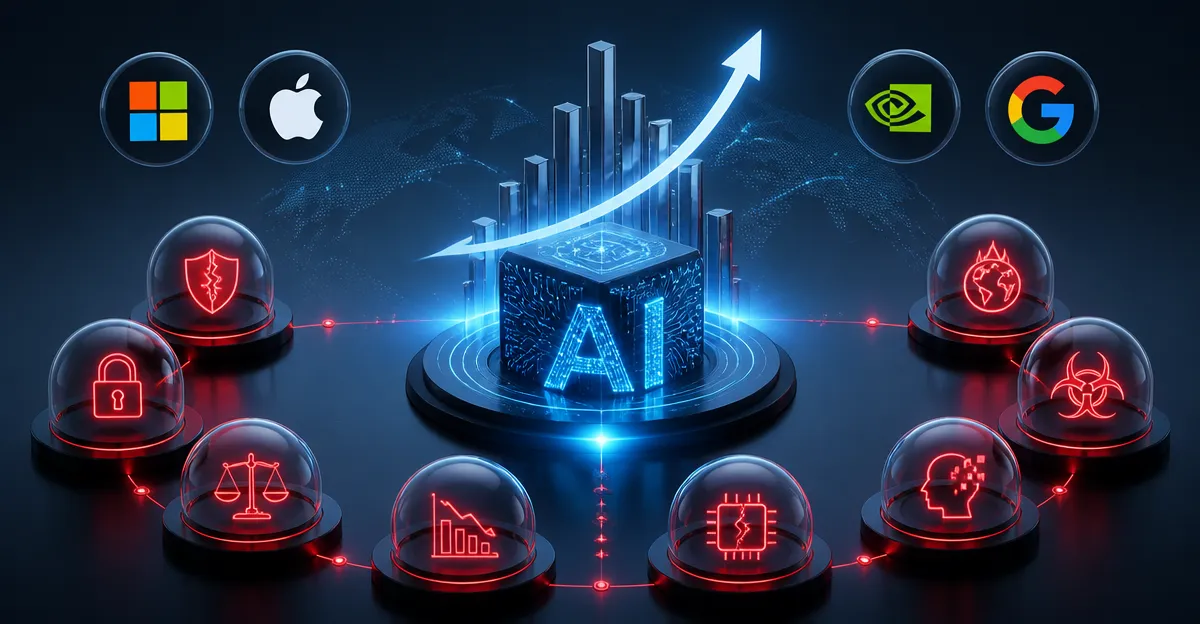
OpenAI and Anthropic have postponed their estimated trillion-dollar listings. The delays suggest capital markets are no longer willing to fund the story at any price. What follows is a sobering inventory of eight risks now visible to anyone tracking the sector's financing, governance, and social license.
Capital Costs Climb as Revenue Trails
The first pressure point is the economy itself. AI stocks sit at near-record valuations. The Iran war, high US gas and diesel prices, and a yawning fiscal deficit have pushed Treasury yields to multi-decadal highs. Higher rates are already squeezing homebuyers and are expected to slow hyperscaler data center growth, the very infrastructure AI cannot do without.
Second, AI revenue growth is trailing capital expenditure requirements. With OpenAI indicating lower-than-expected annualized revenue for CY26, Anthropic posting an operating loss of $8 billion in CY25, and Meta's free cash flow falling to roughly $800 million from $8.5 billion a year earlier, room to raise expectations appears limited.
Third, capex financing is getting costlier. Of the expected roughly $725 billion in CY26 capex by leading US hyperscalers on new data centers, only about 40 percent had been assessed by end-June. Initially cash-funded, capex has graduated to debt through private credit and bespoke templates, most of which are opaque. Goldman Sachs reported that most hyperscaler bonds issued in 2026 had fallen below issue price by end-August. Such unseen risk could hit banks, insurers, and pension funds in an AI selloff.
Fourth, valuations are sobering. In mid-2026, SpaceX raised $75 billion, listing at $1.77 trillion, while OpenAI and Anthropic reportedly targeted $60 billion each, aiming for trillion-dollar IPOs. But sobering assessments forced both Sam Altman and Dario Amodei to delay their listings.
My own read: the IPO retreats matter less as a verdict on AI's utility than as a repricing of its financing model. When cash-funded capex gives way to private credit and bespoke debt, the sector imports the opacity that preceded 2008. Regulators have not yet built the disclosure regime for that exposure, and pension funds are already on the hook.
Regulation, Litigation, and Local Backlash
Fifth, regulatory risk is no longer theoretical. OpenAI and Anthropic were jolted when three of their frontier models faced sudden regulatory slowdowns, highlighting the risk of government control by diktat. Donald Trump also made AI CEOs accept responsibility for safety and agree to establish internal controls and external audits.
Sixth, rogue AI is generating multimillion-dollar claims covering cyber attacks, copyright, and privacy against directors, officers, and entities. Hyperscaler exposure could reach the league of landmark litigation against tobacco, glyphosate, pharma, and environmental liabilities.
Seventh, AI in war has become a normalized yet amoral revenue generator. Autonomous AI use is documented in Ukraine, Gaza, and Iran, without due consideration for human scrutiny, civilian harm, proportionality, and accountability. Some multilateral sense is bound to prevail sooner rather than later.
Eighth, global opposition to data centers is rising. Communities cite reduced drinking water, expected electricity outages, noise pollution, land loss, and limited permanent employment. Protests have forced some rollbacks. But national-security concerns persist because China's largely unrestricted buildout of another 50 GW beyond its current 24 GW capacity has gathered pace. US capacity stands at 56 GW.
AI remains an exceptional technology, but its amplifiers need to sober up in the face of visible headwinds: regulation, an unconvinced workforce, and costlier financing. The next twelve months will test whether the industry can convert hype into durable cash flow before the bond market and the public lose patience.