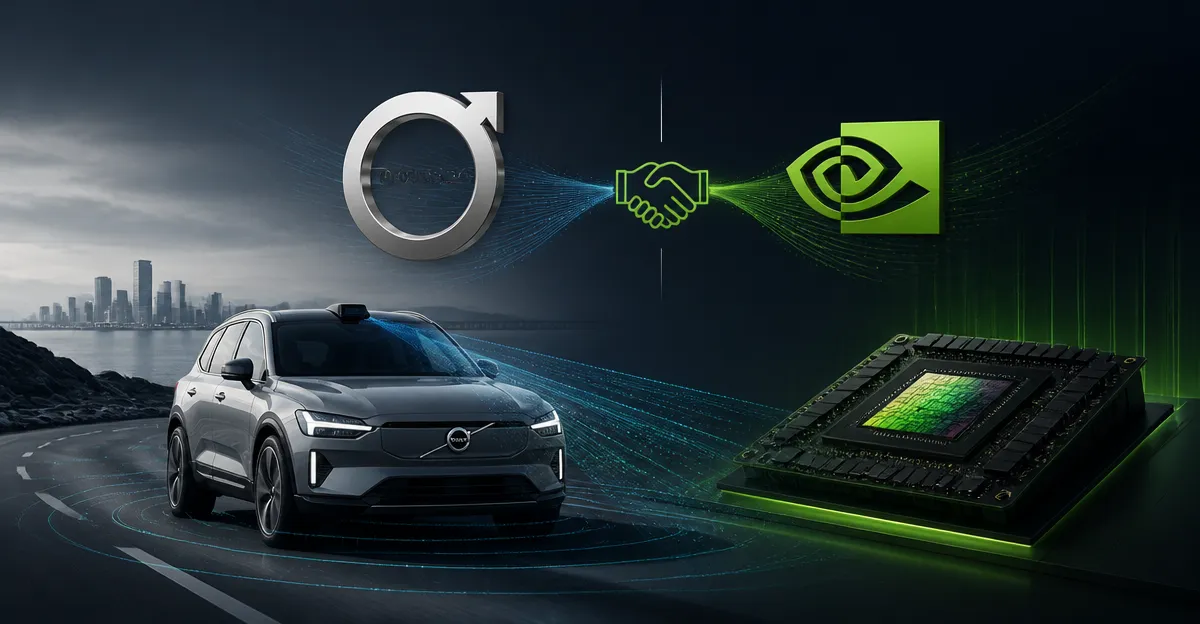
October 16, 2026, (Inside AI) — Volvo Cars and NVIDIA have expanded their long-standing partnership to accelerate the deployment of safe automated driving technology, the companies announced today. The collaboration will integrate NVIDIA's Hyperion sensor and compute architecture, Halos OS, and Alpamayo Stack driving software into future Volvo vehicles, with the first application expected in a next-generation model as part of Volvo's largest-ever product push.
The move signals a significant step toward commercializing eyes-off and mind-off driving capabilities, where the car assumes full control and the driver is free to disengage from the driving task. Volvo aims to combine its nearly 100 years of safety research with NVIDIA's AI computing to set a new benchmark for automated driving that is both safe and trustworthy.
"Volvo has been synonymous with car safety for almost 100 years," said Håkan Samuelsson, president and CEO of Volvo Cars. "By working with NVIDIA, we bring together two distinct strengths: industry-leading safety knowledge and world-class AI technology. That combination gives us a unique opportunity to create safer and more attractive cars for our customers."
"Accelerated computing has transformed the car into an intelligent machine that can understand the world around it," said Jensen Huang, founder and CEO of NVIDIA. "Volvo has spent nearly a century protecting people on the road. Together, we're combining Volvo's extraordinary vehicle safety systems with NVIDIA Hyperion and Halos to build a new generation of cars that make driving safer and more effortless."
Read: Samsung Expects Nine-Fold Profit Surge on AI Chip Demand Boom
Safety Meets AI at Scale
The expanded partnership builds on a decade-long collaboration that began in 2017, when Volvo first tapped NVIDIA for AI computing in its vehicles. Since then, Volvo has positioned itself as a leader in software-defined cars, and this latest move deepens its reliance on NVIDIA's end-to-end autonomous driving stack.
NVIDIA's Hyperion architecture, which includes a suite of sensors and high-performance compute, is designed to handle the massive data processing required for real-time autonomous driving. Halos OS provides the safety-critical operating system, while Alpamayo Stack delivers the driving software. Together, they enable vehicles to navigate complex environments, from highways to urban streets to parking scenarios, without human intervention.
Volvo's safety expertise is expected to play a critical role in validating and refining these systems. The company's human-centric approach to safety, honed through decades of real-world crash data and research, will inform the development of the automated driving features. The goal is to ensure that the technology not only performs well in simulations but also handles the unpredictable nature of real-world driving.
This partnership reflects a broader trend in the automotive industry, where traditional automakers are increasingly collaborating with tech companies to accelerate autonomous driving development. By leveraging NVIDIA's AI platform, Volvo can focus on its core strength—safety—while benefiting from cutting-edge computing. The gradual introduction of eyes-off and mind-off driving will likely be rolled out via over-the-air updates, allowing Volvo to continuously improve the system based on real-world data.
However, the path to full autonomy is fraught with regulatory and technical hurdles. Volvo and NVIDIA will need to demonstrate that their system meets stringent safety standards and can operate reliably in all conditions. The companies have not disclosed a specific timeline for when these features will be available to customers, but the debut in a next-generation Volvo suggests it could be a few years away.
Inside AI could not independently verify the exact capabilities of the Alpamayo Stack or the timeline for regulatory approvals. Volvo has previously stated that it aims to introduce unsupervised autonomous driving by 2025, but that target has since been adjusted. The company now emphasizes a step-by-step approach, prioritizing safety over speed.
Read: Samsung's $80B Quarterly Profit Surpasses Nvidia, But Valuation Lags
As the automotive and tech industries converge, this partnership could set a precedent for how safety and AI are integrated. Volvo's commitment to safety, combined with NVIDIA's AI prowess, might just create a blueprint for the next generation of intelligent vehicles.