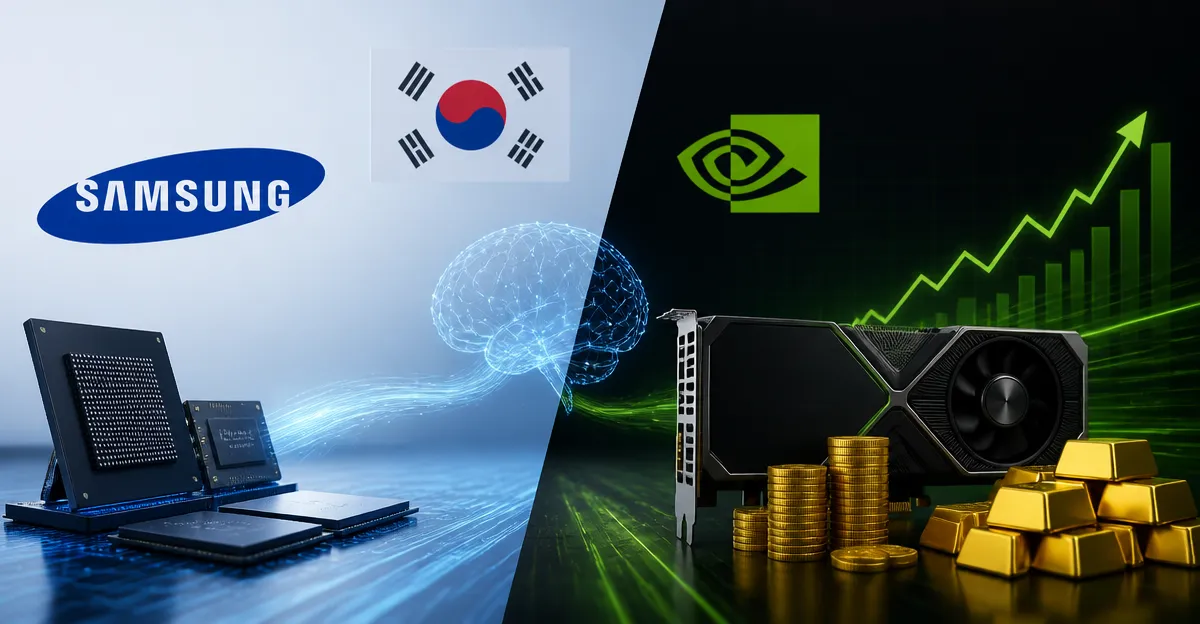
October 8, 2026, (Inside AI) — Samsung Electronics has projected a staggering operating profit of 107.4 trillion won (approximately $80 billion) for the quarter ending September, a nearly ninefold increase from the 12.2 trillion won reported a year earlier. The forecast, released on October 8, underscores the explosive demand for AI memory chips but also highlights a stark contrast with Nvidia, whose market valuation dwarfs Samsung’s despite lower annual earnings.
The South Korean giant, with a market capitalization of $1.3 trillion, is expected to earn $282 billion in operating profit this year, surpassing Nvidia’s projected annual profit. Yet Samsung’s stock trades at a significant discount to its US peer, reflecting deep-seated differences in business models and investor expectations.
Commodity Memory Traps Samsung In Valuation Gap
Samsung’s core business remains heavily reliant on commodity memory chips, particularly DRAM and NAND. These products, while essential for AI servers and devices, are subject to volatile pricing cycles and intense competition. In contrast, Nvidia designs high-margin AI accelerators like the H100 and Blackwell GPUs, which command premium prices and foster a software ecosystem that locks in customers.
“Samsung’s commodity memory business, hefty capital spending and rising pressure to boost shareholder returns will keep its valuation multiple far below its US peer,” noted Robyn Mak, a Reuters Breakingviews columnist, in her analysis. This structural difference means Samsung’s profits, though massive, are seen as cyclical rather than sustainable growth.
The capital intensity of memory manufacturing further weighs on Samsung. Building and upgrading fabrication plants requires tens of billions in annual capital expenditure, limiting free cash flow and returns to shareholders. Nvidia, by contrast, outsources manufacturing to TSMC, allowing it to focus on design and software, which yields higher margins and asset-light scalability.
Investor pressure on Samsung to increase dividends and buybacks is mounting, especially as its cash pile grows. However, such moves could constrain future investments in advanced nodes and capacity expansion, creating a dilemma for management. The company is set to release detailed quarterly results, including divisional breakdowns, on October 29.
Beyond memory, Samsung has sought to diversify into foundry services and logic chips, but it lags behind TSMC and Intel in advanced process technology. Its AI chip ambitions, including custom silicon for data centers, remain nascent compared to Nvidia's dominance. The recent surge in profit is largely attributed to memory price recovery and AI-driven demand, not a fundamental shift in its competitive position.
Analysts also point to geopolitical risks. Samsung’s extensive operations in China and South Korea expose it to trade tensions and supply chain disruptions. Nvidia, while also affected by US export controls, benefits from a stronghold in the AI software stack, making it harder to replace.
Looking ahead, Samsung’s challenge is to translate its manufacturing prowess into higher-value AI components. The company is investing in advanced packaging and HBM (High Bandwidth Memory), which is critical for AI accelerators. However, competition from SK Hynix and Micron is fierce, and pricing power remains limited.
Read: Legend Holdings to Sell BIL Stake as Lenovo's AI Boom Widens Valuation Gap
For now, Samsung’s profit surge is a testament to the AI boom’s broad impact, but its valuation gap with Nvidia signals that investors reward differentiation and ecosystem strength over scale alone. The October 29 earnings call will be closely watched for signs of strategic shifts.