October 7, 2026, (Inside AI) — As enterprises pour billions into artificial intelligence tools, a quiet crisis is unfolding inside corporate training departments. The problem is not a lack of courses. It is an overload of them. Organizations have expanded their AI training catalogs with prompting workshops, tool licenses, and vendor certifications, yet employees remain overwhelmed and executives remain disappointed.
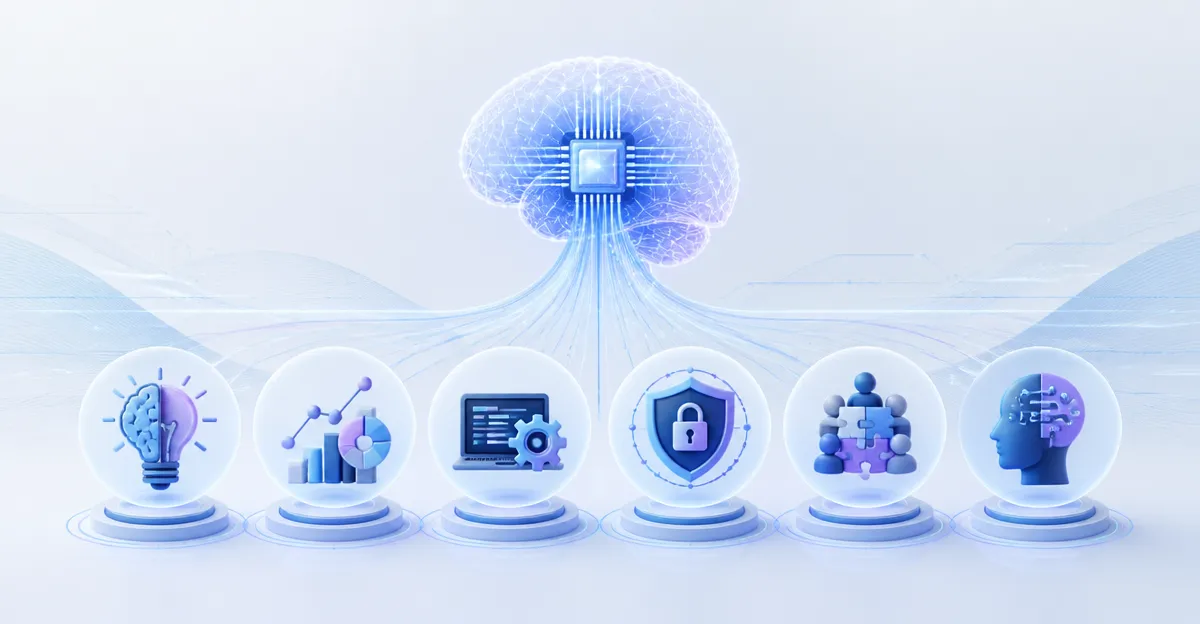
The core issue, according to new research from Gartner, is that companies treat AI skills as an ever-expanding checklist. That approach fails because AI capabilities evolve faster than any curriculum can keep pace. Gartner instead identifies six durable capabilities in two categories: work-orchestration skills and oversight and governance skills. The firm argues these six will evolve alongside the technology itself.
The stakes are high. A July 2025 Gartner survey of 3,029 global employees found that systems thinking improves employee performance by 1.6 times in AI-enabled environments. That finding underscores a broader shift. The workers who thrive will not be those who memorize the most prompts. They will be those who can frame problems, understand interconnected systems, anticipate disruption, verify outputs, mediate between machine and human judgment, and lead ethically.
From Prompt Tricks to Problem Framing
The first three work-orchestration skills form a progression. Problem formulation comes first. AI output is only as good as the input it receives, and ambiguity about the underlying business challenge leads to poor results. Successful organizations are moving away from generic training. They task HR and IT with co-organizing interdepartmental workshops where employees bring real business problems to solve with AI.
At a global law firm, HR and IT developed customized workshops for different business units. Employees brought locally relevant daily friction points. By starting with the problem rather than the technology, they built real problem-formulation skills and achieved faster, more effective iterations with support from peers and IT professionals.
Systems thinking follows. As AI reengineers workflows, employees must understand how individual components interact within the larger whole. At U.S. Venture, a distributor of renewable and traditional energy products, lubricants, tires, and transportation insights, leaders realized individual AI adoption yielded only incremental gains. True growth required process re-engineering. HR deployed an internal staff member to shadow frontline sales employees, witnessing real barriers, tedious workarounds, and approval bottlenecks firsthand. That process-mapping exercise identified genuine business problems worth solving and modeled systems thinking by engaging employees in understanding the layers of work and decision steps involved in embedding AI.
Strategic foresight is the third and most forward-looking work-orchestration skill. Over the next few years, salespeople will have AI agents working alongside them to prioritize leads, conduct research, and nurture prospects independently. To reach that point, systems thinking must evolve into strategic foresight. The goal is not to predict the future but to build change-ready mindsets that anticipate disruption. Leaders can embed what-if scenario planning into existing decision-making processes.
At global law firm Clifford Chance, AI adoption and embedding into legal workflows is shaped through close collaboration between leadership, partners, lawyers, knowledge experts, and technology teams. Together, they examine how AI could reshape client expectations, legal service delivery, and the firm's operating model over the coming years. Rather than focusing solely on short-term productivity gains, the firm tracks KPIs of readiness, adoption, and workforce sentiment to inform its long-term AI strategy.
Trust, Verification, and the Human Override
The second category, oversight and governance, addresses how employees ensure AI results are accurate, safe, and trustworthy. AI judgment and risk mitigation is the foundation. Inherent trust in AI outcomes and overreliance on tools leads to errors, bias, or compliance issues. Formal training helps, but teams need a shared expectation for questioning and checking AI-augmented work.
A global marketing research firm developed a verification audit process using an AI-powered document summarization tool. As part of onboarding, associates act as fact-checkers for their first handful of AI-generated briefs. They use a structured scorecard to verify statistics and cross-reference citations back to original documents. If a summary contained an unvalidated claim, it was logged and routed back to developers for fine-tuning. This hands-on skepticism helped employees identify common hallucination patterns and shifted their relationship with the tool from default trust to contingent trust.
Human-AI mediation is the next stage. More automation changes the work humans do, creating friction between machine logic and human judgment. Employees must interpret ambiguous situations and make nuanced decisions. Organizations can routinize post-mortems and scenario-based pre-mortems to review how to handle complex exceptions. Consider an AI that cancels a long-term customer's subscription due to missed payments but fails to recognize the customer was impacted by a natural disaster. Many healthcare organizations are building human-AI mediation into clinical workflows. Radiologists who disagree with an AI diagnostic recommendation have an immediate escalation path. They log their override with structured justification and a timestamp. These logs are reviewed weekly by an interdisciplinary clinical ethics board, which validates human decisions and uses the data to retrain and improve the underlying AI model.
Ethical leadership is the final stage of skill evolution. As AI creates entirely new forms of work, humans must manage the design and operation of AI systems to deliver fair and responsible results. This goes beyond verifying outputs. Humans must actively shape a trustworthy system. One tactic is institutionalizing red teaming, where employees intentionally pressure test AI systems to find weaknesses. Some organizations incentivize employees to act as internal ethical hackers, seeking bias or confusing autonomous workflows before rollout.
A healthcare technology company developing an AI system to detect cognitive decline in the elderly recognized that inventing this new product would expose it to significant compliance, trust, and privacy risks. HR partnered with IT and product leaders to establish an AI ethics committee within the product team. The committee created governance guardrails and ran red-team exercises that trained employees to critically question every decision to identify bias and ethical risk.
The real test of workforce readiness must go beyond training completion rates to focus on results. Workforce readiness will be hindered, not elevated, by requiring employees to continuously accumulate more skills as AI advances. Building workforce skills that evolve in lockstep with the maturity journey of the technology itself is the input needed to drive real AI value.