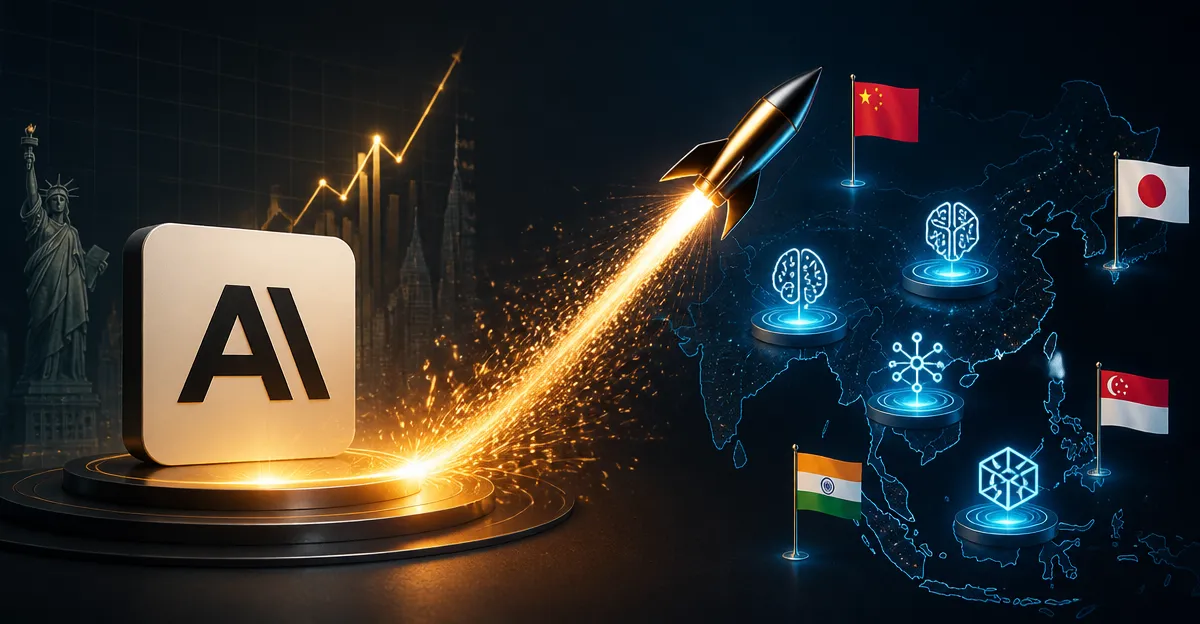
November 18, 2026, (Inside AI) — Anthropic, the San Francisco-based AI safety company, is set to begin trading on Nasdaq this week, marking one of the most anticipated technology listings in recent years. The company, known for its Claude family of large language models, has stated its mission is to "helping humankind chart a safe course" through the age of artificial intelligence. The IPO is expected to raise billions and value the company at a significant premium, drawing intense interest from investors worldwide.
The listing comes at a pivotal moment for the global AI industry. While the United States has dominated the generative AI landscape, Asia has quietly built a robust ecosystem of AI startups, many of which are now eyeing public markets. Anthropic's successful debut could provide a crucial benchmark and a confidence boost for these firms, which have often struggled to attract the same level of funding and attention as their American counterparts. The ripple effects are already being felt in Hong Kong and other Asian financial hubs, where bankers and investors are recalibrating their expectations for upcoming AI IPOs.
Asia's AI Ambitions Meet Wall Street's Yardstick
For years, Asian AI companies have operated in the shadow of Silicon Valley giants. Firms like China's Baidu and Alibaba have made significant strides in AI, but their public market valuations have not always reflected the sector's potential. Smaller startups across Japan, South Korea, and Southeast Asia have faced even steeper challenges, from regulatory hurdles to a lack of deep-pocketed investors willing to bet on long-term research. Anthropic's IPO could change that narrative by demonstrating that AI companies can achieve premium valuations even while prioritizing safety and ethical considerations, a stance that resonates with many Asian founders.
"Anthropic's IPO is a watershed moment for the entire AI industry," said Sarah Chen, a Hong Kong-based venture capitalist who focuses on deep tech. "It shows that investors are willing to pay a premium for companies that combine cutting-edge research with a clear mission. For Asian startups, this is a signal that the public markets are open to them, provided they can tell a compelling story."
The timing is particularly significant. Several Asian AI startups, including Singapore's AI Singapore spinoffs and Japan's Preferred Networks, have been rumored to be considering IPOs in the next 12 to 18 months. A successful Anthropic listing could accelerate those plans by providing a valuation template and proving that there is appetite for AI-focused offerings. However, some analysts caution that the comparison may be flawed. Anthropic's close ties to Google and its focus on safety research set it apart from many Asian firms, which often prioritize applications and commercialization over foundational research.
"The market will inevitably compare Asian AI startups to Anthropic, but that's not always fair," said David Lee, an analyst at a regional investment bank in Singapore. "Anthropic has a unique position in the ecosystem. Asian companies need to differentiate themselves and not just try to copy the Anthropic model. The ones that succeed will be those that leverage local data and address regional needs."
Inside AI observes that the IPO could also intensify scrutiny on governance and transparency. Anthropic has positioned itself as a leader in responsible AI, publishing research on model interpretability and safety. Asian startups, some of which operate in less transparent regulatory environments, may face pressure to adopt similar standards to attract global investors. This could lead to a wave of self-regulation and voluntary disclosures, even in countries where AI laws are still nascent.
The broader market context adds another layer of complexity. Global tech stocks have been volatile in recent months, with investors oscillating between enthusiasm for AI's potential and concerns about inflated valuations. Anthropic's IPO pricing will be closely watched as a barometer of sentiment. If the stock surges on debut, it could unleash a wave of pent-up demand for AI offerings. If it stumbles, Asian startups may need to delay their plans or adjust their expectations.
"We are advising our portfolio companies to be prepared for a range of outcomes," said Mei Lin, a partner at a Southeast Asian venture fund. "Anthropic's IPO is a litmus test. A strong performance would be a rising tide that lifts all boats. A weak one would be a reality check for the entire sector."
Beyond valuations, the IPO could also spur consolidation. Larger Asian tech conglomerates, such as Tencent and SoftBank, have been active investors in AI startups. A successful Anthropic listing might encourage them to accelerate acquisitions or increase their stakes in promising AI firms, aiming to replicate the success of early backers of Anthropic. This could lead to a wave of M&A activity, as conglomerates seek to build out their AI capabilities ahead of public offerings.
Regulatory factors also loom large. Asian governments have been developing their own AI frameworks, with China implementing strict rules on generative AI and Singapore promoting ethical guidelines. Anthropic's public listing will subject it to U.S. securities regulations, including disclosure requirements that may reveal more about its finances and operations. This transparency could set a new standard for AI companies globally, influencing how Asian regulators and investors assess local firms.
As the week unfolds, all eyes will be on Nasdaq. For Asian AI startups, the message is clear: the door to public markets is opening, but the path to success will require more than just a good story. It will demand a commitment to innovation, transparency, and a clear vision for how AI can benefit society. Anthropic's journey will be watched closely, not just as an investment opportunity, but as a blueprint for the next generation of AI companies.

Shamil has a low tolerance for AI that only works in controlled demos. He covers agentic systems and generative AI with the skepticism of someone who has seen too many “revolutionary” tools quietly disappear six months after launch.