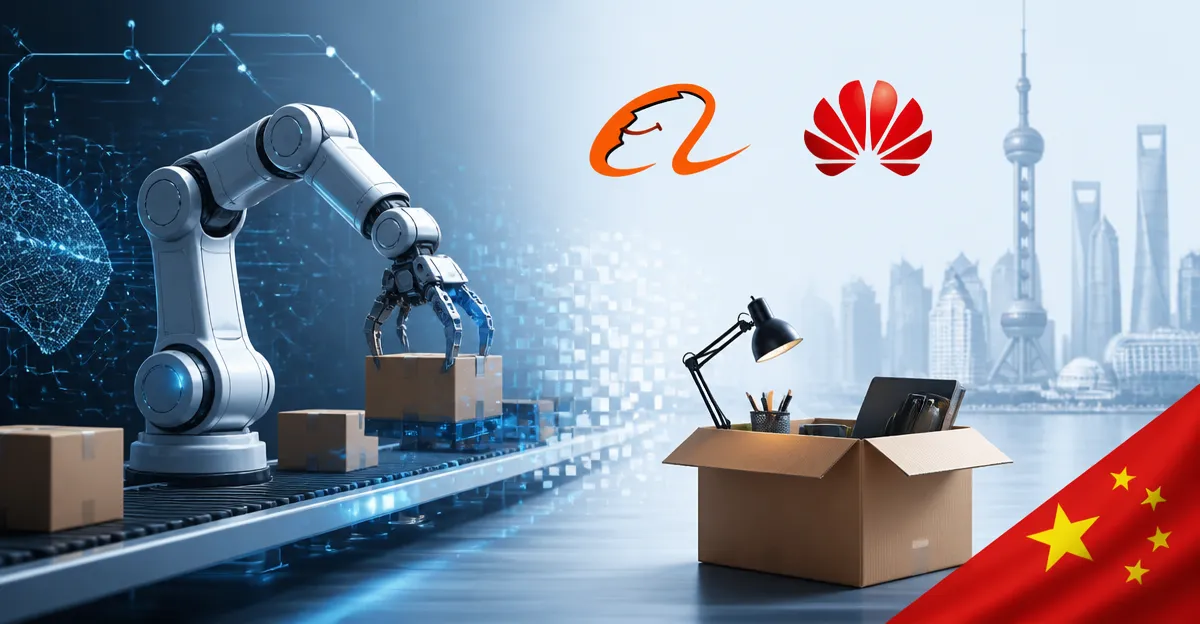
July 31, 2026, (Inside AI) — A malfunction that pulled Baidu’s Apollo Go robotaxis off Wuhan’s streets for months gave 45-year-old driver Yao Xinnong a temporary reprieve. His wages, which had dropped roughly 40% since the driverless fleet launched in 2022, jumped back up as riders returned to human cabs. The incident laid bare the deepening friction between China’s aggressive AI rollout and a labor market where 44% of the workforce now scrapes by in gig roles.
Yao’s experience is not an outlier. It is a signal. Across China, drivers, cinematographers, and office workers are colliding with an automation wave that Beijing once championed without reservation. Now, even state media is acknowledging the strain. An editorial in the government-run Workers’ Daily warned that employment rights are “facing new challenges” in the age of AI, pointing to a “collision between traditional employment rules and the iteration of AI technology.”
The shift is measurable. In 2024, taxi drivers in Wuhan protested Apollo Go’s expansion, a rare public dissent quickly censored. That same year, a local taxi company issued a letter accusing autonomous ride-hailing of allowing “technology to monopolise resources and take away the livelihoods of people at the bottom of society.” When the Guardian visited the firm in July, an employee refused to speak, citing a police agreement and risk of detention. Two years on, the government is echoing those bottom-up fears. It recently pledged to “comprehensively address the impact of changes in the external environment and the development of new technologies such as artificial intelligence on employment.”
Analyst Selina Xu describes a “major vibe shift” in Beijing. After the breakout success of local AI model DeepSeek last year, authorities were “very pro AI development,” she says. “This year, if you look at certain new guidelines that have been published … there has been a lot more emphasis placed on AI for boosting employment and people-first approaches.” The pivot comes as flexible employment surges to an estimated 320 million people this year, up from 160 million in 2019, according to one thinktank. Ride-hailing apps became a refuge for workers fleeing floundering real estate and education sectors. Now robotaxis are closing that escape hatch.
Read: Entry-Level Employment Falls 19%
Cheng Wanhui, an official in Beijing’s Zhongguancun hi-tech zone, says authorities are “paying close attention to the social issues AI brings, as well as potential ethical concerns.” His suggested remedy: “The key is for everyone to shift their mindset, see AI as a tool, and learn how to apply it in their future work.”
But for workers like Tian Zemin, a Beijing cinematographer with nearly two decades of experience, that advice rings hollow. He is out of work, his freelance rate at 40% of what it was in 2019. “I spent six gruelling years working my way up to become a cinematographer, only to be replaced by a piece of software,” he wrote on social media. AI-generated digital clones can now carry a feature-length film, a leap that Tian says left little time to react. “We could be replaced at any moment,” he tells the Guardian. “Perhaps the only thing we can do is adapt as quickly as possible, and try to find the corner that AI still cannot replace – but that corner is getting smaller and smaller.”
Recent court rulings have awarded compensation to white-collar workers laid off and replaced by AI, but many fear the technology will block them from being hired at all. Some analysts argue China’s state control over the private sector gives it an edge over the US in managing job displacement. Beijing could, for example, impose hiring quotas on companies. Yet for drivers and creatives already squeezed, protections may arrive too late. The Wuhan outage was a brief reversal in a longer trend. As one Wuhan driver put it: “If the state really took you into consideration, Apollo Go would never have gone on the market.”
Read: AI Reduces Junior Tech Jobs
The tension is not just economic but philosophical. At Shanghai’s World AI Conference in July, Xi Jinping declared AI should be “an important driver for shared prosperity and common security.” The reality on the ground suggests a more turbulent path. Research from the International Labour Organization underscores that generative AI will augment rather than fully automate most roles, but the transition is uneven and often brutal for those on the front lines.