July 27, 2026, (Inside AI) — Chinese AI labs are no longer just chasing benchmark scores. They are rewriting the economics of model deployment, and that shift could reshape how enterprises buy intelligence.
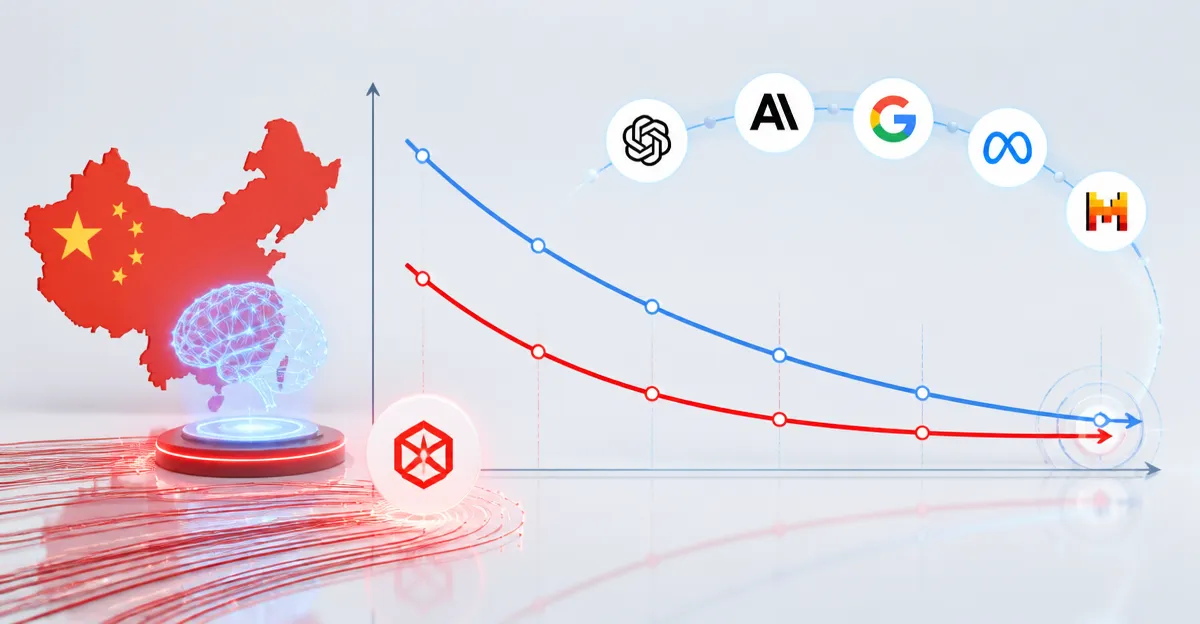
A new analysis from UBS reveals that leading Chinese AI models may cost roughly one-tenth as much to train as comparable overseas systems. Their API prices often sit at 10% to 20% of foreign alternatives. That gap is not a promotional discount—it is structural.
If enterprise users increasingly judge AI by the return on each token rather than raw model performance, the cost differential could become a durable commercial advantage. The question is whether Western providers can match the efficiency without sacrificing margins.
The price delta is engineered across the entire stack. Chinese developers lean on smaller parameter sizes and mixture-of-experts architectures to slash training and inference requirements. In some MoE models, they activate a single-digit percentage to around 10% of total parameters per task—well below the 15% to 30% typical of US models.
Serving efficiency compounds the savings. While industry GPU utilization hovers at 40% to 50%, leading Chinese providers exceed 70% through scheduling and engineering improvements. Lower electricity and data-center costs provide another buffer, and domestic AI chips could further reduce inference costs over time.
UBS estimates that Chinese model providers can maintain API gross margins of 20% to 40% despite much lower prices. That margin profile challenges the assumption that low-cost AI is a race to the bottom.
Enterprise demand is already bifurcating. Expensive frontier models handle complex reasoning, while cheaper, efficient models absorb repetitive, high-volume workflows. This split makes price-performance a more important factor in global procurement, not just a niche concern.
China’s open-source ecosystem accelerates the diffusion of these cost-saving techniques. Labs like DeepSeek, Zhipu AI, and Moonshot AI have published research and released open-weight models, allowing other teams to build on their architecture and engineering work. The result is a rising tide of efficiency that lifts many boats.
Yet the narrative of Chinese models as merely cheap imitators misses a deeper shift. Efficiency itself is becoming a measure of capability. A model that delivers acceptable performance at a fraction of the cost can unlock use cases that were previously uneconomical.
Industry observers note that the focus on cost mirrors earlier platform shifts. Cloud computing, for instance, didn’t win by being more powerful than on-premise servers—it won by being more accessible and scalable. AI may follow a similar trajectory.
Still, the cost advantage is not absolute. US labs retain leadership in raw capability and safety research. But if the market rewards tokens per dollar over points on a leaderboard, the competitive landscape could tilt. The real test will be whether Chinese providers can maintain their efficiency edge as they scale to larger models and more demanding workloads.
For now, the message from UBS is clear: the AI race has a second axis. Capability matters, but so does cost. And on that axis, China is moving fast.