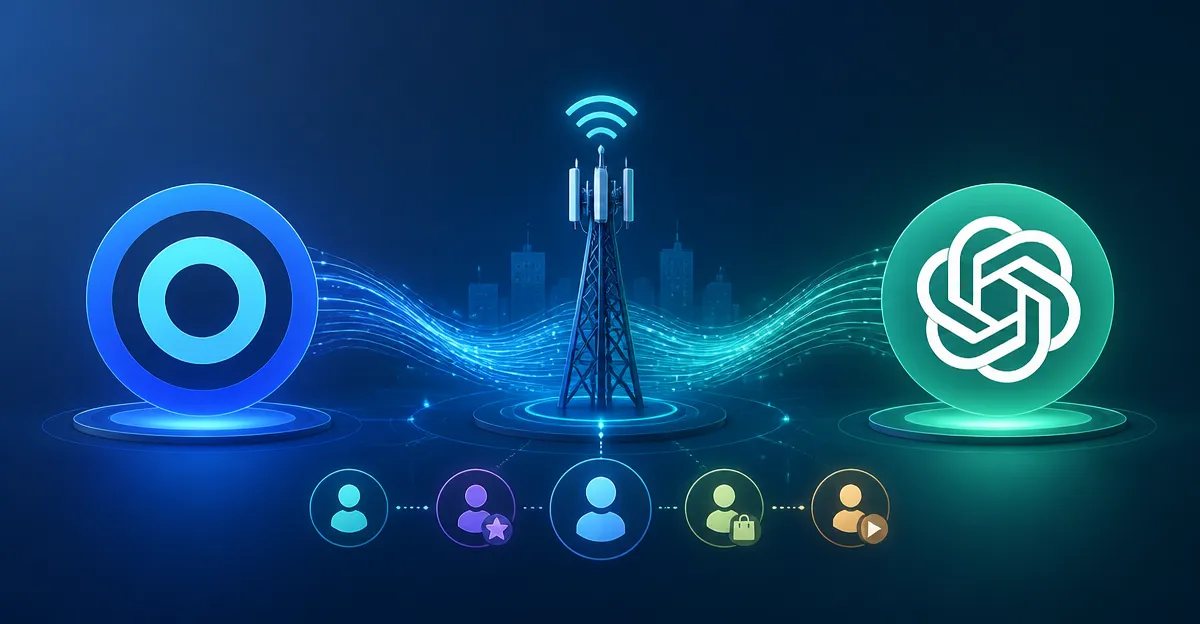
August 4, 2026, (Inside AI) — Telecom operators sit on mountains of customer data, yet turning those signals into real-time personalized action remains a persistent challenge. Circles, a Singapore-based technology company, claims it has cracked that code with an AI-native stack built on OpenAI’s platform, delivering a 22% boost in average revenue per user (ARPU) and a 9% reduction in churn for its own consumer telco, Circles.Life.
The centerpiece is an AI Concierge, a conversational interface powered by OpenAI’s API that unifies search, account management, support, and personalized recommendations. Behind it sits CareX, a proprietary multi-agent architecture that now autonomously resolves 65% of customer service interactions across supported workflows.
Circles’ approach departs from the reactive, menu-driven support typical of the industry. Instead, an orchestration agent ingests real-time context—such as a customer browsing roaming options or questioning a bill—and routes requests to specialist agents for billing, subscriptions, network management, and account services. If needed, cases escalate to human agents with full context attached.
“In an early deployment, one operator achieved 55% autonomous resolution within the first week,” the company noted. Now, with plans to expand into real-time voice support, Circles is targeting 95% autonomous resolution across text and voice channels.
Read: OpenAI’s 5-Step Plan to Manage AI Investments in the Agentic Era
The personalization engine, Xplore IQ, also runs on OpenAI’s API. It replaces broad campaigns with hyper-personalized recommendations, using customer behavior, account history, and real-time signals to suggest roaming packs, plan upgrades, or churn-prevention actions at the right moment. Circles measured the impact by comparing customers who received AI-powered recommendations against a control group, finding the AI-driven cohort achieved the ARPU lift and churn reduction.
These results come as telcos globally grapple with the challenge of real-time personalization at scale. Circles’ deployment offers a concrete case study of what’s possible when that data is fed into a multi-agent AI system.
Internally, Circles uses Codex to accelerate engineering tasks across design, coding assistance, and unit testing, yielding a 29% increase in development efficiency. Engineers retain responsibility for validation and final review, a model that echoes broader industry debates about AI-assisted software development. Research on the productivity effects of AI coding tools, such as a study by GitHub suggests such gains are plausible but depend heavily on task type and developer experience.
Safety guardrails are layered in: personally identifiable information is encrypted before reaching large language models, specialist agents receive scoped access, and the system includes human escalation paths, rate limits, and rollback mechanisms. These controls address a key concern in regulated industries where customer data protection is paramount.
Circles, founded in 2014, now works with telco operators across 14 countries and six continents. Its expansion into voice support and enhanced observability signals an ambition to make the AI-native stack a standard for digital telcos. Whether the 95% autonomous resolution target is achievable remains to be seen, but the early numbers suggest a significant shift in how telcos can turn data into dollars.
Read: OpenAI Proposes ‘Useful Intelligence per Dollar’ as the New AI Scorecard