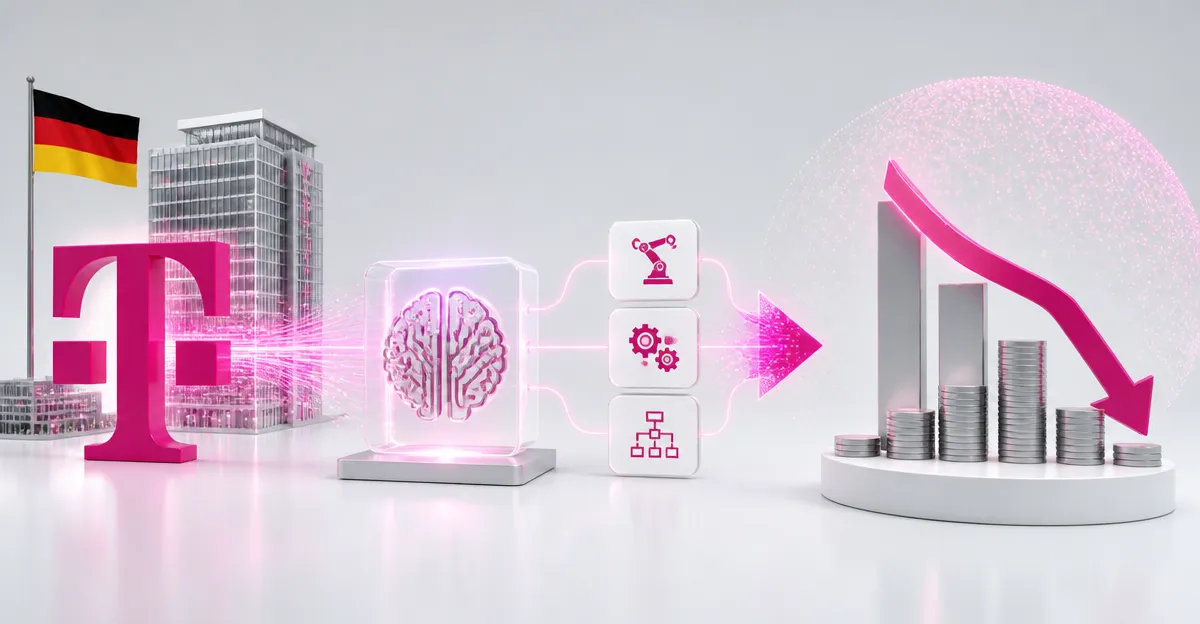
October 5, 2026, (Inside AI) — Deutsche Telekom expects to save roughly €2.5 billion in indirect costs by 2030 compared with its 2023 baseline, the German telecommunications group said on Monday, tying the target directly to a wider rollout of artificial intelligence and automation across its operations.
The figure converts to about $2.8 billion at the exchange rate cited by the company. Deutsche Telekom framed the savings as indirect costs, a category that typically covers procurement, administration, customer operations and support functions rather than the capital-intensive buildout of network equipment.
The company pointed to two concrete uses of the technology. AI now flags peak traffic on the cellular network earlier than previous monitoring methods, and it assists customer service representatives so that subscriber issues can be resolved during the first contact.
"AI detects peak traffic on the cellular network earlier, supports customer service representatives, and thus helps resolve issues immediately," Deutsche Telekom said in a statement.
Why Europe's Largest Carrier Is Betting On Automation
The disclosure matters beyond one company's balance sheet. Deutsche Telekom is Europe's largest telecommunications operator by revenue, with tens of thousands of employees and networks spanning Germany and the United States through its T-Mobile unit. When a carrier of that scale puts a number on AI savings, it becomes a reference point for rivals weighing similar programs.
Telecom operators have spent years chasing cost cuts as revenue growth in mature markets stays flat. Network equipment, spectrum licenses and energy bills consume large budgets, and headcount in service and back-office roles remains one of the few levers management can pull without harming coverage quality.
AI has moved into that gap. Traffic prediction models let operators shift capacity before congestion degrades calls and data sessions. Support copilots shorten call handling times and reduce repeat contacts. Neither application requires replacing the core network, which makes them cheaper to deploy than hardware upgrades.
The €2.5 billion target is a gross expectation, not a confirmed result. Deutsche Telekom did not disclose how much it plans to invest in the AI systems, which vendors it will use, or how many roles could be affected. Those omissions matter because automation savings are usually measured net of software licenses, cloud computing costs and retraining expenses.
Inside AI could not independently verify the cost baseline or the accounting method behind the €2.5 billion projection.
The 2030 deadline also stretches across several budget cycles and at least one likely change in the company's leadership team. Long-range efficiency targets of this kind often get revised when technology costs shift or when regulators intervene.
The Gap Between AI Promises And Audited Results
Telecom is not the only sector making bold automation claims. Banks, insurers and logistics firms have announced multibillion-dollar efficiency programs tied to AI in recent years. Independent audits of those results remain rare, and analysts have repeatedly warned that early savings estimates tend to shrink once implementation begins.
Deutsche Telekom's own history offers a cautionary note. The company has run restructuring programs for more than a decade, combining job reductions with digital service tools. Each round produced savings, but each round also drew scrutiny from labor unions representing workers in Germany, where co-determination rules give employees a formal voice in major operational changes.
Customer service is the most sensitive area. AI copilots that summarize calls and suggest answers can raise productivity, yet they can also push representatives into faster, more scripted interactions. Subscribers notice the difference, and churn becomes a risk when cost cutting outpaces service quality.
Network traffic prediction carries less public friction. Congestion management is largely invisible when it works. The technical challenge lies in data quality, since models trained on historical traffic patterns can misread sudden demand spikes caused by events, outages or new device launches.
Deutsche Telekom's announcement lands as European regulators debate how AI systems should be governed under the EU AI Act, whose obligations for high-risk uses phase in over the coming years. Telecom applications such as network optimization and customer support generally fall outside the highest-risk categories, but transparency and data governance rules still apply.
For investors, the immediate question is whether the €2.5 billion figure reflects genuine operating leverage or a restatement of cuts already planned. The company has not published a line-item breakdown, and its next annual report will be the first real test of the claim.
Rivals including Vodafone, Orange and Telefónica have launched their own AI efficiency initiatives, though few have attached a specific euro target to a fixed year. If Deutsche Telekom hits its number, that silence will not last long.