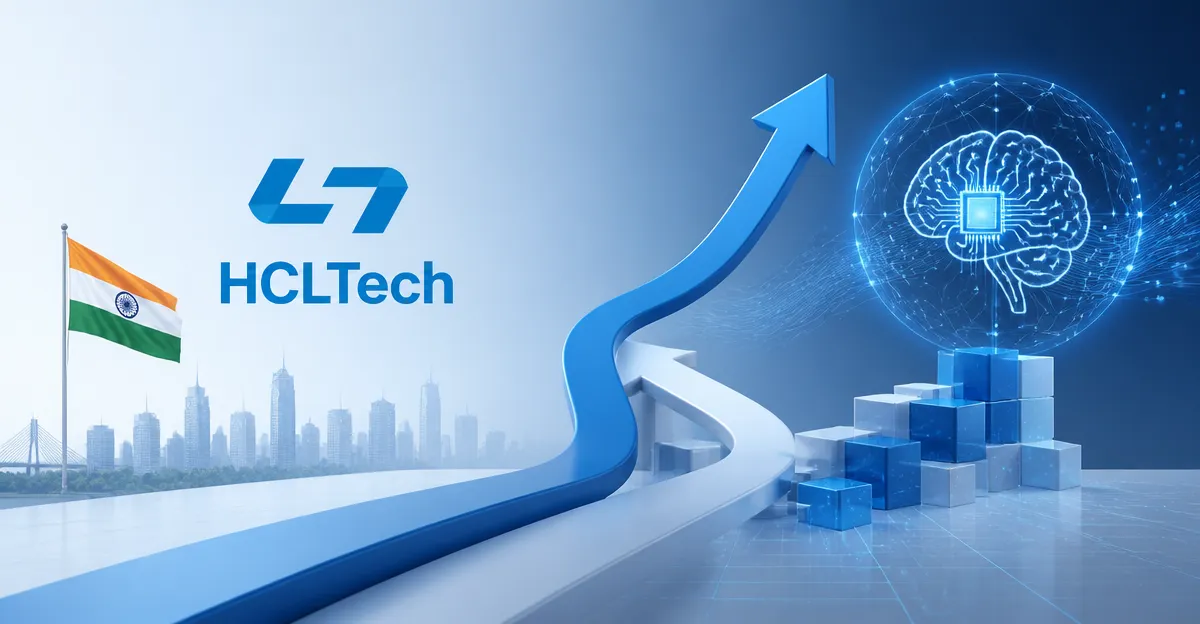
September 10, 2026, (Inside AI) — C. Vijayakumar, the chief executive of HCLTech, has staked the company’s future on a radical premise: double revenue with half the workforce. The strategy, first announced in February 2025, abandons the linear staffing model that defined IT services for decades. Instead, HCLTech is betting that AI-augmented, platform-led delivery will decouple growth from head count.
The pivot carries immediate financial pain. HCLTech expects a 2% to 3% near-term reduction in its existing book of business. Yet the company is reinvesting profits into AI technology, differentiated intellectual property, and workforce training. The goal is to turn a fraction of its 227,000 employees into AI builders and the rest into AI superusers.
This is not a cautious experiment. Vijayakumar has framed the shift as an existential imperative. The old model, where more engineers meant more revenue, is collapsing under the weight of generative AI’s productivity gains. Knowledge work that once demanded large teams can now be completed dramatically faster with far less human effort.
From Linear Growth to Platform-Led Delivery
HCLTech’s history spans five decades of reinvention. Founded in 1976 by Shiv Nadar and colleagues, the company moved from IT hardware to engineering, R&D, services, and software. Vijayakumar joined in 1994 as an engineer and rose to CEO in 2016. Each transition required abandoning protected revenue streams for uncertain new frontiers.
The current shift is the most aggressive yet. Vijayakumar has told employees, clients, shareholders, and the media the same message: some jobs and revenue streams will disappear, others will be created, and AI will operate autonomously in very few areas. Most often, a human will remain in the loop.
The company’s near-term ambition is to deliver at least 5% revenue growth without adding head count. Beyond that, incremental growth will likely require additional talent. But the cultural signal is clear. Vijayakumar said:
“We are no longer dealing with business as usual. AI changes everything. And your company is encouraging you to stay ahead of the curve.” C. Vijayakumar, CEO, HCLTech
To drive adoption, Vijayakumar convened the top 150 service-delivery and corporate-function leaders, then traveled globally to meet all 1,200 sales team members. He also leads by example. He uses Claude, Anthropic’s AI assistant, for research and strategic debate, and built his own revenue-forecasting app.
AI Force and the Economics of Cannibalization
The centerpiece of HCLTech’s internal transformation is AI Force, a platform that applies AI across the entire software-development and data life cycles, not just code generation. The company deployed it in two of its largest wins this fiscal year: Guardian Life Insurance and a major fashion retailer.
HCLTech also established an office of responsible AI governance. Every platform must include guardrails so AI-enabled decisions can be checked for biases, traced, reviewed, and reversed. On the workforce side, 5% to 10% of employees are expected to become AI builders. The remaining 90% to 95% are being trained as AI superusers, with the hope of boosting individual productivity by a factor of three to four.
Client adoption has been gradual, constrained by security, legal, and privacy clearances. HCLTech has compressed the approval process from three months for early clients to two weeks now. The company then runs pilots, measures output, and scales successful deployments across functions.
Vijayakumar rejects the idea that enterprises can simply work directly with AI providers. He argues that frontier model builders and systems integrators play distinct roles. HCLTech embeds AI into legacy environments, operations, and governance, tying deployments to measurable business outcomes.
Recent wins include an AI adviser for clinicians that saved 10 minutes of administrative work per interaction, a bank’s shift from sampling-based trade surveillance to 100% AI, and AI-optimized cargo packing that increased revenues at an aircraft manufacturer. HCLTech’s advanced AI revenue reached a $620 million annualized run rate as of March 2026, with expected growth of 30% per year.
The company tracks internal adoption, fluency, productivity gains, cost savings, and innovative solutions. Externally, it measures the number of clients with deployed AI and the depth of each deployment. Vijayakumar said HCLTech is still at the beginning of the journey, with significant opportunities ahead.