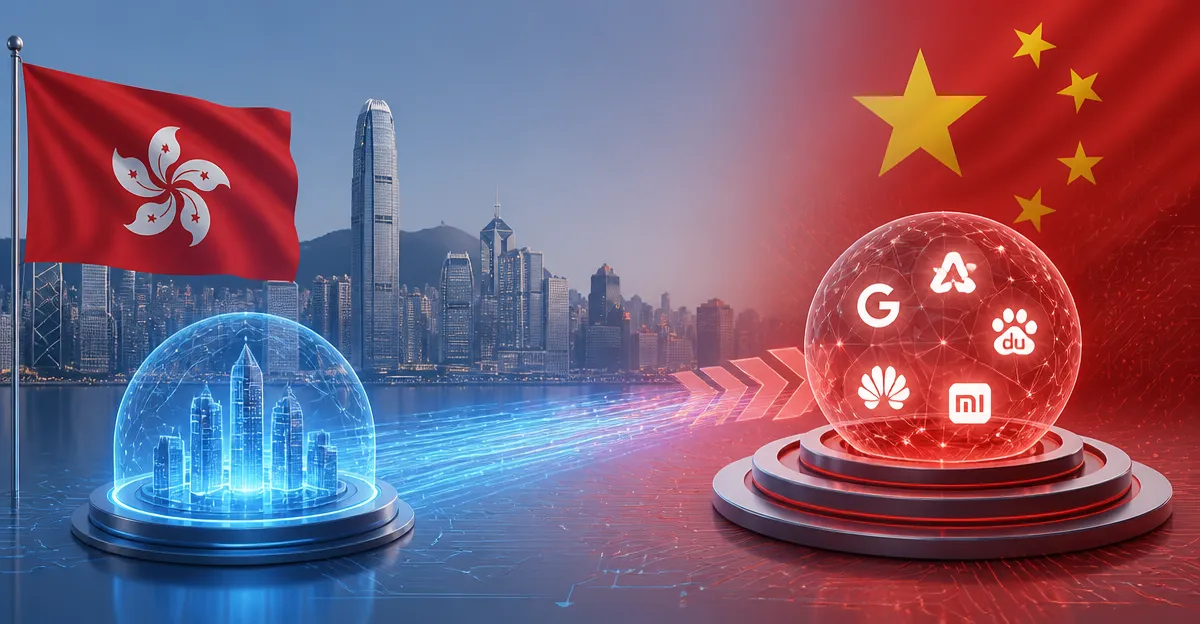
August 12, 2026, (Inside AI) — Hong Kong is making an aggressive push to reshape its stock market into a global technology listing hub, directly challenging the Nasdaq’s dominance. The move comes as Beijing’s AI sector surges, with a wave of mainland hardware firms, particularly makers of optical transceivers for AI data centers, lining up to list in the city. The debut of Zhongji Innolight last month has already begun to shift a landscape long dominated by Chinese internet platforms.
The Hang Seng Indexes Company this week proposed a revamp of the Hang Seng Tech Index to add more growth-oriented constituents. It also suggested incorporating revenue growth into inclusion criteria, a change that would better accommodate smaller, fast-expanding firms. Meanwhile, China International Capital Corporation (CICC) expects the benchmark Hang Seng Index could add more tech names in its quarterly review later this month.
These moves are designed to correct a structural weakness. Hong Kong’s market has been left behind in the global AI trade this year because its largest listings remain Chinese internet platforms reliant on e-commerce revenue, not AI-driven growth. By broadening its tech exposure, the city aims to capture investor enthusiasm for AI infrastructure and hardware, a segment where China is rapidly advancing.
Optical Transceivers Become the New Listing Engine
The pipeline of mainland hardware firms seeking Hong Kong listings underscores a strategic shift. Optical transceivers, essential for high-speed data transmission in AI data centers, have become a critical bottleneck. Chinese manufacturers now dominate this niche, and their public offerings could provide global investors with direct access to AI infrastructure plays that are scarce on other exchanges.
Read: Moonshot AI Reportedly Submits Confidential Hong Kong IPO Filing
This hardware focus differentiates Hong Kong from the Nasdaq, which is heavily weighted toward software and platform companies. By leveraging China’s manufacturing strength in AI components, the city could carve out a unique identity as the listing venue for the physical backbone of AI. The trend also aligns with Beijing’s broader ambition to lead in AI open-source models and humanoid robotics, sectors that may produce the next generation of listings.
Can Hong Kong Rival Nasdaq’s Tech Magnetism?
Skepticism remains about whether these reforms can truly rival the Nasdaq or the New York Stock Exchange. Hong Kong’s market has historically suffered from lower valuations and liquidity compared to U.S. exchanges, and geopolitical tensions continue to cloud its appeal. However, the city’s unique access to mainland China’s tech pipeline, combined with a regulatory environment that is more predictable than Beijing’s direct oversight, could attract firms wary of U.S. delisting risks.
Read: Baidu Says Wenxin Will Return to AI’s Top Tier, Targets Hong Kong Listing by Year-End
The index changes are a tactical step, but the real test will be whether Hong Kong can sustain a pipeline of innovative, high-growth companies beyond the current hardware wave. For now, the influx of optical transceiver makers signals that the city is finally getting the raw materials to build a credible tech bourse.