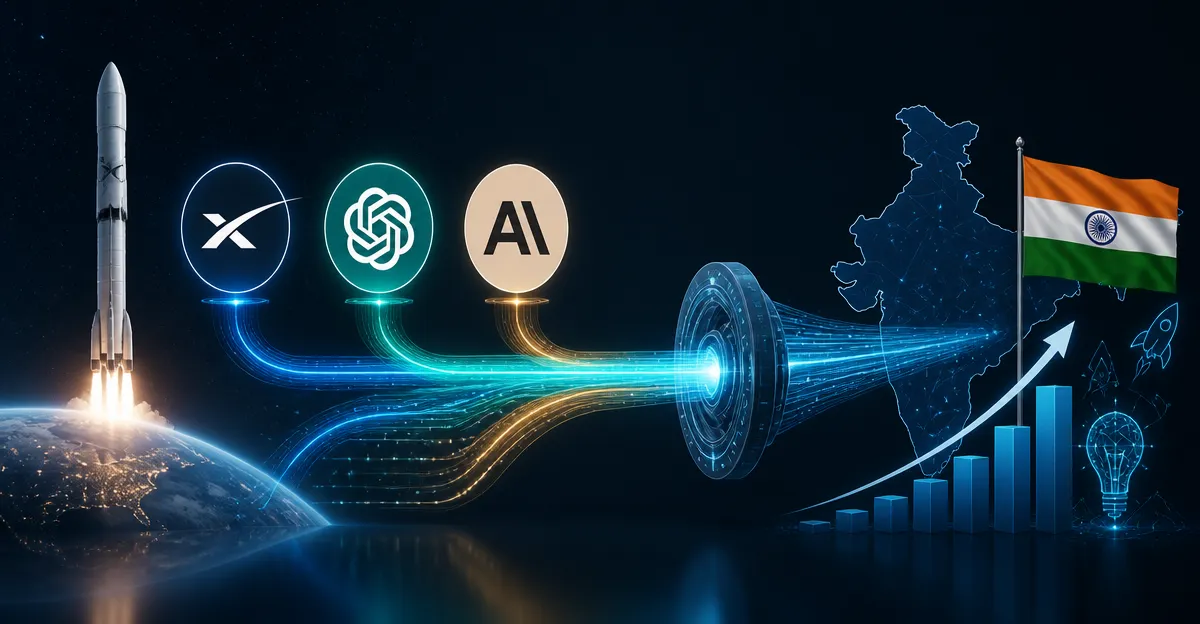
July 13, 2026, (Inside AI) — SpaceX’s record-smashing $75 billion IPO last month didn’t just make history—it primed the pump for a cascade of capital that could soon flow into Indian startups. The listing, which valued Elon Musk’s space-and-AI venture at $1.8 trillion, delivered windfall returns to early backers. Now, with AI titans OpenAI and Anthropic quietly filing for their own mega-IPOs, the same venture capital and private equity firms are sitting on mountains of fresh liquidity. Data from Tracxn reveals that 54 firms invested in at least one of the three companies have already poured $57.8 billion into 1,376 rounds in Indian tech firms since 2016. The question is whether their IPO jackpots will reopen the funding taps for India’s cash-starved startup ecosystem.
The numbers are staggering. Peter Thiel’s Founders Fund saw its $600 million SpaceX stake balloon to over $50 billion at the IPO price of $135 per share. Andreessen Horowitz notched its biggest-ever return. Valor Equity Partners’ 4% slice was worth around $70 billion. These aren’t just paper gains—they’re real dollars that can be recycled into new funds. And India, already a familiar destination for these investors, could be a prime beneficiary. But the path from IPO pop to Indian startup check isn’t straight.
“Historically, successful exits have strengthened the ability of VC and PE firms to raise larger successor funds,” said Neha Singh, Tracxn’s Co-founder. “Given that India already features in the active portfolios of these 54 firms, a recovery in investment activity is plausible as fresh capital is raised and redeployed.”
Yet Singh warns that IPO proceeds go mainly to Limited Partners, not directly into General Partner war chests. Any uptick in India deals will likely come over the medium term as new funds are raised. There are early signals: Valor Equity Partners aims to raise $2.5 billion by end-2026, though its focus on US deep tech and defense makes an India allocation uncertain. PitchBook notes improving liquidity in Asia-Pacific, hinting that the region’s capital recycling engine is sputtering back to life after years of sluggish exits.
The contrast in investment patterns is stark. In India, 71% of these firms’ deals were seed or early-stage, while in SpaceX, Anthropic, and OpenAI, 93% of the capital went to late-stage rounds. Singh calls it a “deliberate strategy of concentrating capital behind a small number of category-defining companies.” That discipline, if redirected, could mean larger, later-stage bets on Indian winners—or a continued trickle of early-stage sprinkles.
The Liquidity Drought and a Glimmer of Hope
India’s startup funding engine has been sputtering. In 2025-26, startups raised $11.7 billion, down 18% year-on-year. The broader foreign capital picture is bleaker: over 2023-24, 2024-25, and 2025-26, repatriation of past investments hit $150 billion, swallowing 61% of gross FDI and leaving net FDI at a paltry $18 billion. Private credit has stepped into the void, with Moody’s pegging the Indian market at $25 billion—double its size five years ago. But equity checks from global VCs remain the lifeblood for tech founders.
The IPO pipeline itself is a double-edged sword. OpenAI, seeking a $1 trillion valuation, and Anthropic, which raised $65 billion at a $965 billion valuation in May, could suck up even more late-stage capital before their listings. But if they pop like SpaceX, the wealth effect could be transformative. Peak XV’s $1.3 billion fundraise in February for India and APAC shows that some GPs are already reloading. The real test is whether SpaceX’s bonanza emboldens LPs to back more India-focused vehicles.
For Indian founders, the message is mixed. The money is coming—but not tomorrow, and not for everyone. Firms that cut their teeth on SpaceX’s rocket ride may favor startups with similar moonshot DNA: deep tech, AI infrastructure, space-tech. Tellingly, only $160 million has flowed into Indian space-tech from these 54 firms, across just four rounds. That could change if the IPO riches trickle down. As Singh puts it, the effect will be “over the medium term as successor funds are raised and deployed.” For now, India’s startup faithful must watch the Nasdaq ticker and wait.