July 13, 2026, (Inside AI) — Tata Consultancy Services is building a vanguard of up to 8,900 forward-deployed engineers and actively scouting for AI acquisitions, betting that artificial intelligence will expand its business rather than cannibalize its core outsourcing model.
CEO K Krithivasan and CFO Samir Seksaria revealed the dual strategy in exclusive interviews with Reuters, framing it as a decisive pivot to capture AI-driven transformation. The move directly counters mounting investor anxiety that generative AI could hollow out India’s $315 billion IT services sector.
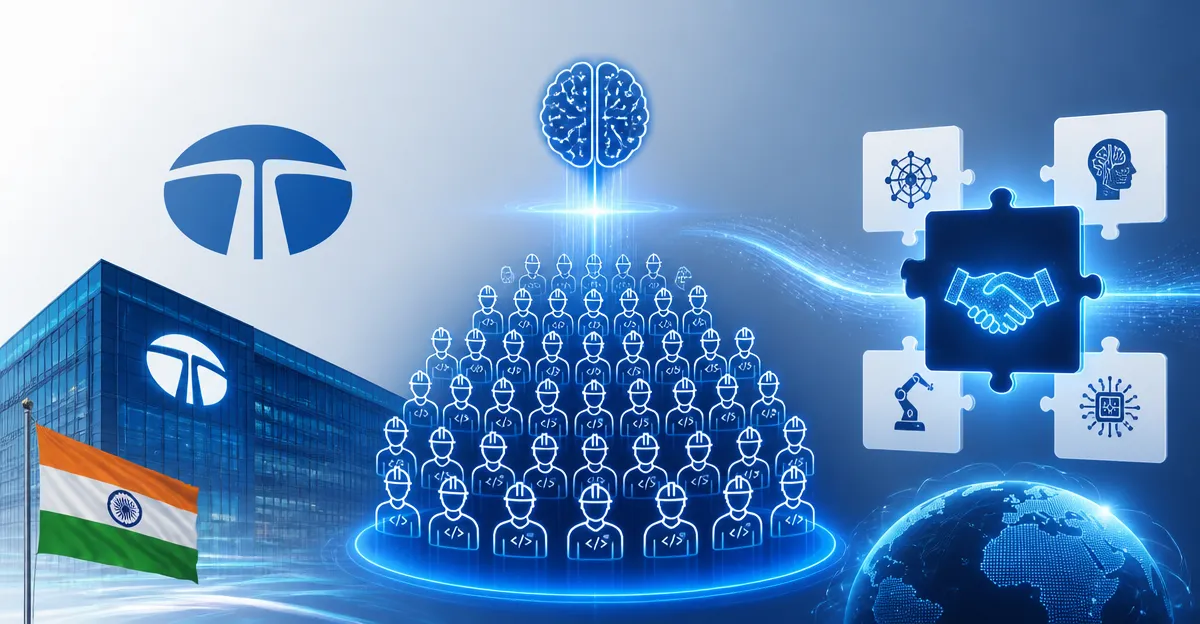
Krithivasan said the company aims to designate 1% to 1.5% of its workforce as forward-deployed engineers, or FDEs. Based on TCS’s end-June headcount, that translates to roughly 5,900 to 8,900 specialists who will embed with clients to accelerate AI adoption and customize tools for specific business needs.
The CEO did not specify whether these roles would be filled through external hiring or internal reskilling. But the initiative signals a major shift for the Mumbai-based giant, which until late 2025 had largely avoided acquisitions in favor of organic growth.
CFO Samir Seksaria confirmed the company is now evaluating deals in AI, data security, and cybersecurity.
“We are looking at where we can find things which will help us enable or enhance our strategic positioning,” Seksaria said.
This acquisition appetite puts TCS in direct competition with the very AI labs whose technology it deploys. OpenAI, Anthropic, and Microsoft have all expanded their own FDE teams, recognizing that enterprise AI adoption requires hands-on integration. By scaling its own embedded engineering force, TCS aims to turn its deep client relationships into a defensive moat.
Krithivasan dismissed the notion that AI will dismantle the outsourcing model. He argued that stitching together multiple AI models, connecting them to legacy systems, and managing data flows demands intimate customer knowledge—a domain where TCS claims an edge.
“What you need is a deep knowledge of the customer environment to make it work. That is where we differentiate ourselves. This has nothing to do with cost arbitrage. It’s essentially because of the talent pool that we have built,” Krithivasan said.
Yet the numbers paint a more complex picture. TCS’s annualized AI revenue growth decelerated to 13% in the first quarter, down from 28% in the prior quarter. Krithivasan acknowledged the volatility, stating he would like the business to grow about 25% quarter-on-quarter over the long term, but he does not expect a linear trajectory.
This slowdown echoes a broader industry recalibration. Rivals Infosys and Wipro have reported similar headwinds as clients pause discretionary spending and scrutinize AI project returns. The initial euphoria around generative AI pilots is giving way to harder questions about scalability and cost, according to analysts at Forrester.
TCS is betting that its dual investment—in people and acquisitions—will smooth out the bumps. The company spends about $1 billion annually on talent development and internal AI accessibility, with a focus on training, targeted hiring, and niche recruitment in AI-native technologies, Seksaria noted.
This figure, while substantial, is dwarfed by the capital pouring into pure-play AI startups. OpenAI alone has raised over $20 billion. TCS’s challenge will be to integrate acquired capabilities without diluting its services culture or alienating existing clients who may view its AI ambitions as a competitive threat.
Historically, Indian IT firms have struggled with product-oriented acquisitions. Wipro’s $1.45 billion purchase of Capco in 2021 was an exception, not the rule. TCS’s renewed M&A interest suggests it sees a window to buy niche AI expertise before valuations climb further.
The FDE model itself is an evolution of the traditional consultant role, but with deeper technical chops. These engineers don’t just advise; they co-build. That requires a blend of software engineering, data science, and domain expertise that is in short supply globally.
TCS’s scale gives it an advantage in training pipelines. With over 600,000 employees, even a small percentage shift represents a formidable force. But the real test will be whether these FDEs can deliver the measurable productivity gains that clients now demand—and whether TCS can capture a fair share of that value.
As the AI hype cycle matures, TCS’s strategy may prove prescient or perilous. For now, it is placing a large, calculated wager that the future of IT services is not about writing code, but about embedding intelligence.