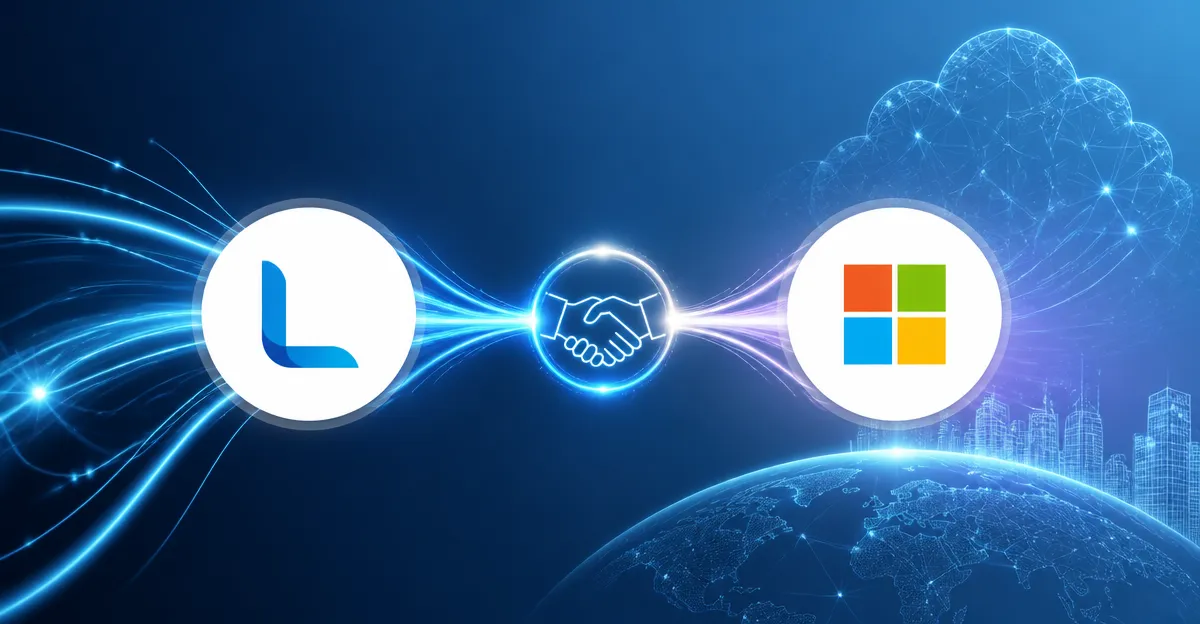
November 3, 2026, (Inside AI) — Lumen Technologies and Microsoft on Monday expanded their co-selling agreement, aiming to sell enterprise customers on networks built for AI workloads. The announcement, made at Microsoft's Redmond headquarters, positions Lumen's fiber and cloud-networking stack as a connectivity layer for Azure AI deployments.
The move targets a persistent gap: enterprises can spin up AI models in the cloud, but connecting them to distributed data and legacy systems remains slow and fragmented. Lumen and Microsoft will jointly plan accounts where network modernization, Azure migration, and AI transformation overlap. Lumen also intends to bring its full suite of cloud networking and application connectivity capabilities to Azure, and the companies plan to explore how AI-ready connectivity can work with Microsoft's agent governance and security tools.
Financial terms were not disclosed. The expanded collaboration builds on an existing relationship in which Lumen's Private Connectivity Fabric supports Microsoft data center connectivity and Azure supports Lumen's own workload modernization.
Why Microsoft Needs A Fiber Partner For AI
The deal arrives as AI infrastructure spending shifts from model training to inference and agentic applications. Those workloads demand low-latency, high-throughput links between data centers, clouds, and edge sites. Microsoft's Azure has the compute, but it relies on partners for last-mile and long-haul fiber. Lumen owns a large fiber backbone and a cloud-native control plane, giving it a physical asset that pure software networking firms lack.
Read: Big Tech Returns Smallest Share of Cash to Shareholders in 15 Years as AI Spending Surges
"AI is reshaping where applications run and how organizations use and move data," said Katy Brown, Corporate Vice President, Americas Markets and Industries at Microsoft. "Microsoft is committed to giving customers choice as they connect existing environments to Azure. Our work with Lumen is focused on helping customers align their broader network transformation with their Azure cloud and AI priorities, while taking advantage of Azure's native networking, security, scale and innovation."
Lumen's pitch rests on simplification. Enterprises often treat each cloud connection as a separate project, leading to policy sprawl and visibility gaps. Lumen's Alkira solution, available through Microsoft Marketplace, offers a single portal to connect, secure, and manage hybrid and multi-cloud networks. The companies say joint account planning will help customers link sites, data centers, and clouds for Azure-based AI initiatives, apply consistent policies across environments, and add new clouds or partners without starting from scratch.
"Enterprises are moving quickly to adopt AI, but many are still figuring out how to connect the data, applications and infrastructure behind it," said Ryan Asdourian, chief strategy and marketing officer at Lumen. "Together with Microsoft, we're bringing cloud, network and AI planning together earlier and putting AI to work more effectively."
The co-sell model is not new for Microsoft, which runs similar agreements with network and systems-integration partners. What differs here is timing: the companies are pitching network transformation as a prerequisite for AI, not an afterthought. That framing could accelerate deals, but it also puts Lumen in competition with other Azure networking partners and Microsoft's own Azure Virtual WAN, which customers can use without Lumen.
Analysts note that co-selling agreements often produce more announcements than revenue. Success will depend on whether Microsoft's field sales team prioritizes Lumen in competitive deals. Lumen, which has struggled with revenue growth in recent years, needs enterprise AI projects to lift demand for its connectivity services.
The collaboration also signals a bet on agentic AI. As enterprises move from AI experiments to agent-operated business processes, the companies argue that connectivity alone will not suffice. They plan to explore how Lumen's AI-ready connectivity can integrate with Microsoft's agent governance and security capabilities. That work remains exploratory, with no timeline announced.
Read: Microsoft Offers Voluntary Exit to 60,000 Staff as AI Layoff Narrative Falters
For now, the expanded partnership gives Microsoft a fiber partner with enterprise reach and gives Lumen a channel into Azure's customer base. Both companies say they will share more details as joint go-to-market plans progress.