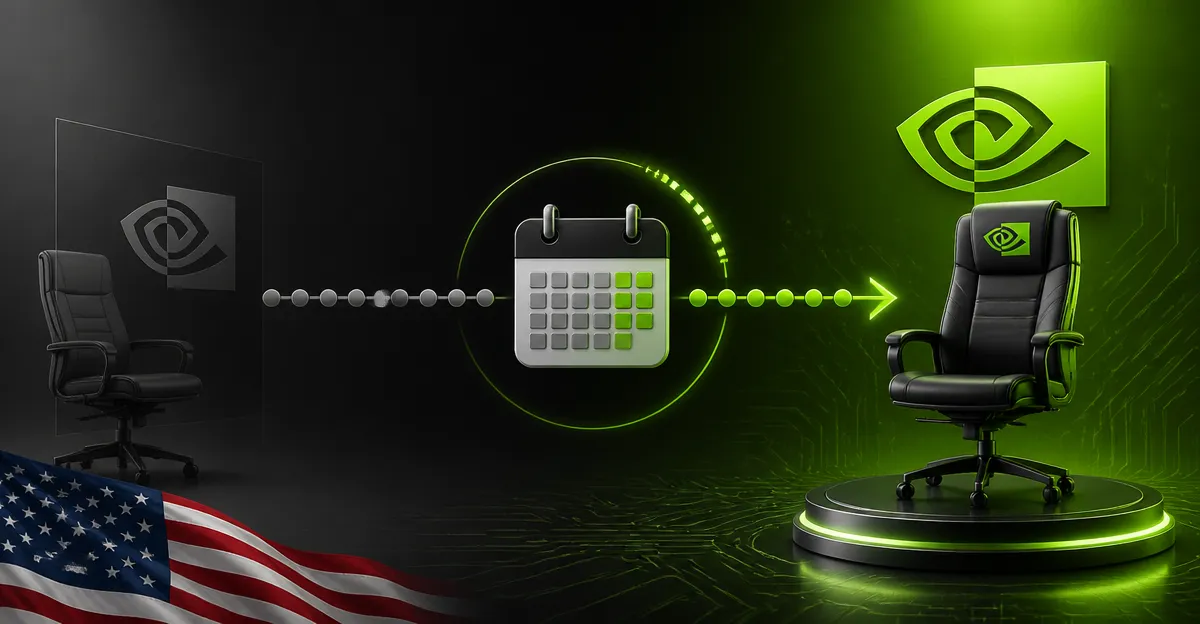
November 23, 2026, (Inside AI) — Nvidia’s board of directors has unanimously reinstated co-founder Jensen Huang as president, CEO, and board member, effective immediately. The decision, announced on November 23, reverses the board’s earlier acceptance of his resignation just 11 days ago on November 12. The board stated it reached the decision after discussions with Huang and consultations with senior US government officials. Based on that input, directors concluded his reinstatement poses no national security risk. Colette Kress, who served as interim CEO, returns to her role as Executive Vice President and Chief Financial Officer. Nvidia shares rose around 33% in premarket trading following the announcement, according to Reuters.
The reversal underscores the board’s confidence in Huang’s leadership and the perceived risks of a prolonged transition at a company central to the AI chip industry. Nvidia’s market value has hovered near $1 trillion, and any leadership uncertainty could ripple through supply chains and investor confidence. The board’s consultation with government officials highlights the growing intersection of national security and corporate governance in the semiconductor sector. Huang’s return also signals that the board views his continued leadership as essential to navigating export controls and geopolitical tensions.
Nvidia will continue an independent investigation into reports that Huang was targeted by a foreign intelligence effort. The company has also established a National Security and Export Control Committee, comprising independent directors, to oversee trade compliance and national security risks. Additionally, Nvidia is searching for a Chief Compliance Officer. These moves suggest the board is tightening oversight while restoring Huang to power.
Board’s Swift Reversal Raises Governance Questions
The 11-day gap between resignation and reinstatement is unusually short for a company of Nvidia’s size. Corporate governance experts note that such rapid reversals are rare and often stem from new information or external pressure. In this case, the board’s consultations with US officials appear to have been decisive. The establishment of a new committee and the search for a compliance officer indicate that national security concerns are now a permanent fixture in Nvidia’s boardroom. The market’s positive reaction, with shares jumping 33%, suggests investors view Huang as irreplaceable, at least in the near term.
Nvidia’s situation is not entirely unprecedented. In 2018, Tesla’s board faced scrutiny over CEO Elon Musk’s behavior, but he remained in place. However, a resignation followed by a swift reinstatement is far rarer. The board’s decision to consult government officials before reinstating Huang reflects the heightened scrutiny of semiconductor technology and export controls. Nvidia’s chips are critical for AI development, and the US government has restricted exports to certain countries. Huang’s leadership is seen as crucial for managing these restrictions.
Huang co-founded Nvidia in 1993 and has led the company for most of its history. His resignation on November 12 was unexpected, and the board initially named Kress as interim CEO. The reasons for his resignation remain unclear, but the investigation into foreign targeting may be related. The board’s statement did not specify why Huang resigned or what prompted the reversal beyond the consultations. Nvidia’s stock had fallen slightly after the resignation announcement, but the reinstatement more than recovered those losses.
The new National Security and Export Control Committee will be composed of independent directors, according to the company. Its formation suggests the board wants to separate national security oversight from day-to-day management. The search for a Chief Compliance Officer further indicates a desire to professionalize compliance functions. These steps may reassure regulators and investors that Nvidia is serious about export controls and security.
Huang’s reinstatement also raises questions about the board’s initial decision to accept his resignation. If his return poses no national security risk, why was his resignation accepted in the first place? The board has not provided a detailed explanation. This gap could invite scrutiny from shareholders and analysts. However, the market’s reaction suggests investors are willing to move on.
Nvidia’s shares rose 33% in premarket trading, a significant move for a company of its size. The stock had been volatile in recent months amid broader tech sector fluctuations. The reinstatement news appears to have restored investor confidence. The company’s AI chips are in high demand, and Huang’s vision has been central to its strategy. His return likely ensures continuity in product roadmap and partnerships.
The investigation into foreign intelligence targeting continues. Nvidia has not disclosed details about the nature of the threat or which foreign entity might be involved. The company said it will cooperate fully with authorities. The outcome of the investigation could have implications for Huang’s tenure and the company’s operations.
Nvidia’s board has not announced a timeline for the investigation or the search for a Chief Compliance Officer. The company’s next earnings call may provide further details. For now, Huang is back at the helm, and the market has responded positively. The episode highlights the complex interplay between corporate leadership, national security, and market expectations in the AI era.

Shamil has a low tolerance for AI that only works in controlled demos. He covers agentic systems and generative AI with the skepticism of someone who has seen too many “revolutionary” tools quietly disappear six months after launch.