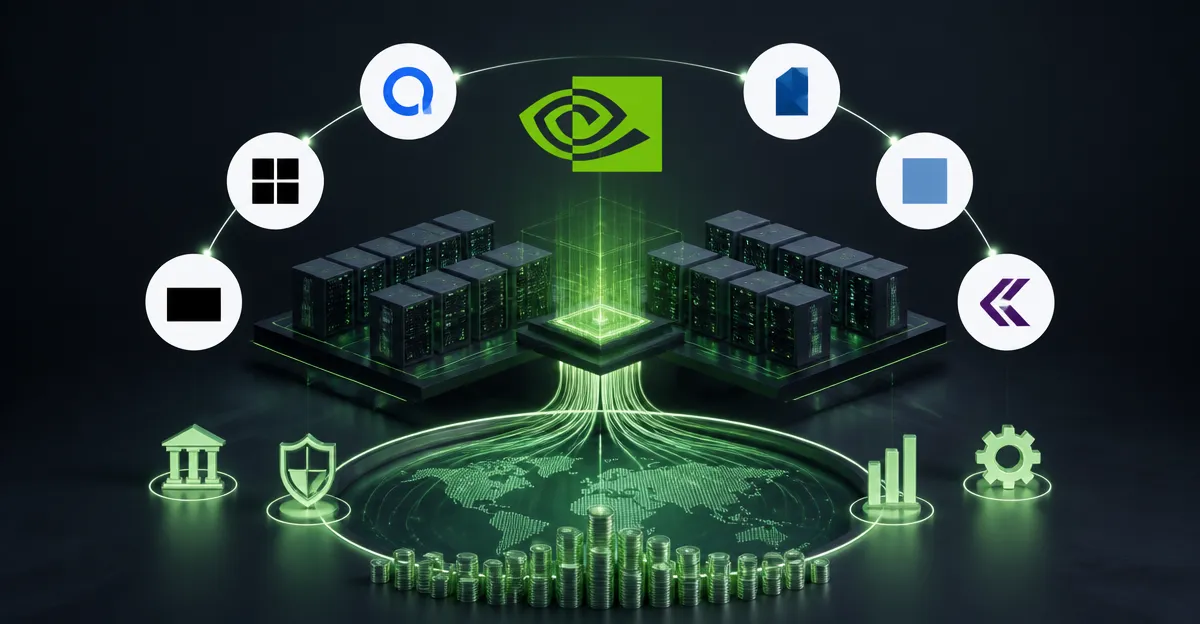
August 11, 2026, (Inside AI) — NVIDIA has partnered with six of the world’s largest alternative asset managers — Apollo, BlackRock, Blackstone, Brookfield, Goldman Sachs and KKR — to create financing platforms aimed at mobilizing over $500 billion of third-party capital for AI compute infrastructure. The partnerships, which remain subject to final agreements, represent an unprecedented collaboration between the dominant AI hardware provider and the titans of private capital.
The platforms will independently underwrite and finance the massive buildout of data centers, specialized chips, and energy systems required to train and run advanced AI models. NVIDIA’s role centers on providing its accelerated computing expertise and technology, while the financial partners will structure investment vehicles to attract institutional capital at scale.
This move signals a structural shift in how AI infrastructure is funded. Rather than relying solely on tech companies’ balance sheets, the initiative taps into the deep pools of capital managed by these firms, which collectively oversee trillions in assets. Apollo alone reported approximately $1.05 trillion in assets under management as of June 30, 2026, while Blackstone holds over $1.3 trillion and Brookfield more than $1 trillion.
The announcement comes amid surging demand for AI compute, driven by the rapid expansion of large language models and generative AI applications. Industry analysts have repeatedly warned that the current pace of data center construction is insufficient to meet projected needs. By creating dedicated financing platforms, NVIDIA and its partners aim to accelerate deployment and reduce bottlenecks.
Details on the structure of the platforms remain sparse. The press release emphasized that each partnership is independent, with the financial firms underwriting AI infrastructure on their own terms. This suggests a model where NVIDIA provides technical validation and perhaps preferential access to its hardware, while the asset managers raise and deploy capital through separate vehicles.
NVIDIA’s forward-looking statements cautioned that the partnerships are subject to risks including global economic conditions, competition, and market acceptance of new technologies. Similarly, each financial partner included extensive risk disclosures, underscoring the uncertainty inherent in such large-scale infrastructure bets.
Wall Street’s AI Bet Gets Concrete
The collaboration formalizes a trend that has been building for years. Private equity and infrastructure funds have increasingly poured money into digital infrastructure, but this marks the first time a chipmaker has directly aligned with a consortium of this magnitude to create dedicated financing platforms.
BlackRock, traditionally known for its passive investment strategies, has been expanding its alternative investments arm. Goldman Sachs and KKR bring deep experience in structuring complex financing deals, while Brookfield and Blackstone have extensive infrastructure portfolios. Apollo’s retirement services arm, Athene, could provide a natural source of long-term capital.
The $500 billion target, while staggering, reflects the scale of the AI infrastructure challenge. A single state-of-the-art AI training cluster can cost over $1 billion, and industry projections suggest global AI infrastructure spending could reach $1 trillion by 2030. By mobilizing third-party capital, NVIDIA avoids diluting its own balance sheet while ensuring its chips find a home in rapidly expanding data centers.
However, the announcement leaves critical questions unanswered. How will the platforms balance the need for standardized, scalable infrastructure with the bespoke requirements of different AI workloads? Will the financing structures prioritize NVIDIA’s own hardware, potentially locking in customers and stifling competition? And how will the partnerships navigate the complex regulatory landscape, given growing scrutiny of both Big Tech and private capital?
Energy and Regulatory Hurdles Loom Large
One of the most pressing challenges is energy. AI data centers consume enormous amounts of electricity, and securing reliable, sustainable power sources has become a major bottleneck. The press release did not address how the platforms will tackle energy procurement, but Brookfield’s expertise in renewable energy and infrastructure could prove pivotal.
Regulatory risks also abound. Governments in the U.S. and Europe are increasingly focused on the concentration of AI compute power and the environmental impact of data centers. Any new large-scale construction will face permitting hurdles, community opposition, and potential antitrust scrutiny. The involvement of six major financial players could attract additional regulatory attention.
Despite these uncertainties, the partnerships signal a maturation of AI infrastructure as an asset class. By bringing together the leading chipmaker and the world’s top capital allocators, the initiative could set a template for future large-scale technology financing. The final agreements, when executed, will reveal whether this ambitious vision translates into concrete projects or remains a high-profile statement of intent.