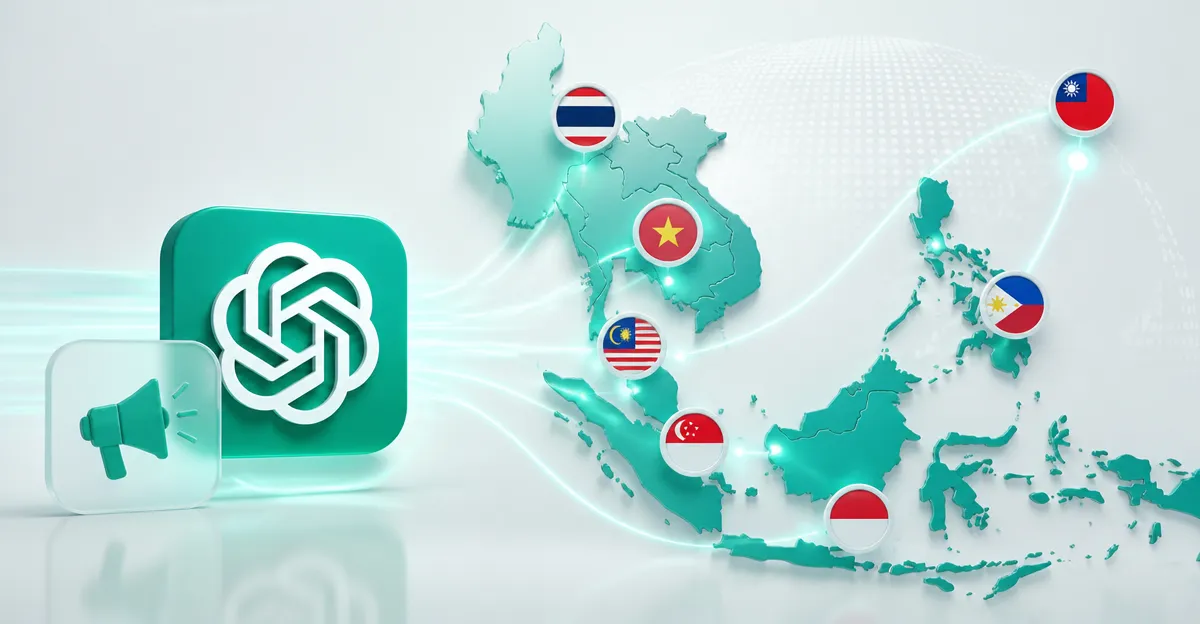
September 24, 2026, (Inside AI) — OpenAI's advertising business crossed a significant threshold this week, extending ChatGPT Ads into seven new markets across Southeast Asia and Taiwan. The expansion covers Indonesia, Malaysia, the Philippines, Singapore, Thailand, Vietnam, and Taiwan.
The move follows earlier Asia Pacific launches in Australia, New Zealand, Japan, South Korea, and India. With this rollout, ChatGPT Ads now operate in more than 60 countries, according to OpenAI.
The timing matters. OpenAI disclosed in late August that ChatGPT Ads reached a $1 billion annualized revenue run rate in under 200 days after launch. That figure places the advertising unit among the fastest-scaling revenue lines in enterprise software history, though it remains a fraction of the company's overall costs.
Advertisers gain access through the OpenAI Ads Solutions team, agency partners including dentsu, Havas Media, Omnicom Media, Publicis Groupe, and WPP, and technology partners. Eligible businesses can also use self-service tools through Ads Manager.
OpenAI frames the advertising push as a way to subsidize access. Ads appear only for users on Free and Go plans. Plus, Pro, and Enterprise subscriptions remain ad-free. The company says this structure helps "democratize access to intelligence" by supporting free and low-cost ChatGPT tiers.
Privacy protections form the core of OpenAI's pitch to skeptical users. The company states that conversations stay private from advertisers, customer data is never sold, and ad content remains clearly labeled and separate from ChatGPT's answers. Advertising does not influence the answers ChatGPT provides, according to the company. Users retain control over ad personalization.
Why Southeast Asia Is The Real Test
The region presents a different challenge than previous launches. Southeast Asia's digital advertising market is fragmented across languages, payment systems, and regulatory regimes. Indonesia alone has over 270 million people and a rapidly growing smartphone-first internet population. Vietnam and the Philippines share similar dynamics.
Taiwan adds a mature, high-income market with strong privacy expectations. Singapore functions as a regional advertising hub for multinational brands. Together, these seven markets represent a combined population exceeding 600 million people.
OpenAI's agency partnerships signal that it is not trying to build a direct sales force from scratch in each country. Relying on WPP, Publicis, and Omnicom gives the company immediate access to brand budgets that already flow through these holding companies. That approach mirrors how Google and Meta scaled advertising internationally in their early years.
The company has not disclosed specific revenue targets for the region. It also has not published data on how many advertisers are active in the new markets or what formats will be available at launch.
Read: OpenAI Seeks $1.5 Trillion Valuation in New Funding Round
Competitors are watching closely. Google's search advertising business generated over $175 billion in 2024, and Meta's ad revenue exceeded $160 billion that same year. ChatGPT Ads at $1 billion annualized remains small by comparison. The question is whether conversational advertising can scale to rival search intent-based models.
OpenAI says it will continue expanding into new markets and building new formats, optimization tools, and measurement solutions over the coming months. The company's stated goal is to make ads useful to users while remaining effective for advertisers.
Businesses interested in the new markets can visit ads.openai.com to begin the process. Whether Southeast Asian users embrace advertising inside their AI conversations, or resist it, will shape how aggressively OpenAI pushes into the next wave of countries.