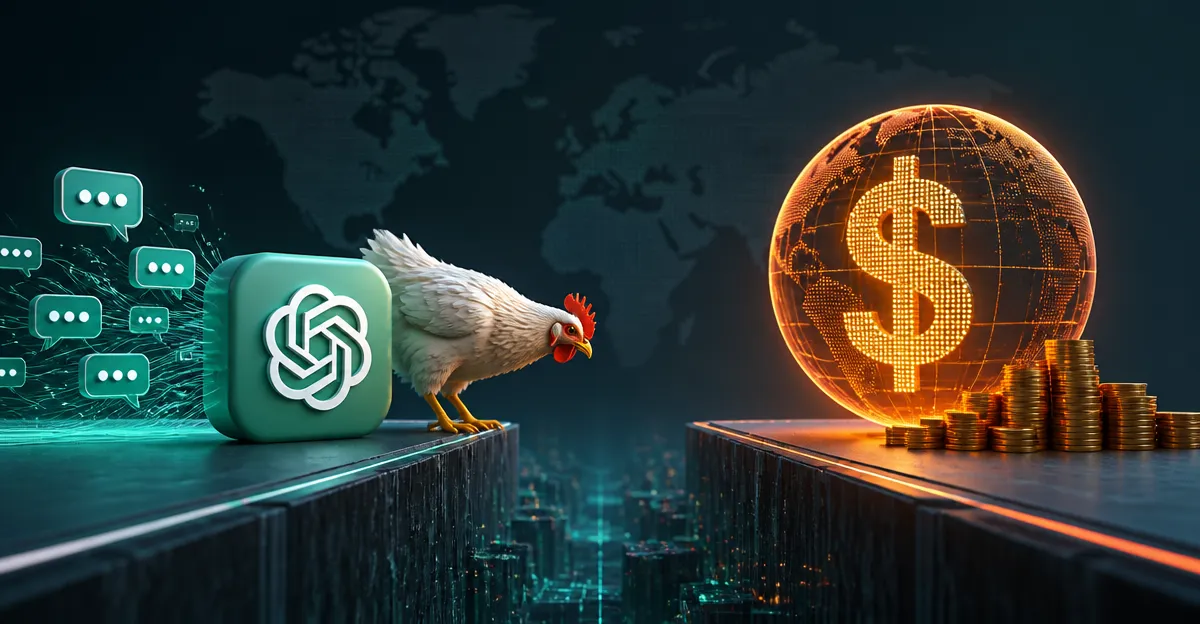
September 17, 2026, (Inside AI) — OpenAI has held talks with investors about a new funding round that could value the ChatGPT maker at $1.2 trillion, according to sources familiar with the discussions. The company itself believes it deserves at least $1.5 trillion, arguing that recent advances in its AI models justify the higher figure. The gap between those two numbers is not a rounding error. It is a $300 billion bet on whether OpenAI can keep growing fast enough to satisfy the most aggressive expectations in technology history.
The funding conversations began after investors approached OpenAI, not the other way around. That detail matters. It suggests demand for a piece of the company remains strong despite mounting questions about safety, regulation, and the economics of running large AI models. But the company's decision to push for an even higher valuation than investors initially proposed reveals something else: OpenAI is playing a high-stakes game of chicken with its own backers.
At $1.5 trillion, OpenAI would instantly become one of the most valuable companies on Earth, rivaling Microsoft, Apple, and Nvidia. That comparison is not accidental. Nvidia's market capitalization surged past $3 trillion in 2024 on the back of AI chip demand. Microsoft, which has invested billions in OpenAI, sits above $3 trillion as well. OpenAI's leadership appears to believe it belongs in that tier.
The problem is what new investors get for their money. At a $1.5 trillion valuation, the upside from here depends on OpenAI growing into a company that generates hundreds of billions in annual revenue. Current revenue is estimated in the low tens of billions. The math requires either a massive acceleration in adoption or a pricing power that no software company has ever achieved.
Read: AI Spending Slowdown Fears Rattle Investors After Industry Warnings
Meanwhile, the risks are not shrinking. OpenAI faces ongoing litigation over copyright, regulatory scrutiny in the European Union and United States, and internal tensions over its transition from nonprofit to for-profit entity. Safety researchers have warned that the company's pace of deployment outruns its ability to understand the systems it releases. Each of those issues could weigh on future cash flows.
The chatbot frenzy that lifted OpenAI's profile also lifted every competitor. Google, Anthropic, Meta, and xAI all now field capable models. Switching costs for users remain low. That competitive pressure makes the $1.5 trillion target look less like a valuation and more like a negotiating position.
Investors who participated in earlier rounds at valuations of $80 billion or $300 billion have already seen enormous paper gains. New backers at $1.2 trillion or $1.5 trillion would need the company to roughly double or triple again to match those returns. That is a much harder ask.
The broader AI investment climate remains hot, but it is no longer indiscriminate. Several AI startups that raised at peak valuations in 2024 and 2025 have struggled to justify those numbers in subsequent rounds. Public market investors have grown more selective about AI exposure. OpenAI is not immune to that shift, no matter how dominant ChatGPT appears.
What OpenAI is really selling is a story about the future. The company argues that its latest models represent a step change in capability, one that will unlock new markets in enterprise software, education, healthcare, and scientific research. If that story holds, $1.5 trillion could look cheap in hindsight. If it does not, the company will have priced itself out of the very investors it needs to fund the compute, talent, and energy required to stay ahead.
Inside AI could not independently verify the specific valuation figures or the status of the negotiations. The talks remain private and no deal has been announced. What is clear is that OpenAI is testing the limits of investor patience at the exact moment when the costs of running frontier AI are rising faster than almost anyone predicted.
Read: OpenAI Tests Sponsored Agents and AI Ad Tools in ChatGPT
The outcome of this round will not just set OpenAI's price. It will set the ceiling for every AI company that follows. If investors balk at $1.5 trillion, the entire sector's fundraising math changes. If they pay it, the bubble talk gets louder. Either way, the chicken game has begun.