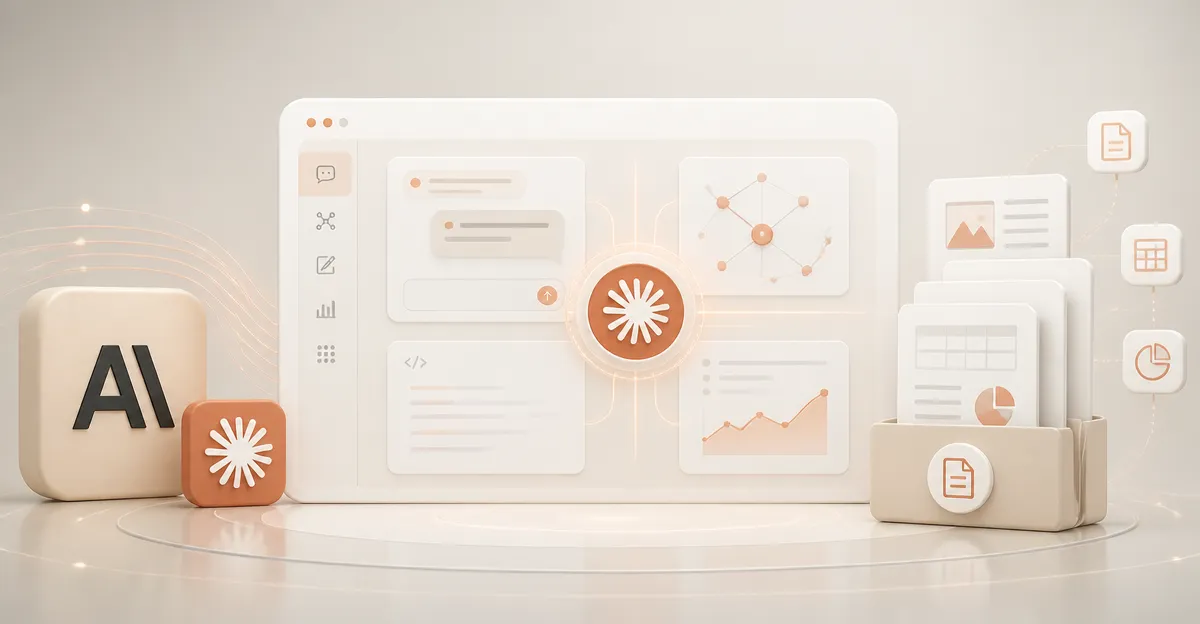
September 16, 2026, (Inside AI) — Anthropic announced Wednesday it is merging the chat and Cowork functions of its Claude AI assistant into a single interface and rolling out new document and presentation tools. The company is also folding its visual work tool, Claude Design, into the main interface. The changes arrive after users complained about having to pick the right tool for each task, Anthropic said.
The update places Anthropic in direct competition with OpenAI, which launched ChatGPT Work in July. That product combined its chatbot with the Codex coding tool. Both companies are racing to win enterprise customers and non-coders who want AI-powered work tools. The timing is notable because both firms are reportedly preparing for public offerings.
Users will no longer need to switch between different tools. Claude will automatically determine and deploy the capabilities required for a task, Anthropic said. The company is also introducing Claude Docs and Claude Slides in beta. These allow users to create documents, presentations and visual designs in a single conversation. The AI tool will also let users create and export documents to Google Docs or Microsoft Word, and presentations to PowerPoint or PDF files.
The update is rolling out first to Pro and Max subscription plans on web, desktop and mobile over the coming weeks. It will later reach Team and Free plans, Anthropic said.
Read: Anthropic Releases Fable 5.1 and Mythos 5.1 with Better Coding and Research
Why Anthropic Is Consolidating Its Toolset Now
The consolidation reflects a broader shift in the AI assistant market. For the past two years, companies have released specialized tools for coding, writing, design and data analysis. That approach created friction. Users had to learn which tool handled which task. Anthropic's move acknowledges that fragmentation has become a barrier to adoption, especially among enterprise workers who are not developers.
OpenAI made a similar calculation with ChatGPT Work. By combining its chatbot with Codex, OpenAI aimed to keep users inside one interface. Anthropic's response goes further by adding document and presentation creation directly into the conversation flow. This means a user could ask Claude to draft a report, turn it into a slide deck and export it to PowerPoint without leaving the chat window.
The export options are strategically important. Google Docs, Microsoft Word and PowerPoint remain the dominant formats in corporate environments. By supporting these formats, Anthropic reduces the friction of adopting Claude in workplaces that rely on Microsoft and Google productivity suites. This is a practical play for enterprise adoption, not just a feature update.
The timing also matters. Both Anthropic and OpenAI are reportedly moving toward IPOs. Enterprise revenue and user retention are key metrics for public market investors. A unified interface that appeals to non-coders could expand Anthropic's addressable market beyond software developers and AI researchers. The company has not disclosed specific user numbers for Cowork or Claude Design, and Inside AI could not independently verify adoption figures.
Anthropic has positioned itself as a safety-focused AI lab. Its Claude models are known for strong performance on reasoning and long-context tasks. The company has raised billions in funding from Amazon and Google. The IPO plans, first reported by multiple outlets, would test whether safety-focused AI companies can attract public market investors at high valuations.
The competitive dynamics extend beyond OpenAI. Microsoft, Google and Meta are all integrating AI assistants into productivity tools. Microsoft Copilot is embedded in Office 365. Google Gemini is woven into Workspace. Anthropic lacks its own productivity suite, so partnering with Google Docs and Microsoft Word through export features is a pragmatic workaround. It lets Claude users work with those formats without requiring Anthropic to build a competing suite.
One open question is how well the automatic tool selection will work. Anthropic says Claude will determine which capabilities to deploy. If the system misjudges a task, users could face frustration rather than relief. The company has not published benchmarks for tool selection accuracy. Inside AI could not independently verify performance claims.
The beta label on Claude Docs and Claude Slides suggests these features are not yet fully polished. Beta products often change based on user feedback. Anthropic will likely iterate quickly, especially if enterprise customers request specific formatting or collaboration features. The rollout to Pro and Max plans first is a common strategy. It rewards paying users and generates feedback before a broader release.
Anthropic's announcement did not include pricing changes. The company did not say whether the new document and presentation tools would remain part of existing subscription tiers or become add-ons. That detail could matter for enterprise buyers comparing costs with ChatGPT Work and Microsoft Copilot.
The broader trend is clear. AI assistants are moving from single-purpose chatbots to unified work platforms. The winners will be those that reduce friction, support common file formats and integrate smoothly into existing workflows. Anthropic's latest update is a step in that direction. Whether it is enough to close the gap with OpenAI and Microsoft remains to be seen.