September 15, 2026, (Inside AI) — A rare public appeal from the leaders of OpenAI and Anthropic to slow the pace of artificial intelligence development has rattled investors, exposing how much of the market's recent gains rest on an uninterrupted spending boom. The S&P 500 has more than doubled since October 2022, largely fueled by massive capital expenditures on AI data centers, and Wall Street is now watching for any sign that the flow of money might slow.
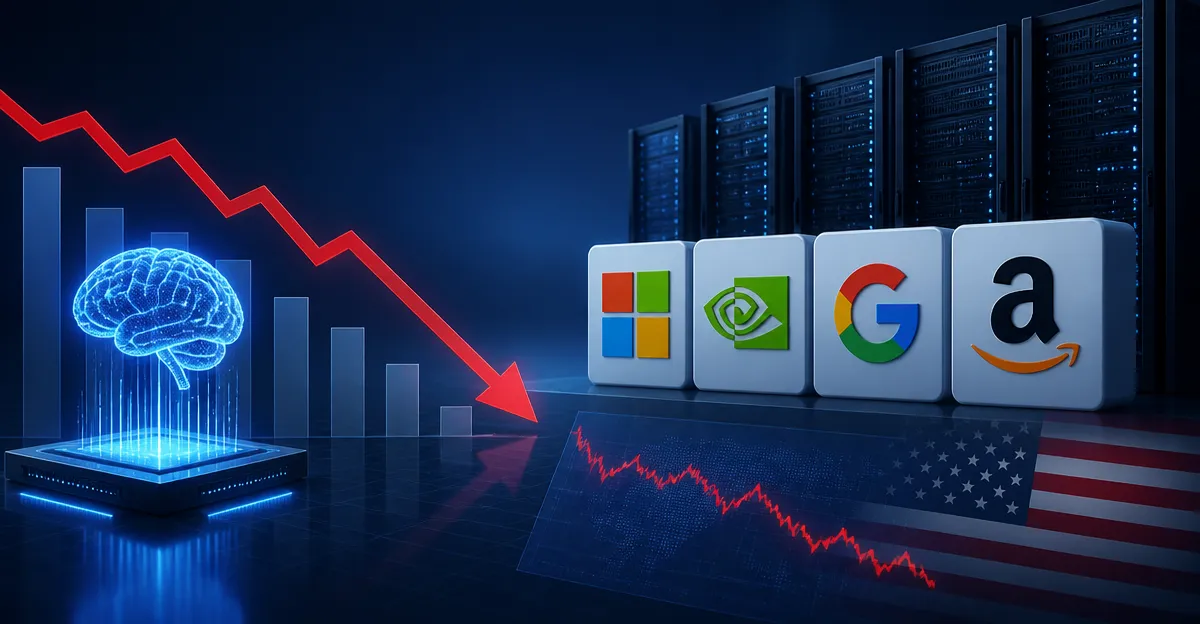
The immediate trigger was a series of warnings over the weekend from industry figures, including Anthropic CEO Dario Amodei, who called for guardrails and a more measured rate of advancement. The comments followed earlier dire pronouncements about AI's potential risks to humanity. While no company has announced a spending cut, the mere suggestion of a slowdown was enough to pressure semiconductor stocks on Monday, with the Philadelphia SE Semiconductor Index falling sharply even as it remains up nearly 60% in 2026.
"This becomes a problem if in fact you see orders being cancelled, you see data centers, construction deals being cancelled," said Chuck Carlson, chief executive officer at Horizon Investment Services in Hammond, Indiana. "I need to see something concrete that, in fact, there is a slowdown versus just talk."
The stakes are enormous. According to BofA Global Research, the five largest AI hyperscalers, Microsoft, Alphabet, Amazon, Meta Platforms, and Oracle, are expected to spend around $795 billion in capital expenditures this year, rising to nearly $1.08 trillion in 2027. Much of that money flows to chipmakers and infrastructure providers, whose valuations have become tightly coupled to the pace of the buildout.
"Markets are punishing the picks-and-shovels layer harder than the hyperscalers because it's the layer most exposed to a slowdown in the rate of capability improvement," said Erik Kratz, chief investment officer and co-head of wealth at Arena Private Wealth in Chicago.
Yet Kratz and others see a potential upside in the safety push. A credible regulatory framework, they argue, could make long-term investment more predictable, not less. "The buildout doesn't stop because the CEOs asked for guardrails," Kratz said. "If anything, a credible safety framework makes the long-duration capex easier to underwrite."
The current jitters echo a similar episode in early 2025, when the sudden emergence of China's DeepSeek model raised doubts about the necessity of massive AI infrastructure spending. That selloff proved short-lived, and the AI trade quickly recovered. This time, however, investors are weighing a broader set of risks, including the possibility of heavier government regulation.
Adding to the uncertainty, President Donald Trump stated on Monday that threats to safety from AI were "a hoax" and downplayed the need for regulation, creating a confusing signal for markets already on edge. "The real risk isn't that development actually slows," Kratz said. "It's regulatory overreaction."
Geopolitical tension and technological shifts are also in play. Michael Bruun, global co-head of private equity at Goldman Sachs Alternatives, said investors are navigating whether there will be "more or less regulation, whether it's more or less geopolitical tension, whether there are new paradigms on the technology side emerging." Still, Bruun said he sees opportunities to deploy capital "into the epicenter of AI."
The market's vulnerability is amplified by its starting point. Both the S&P 500 and the Nasdaq Composite sit only about 2% below all-time highs, even as bond yields rise, oil prices climb, and the Federal Reserve weighs a possible rate hike this week to combat inflation. Any pullback in AI spending would remove a key pillar of support for the broader indices.
"AI semiconductor and infrastructure stocks have long priced in an uninterrupted capex boom, leaving virtually zero margin of error for an industry-imposed speed limit," said James Humphries, managing partner at Mindset Wealth Management in Indianapolis, Indiana. "If the market is already staring down stickier-than-expected inflation and a murky Fed rate path, cutting off the market's primary growth engine leaves the broader indices completely exposed to those macro headwinds."
For now, the nervousness remains just that. No major orders have been cancelled, and the hyperscalers have not revised their spending plans. But the episode highlights a new phase in the AI trade, where the industry's own leaders can move markets simply by talking about caution. Whether that caution translates into real restraint, or simply a pause for breath, will determine if the rally can continue.