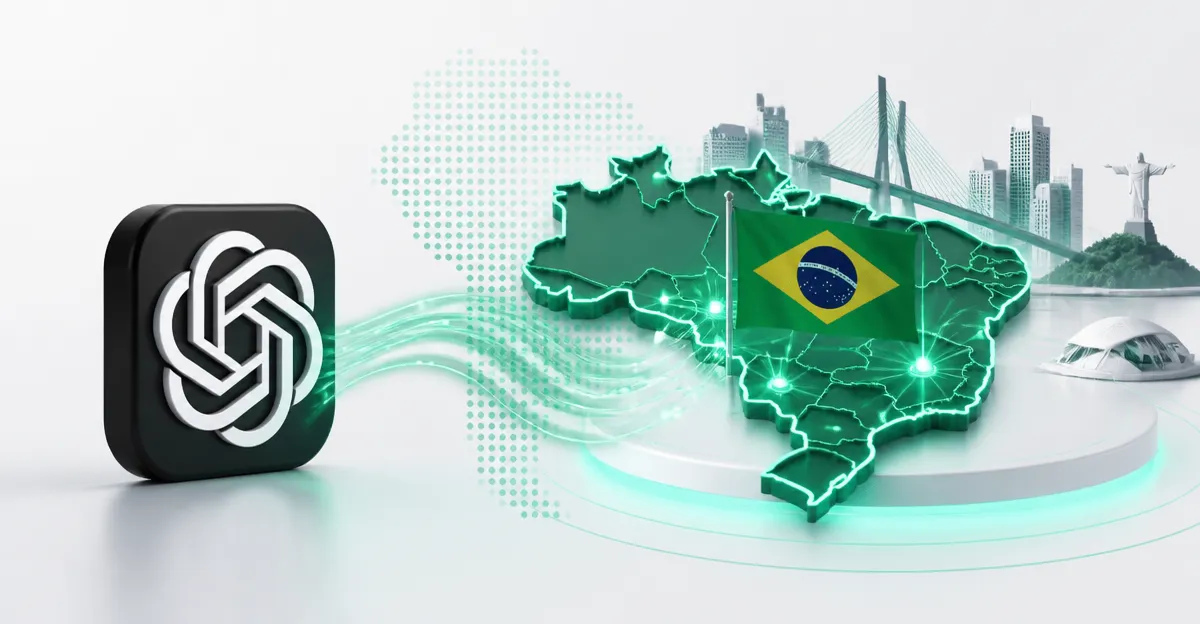
August 27, 2026, (Inside AI) — OpenAI has formally launched commercial operations in Brazil, establishing a São Paulo-based team to serve businesses, developers, researchers, and public institutions. The move deepens the company’s footprint in one of its fastest-growing markets, where ChatGPT usage and developer activity have surged over the past year.
Brazil now ranks among ChatGPT’s three largest markets by weekly active users. The user base has nearly doubled in twelve months, with roughly 215 million messages sent to ChatGPT daily. Work-related use is also climbing. In June 2026, 35% of classified messages from individual accounts in Brazil were work-related, versus 30% globally. Of those, 53% asked ChatGPT to complete a task or produce an output, such as drafting proposals, analyzing information, writing code, or creating marketing materials.
The commercial launch is not just about sales. OpenAI is pairing it with developer outreach, creator programs, and local partnerships. The company says it wants to learn from Brazilian usage patterns while helping organizations turn adoption into economic gains.
Developer Surge and Enterprise Adoption Signal Market Shift
Brazil ranks second globally by number of developers using the OpenAI API. It is also Codex’s largest market in Latin America. Since the beginning of 2026, weekly Codex users in Brazil have grown more than elevenfold, while daily interactions have increased nearly thirtyfold.
Read: OpenAI Launches ChatGPT for Financial Services Industry
Enterprise adoption is accelerating too. ChatGPT Enterprise seats in Brazil have increased fivefold year over year. Brazil now sits among OpenAI’s ten largest markets by number of business customers. Companies are deploying OpenAI technology across financial services, commerce, mobility, customer service, software development, and internal operations.
An independent study by RegLab, funded by OpenAI, estimates AI could add nearly R$1 trillion to Brazil’s economy by 2030. Realizing that potential requires skills, research, responsible deployment, and close collaboration with Brazilian institutions, according to the company.
The local team will help organizations identify valuable use cases, prepare their people, establish responsible governance, and scale what works. OpenAI also held its first OpenAI para Devs roadshow in the week leading up to the launch. The program brought together 285 developers, startup engineers, founders, and technical creators in Recife, Rio de Janeiro, Florianópolis, and São Paulo.
Delivered entirely in Portuguese, the roadshow included technical presentations, live Codex demonstrations, hands-on workshops, and sessions featuring local partners Adapta and Brendi. It culminated in the OpenAI Hackathon Brasil, a full-day gathering in São Paulo where developers used Codex to build projects around Brazilian needs.
The winning team built a prototype to help micro and small businesses navigate public procurement opportunities. The tool lets entrepreneurs describe their businesses by voice, matches their profiles with relevant opportunities and eligibility requirements, and maps nearby public-sector demand.
Creators and Cultural Context Shape Local Strategy
Brazil is not only adopting AI at scale; it is developing distinctive ways to use it. The country has the world’s highest rate of ChatGPT Images use and ranks among the five largest markets for voice and dictation. Weekly voice users in Brazil have doubled over the past year.
Read: OpenAI Expands ChatGPT for Teachers to 55 More U.S. School Districts
That creativity surfaced in a collaboration with Alcione, one of Brazil’s most iconic artists, who explored ChatGPT Voice in a playful conversation about love and relationships. OpenAI also held its first-ever Creators Day in São Paulo.
Visual artist Dell Nunes uses AI to portray Brazil’s diversity and communities on urban peripheries. Paulo Aguiar works across text, images, video, and music, keeping human creative direction at the center. Thaís Martan plans to use ChatGPT Work during a journey by catamaran, incorporating AI into how she works and explores while at sea.
OpenAI frames its Brazil push as a two-way exchange. The company wants to make its technology more accessible while listening to a community whose ideas and cultural context can shape how people use ChatGPT worldwide.
OpenAI is hiring for positions in São Paulo. The company says it is just getting started in Brazil.