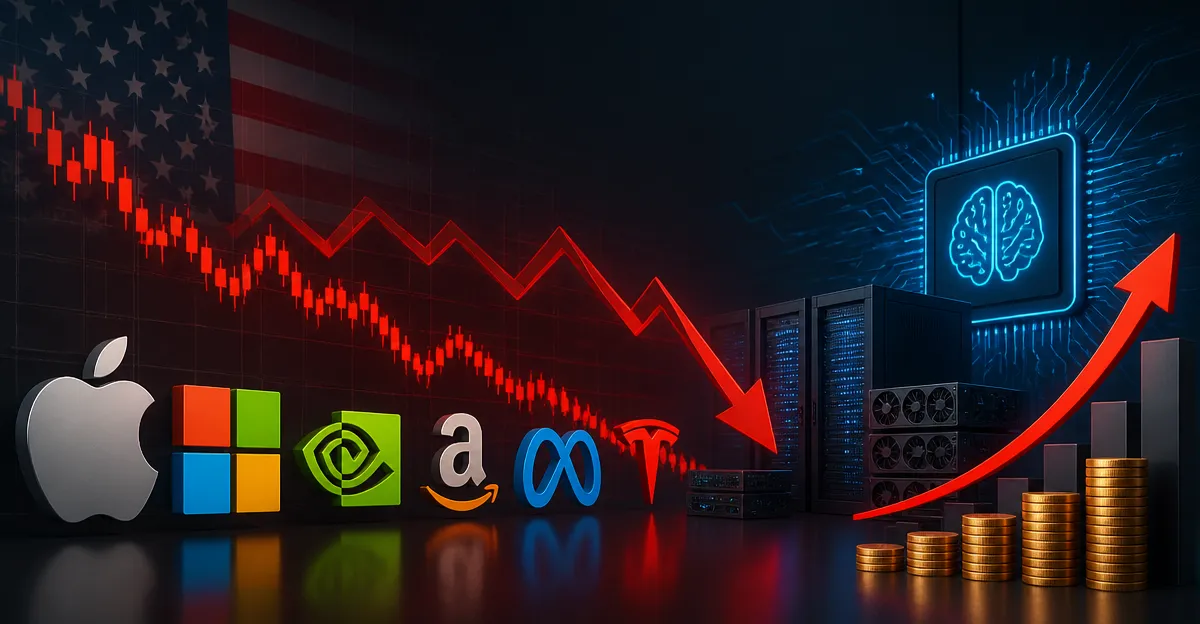
October 9, 2026, (Inside AI) — A single number jolted global markets this week: OpenAI's annualized revenue is running roughly $20 billion below what the company had previously signaled to investors. The disclosure, first reported by The Information and confirmed by two people familiar with the matter, triggered a sharp selloff in technology stocks from Tokyo to New York and exposed a growing fault line in the artificial intelligence boom.
The MSCI Asia-Pacific ex-Japan index slipped 0.16% on Friday and headed for a second consecutive weekly decline of more than 1%. Japan's Nikkei 225 fell over 1%, while markets in South Korea and Taiwan were closed for a holiday. On Wall Street, the Nasdaq led major indexes lower overnight as semiconductor and AI infrastructure names bore the brunt of the selling.
The revenue shortfall matters because it undercuts the central premise of the AI trade: that demand for generative AI services is growing fast enough to justify hundreds of billions of dollars in capital expenditure. OpenAI has committed to spending tens of billions on computing infrastructure, including a $500 billion Stargate data center venture with Oracle and SoftBank. If revenue is tracking $20 billion below projections, the math behind those commitments becomes harder to defend.
"It has been a sea of red across technology, AI infrastructure and semiconductors, with the OpenAI headlines seemingly providing the catalyst for investors to take some exposure off the table," said Chris Weston, head of research at Pepperstone.
"For now, though, the price action suggests investors are becoming more selective about where they want exposure and, importantly, what price they are prepared to pay for future growth," he said in a note.
The Bond Market Is Repricing AI Risk
The OpenAI disclosure landed in an already fragile macro environment. Brent crude traded at $103.70 per barrel in Asian hours after surging more than 4% in the prior session on Middle East war concerns. Elevated energy prices have fanned inflation worries and pushed sovereign borrowing costs to multi-decade highs.
The US 10-year Treasury yield held steady at 5.226% on Friday, not far from the 24-year high it touched on Wednesday. A months-long global bond selloff, driven by rising government debt and expectations of further central bank rate hikes, has made capital more expensive for everyone. For AI companies that rely on debt markets to fund chip purchases and data center construction, the shift is particularly acute.
"With long-term yields back around multi-decade highs, investors no longer have the luxury of valuing AI growth in a low-cost-of-capital world," said Charu Chanana, chief investment strategist at Saxo.
Chanana said higher sovereign yields and now rising corporate issuance to fund AI infrastructure mean capital is becoming "both more expensive and more selective, which puts balance sheets and the quality of future earnings firmly in focus."
The fundraising pipeline underscores the scale of the bet. SpaceX, Broadcom, and Oracle are all expected to raise billions in coming months to buy high-end AI chips. Meanwhile, Australia's Firmus, a data center operator backed by Nvidia, shelved its $5 billion initial public offering on Friday, citing market volatility. The company said it would pursue a private fundraising round instead.
That decision is telling. When a well-funded AI infrastructure player with Nvidia's backing chooses private capital over public markets, it signals that IPO investors are no longer willing to underwrite AI growth at any price.
Currency markets reflected the broader risk-off mood. The dollar stood tall as the euro headed for a fifth straight week of losses, last fetching $1.122, near a 17-month low touched earlier this week on French debt worries. France has been hit hard as investors scrutinize its debt load and political outlook ahead of 2027 presidential elections.
"With the two rounds of the presidential elections only in April and May next year, French bond spreads are still looking at more than half a year of higher volatility and continued spread elevation," ING analysts said in a note.
Geopolitical risk added another layer. President Donald Trump said Thursday the US would not attack Iran before November's midterm elections, but traders remained skeptical.
"The big question for markets is whether Trump sticks to his word if Iranian attacks intensify," said Nick Twidale, chief market strategist at ATFX Global.
"Any indication that the White House is reconsidering military action could see oil prices spike sharply higher, particularly with tanker traffic through the Strait of Hormuz already under significant pressure."
The immediate question for AI investors is whether this week's selloff represents a healthy correction or the start of a deeper reassessment. The OpenAI revenue miss, combined with rising capital costs and geopolitical uncertainty, has forced a reckoning with valuations that assumed perpetual low rates and flawless execution. For now, the market is demanding proof, not promises.