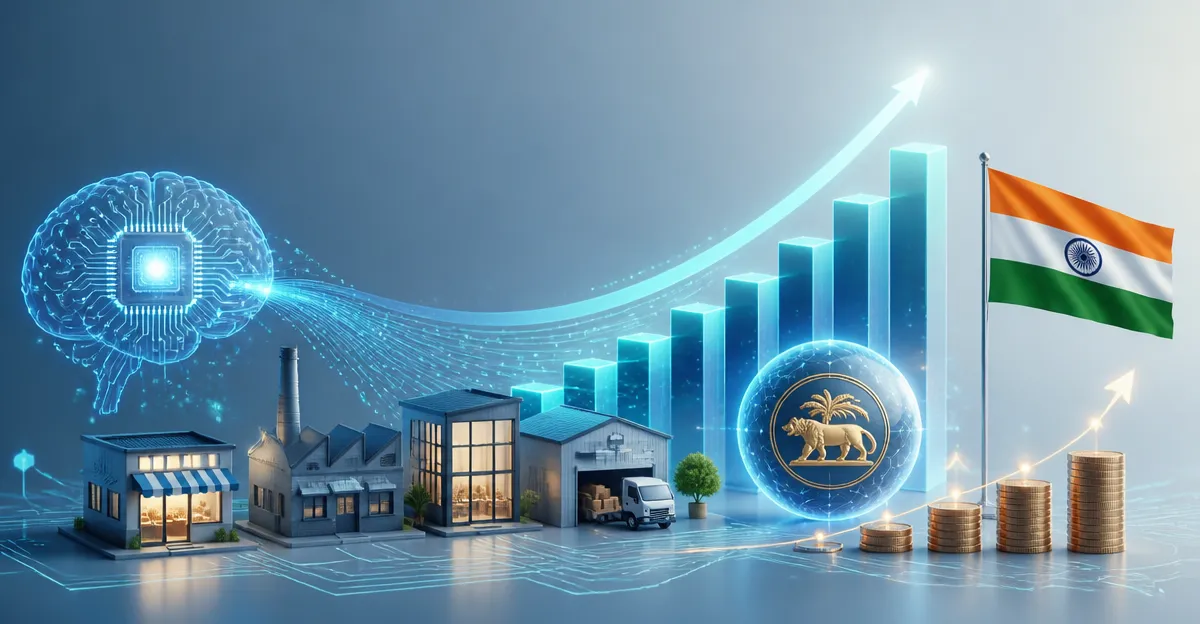
November 27, 2026, (Inside AI) — India's micro, small and medium enterprises (MSMEs) stand to gain between $490 billion and $685 billion in economic value from artificial intelligence, according to Reserve Bank of India Governor Sanjay Malhotra. Yet the sector's adoption of the technology remains strikingly low, with only about 15% of Indian MSMEs using AI, trailing peers in China, the US and Germany.
Malhotra delivered the estimate at the SME Finance & Investment Summit in Mumbai on Friday, where he pressed smaller firms to treat technology as a growth lever rather than an optional upgrade. The gap between the potential prize and current uptake forms the central tension in the RBI's push.
"(AI) can help small firms compete with larger players on speed, quality and personalisation. Overall, AI is estimated to generate $490 billion-$685 billion of economic value for the MSME sector," Malhotra said.
The figure matters because India's MSME sector employs tens of millions and contributes roughly a third of the country's GDP. A productivity gap sits at the heart of the problem. Value added per worker in Indian MSMEs is just 26% of that of large enterprises, a ratio well below advanced economies and even below Brazil and Mexico.
Read: Pakistani AI Adoption
Malhotra quantified the upside of closing that gap. If Indian MSMEs lifted productivity to the level of top-quartile firms in their sub-sectors in advanced economies, the gain would equal about 11% of GDP.
"This is a prize too large to ignore," he said.
Adoption Is Shallow, Not Absent
The RBI chief drew a distinction between awareness and real deployment. A recent survey found that 76% of MSME leaders used AI in some form, but only 5% had made it central to their operations. That gap suggests most firms are experimenting at the edges rather than rebuilding workflows around the technology.
"Technology is the key to productivity, yet adoption remains shallow. India's MSME sector has an AI adoption rate of about 15%, behind peers such as China, the US and Germany," Malhotra said.
He offered a practical starting point: digital accounting, inventory management, quality control and customer engagement. These are low-cost entry points that do not require large engineering teams, and they build the data foundations that more advanced AI tools depend on.
The commentary here is worth separating from the headline number. India's AI conversation has largely centred on startups, large enterprises and government infrastructure. The MSME segment, which employs the bulk of the organised workforce, has stayed on the periphery. Malhotra's remarks signal a shift in official thinking: the productivity gap is now being framed as an AI adoption problem, not merely a credit problem. That reframing could redirect policy attention toward training, tooling and data access for small firms, areas that collateral-free lending alone cannot fix.
Read: Free AI Skills Training
Malhotra was careful to set boundaries on what the central bank and government can deliver.
"The Reserve Bank and the Government can create the enabling conditions. But growth must ultimately come from enterprises themselves," he said.
Existing support includes collateral-free lending up to a threshold, digital lending frameworks, priority sector lending allocations and easier working capital access. Malhotra urged banks to treat MSMEs as partners rather than boxes to tick.
"These enterprises are potential partners in your growth; the relationship can be both profitable and socially valuable," he said, warning lenders against approaching the sector "merely as a matter of regulatory compliance or as a target to be met."
The Trade Deals Sitting Unused
Beyond technology, Malhotra flagged a second underused lever: free trade agreements. India has signed pacts with the UK, Australia and Oman in recent years, but MSMEs are not exploiting them.
"Only about 20-30% of eligible Indian exports take advantage of the lower tariffs available under our FTAs. It is remarkably low compared with 60-70% utilisation by partner countries' exports to India. It is an opportunity we are leaving on the table," he said.
He advised firms to study the agreements relevant to their products and invest in quality, standards and certification. The low utilisation rate points to information gaps and compliance costs that disproportionately burden smaller exporters.
Malhotra's twin message, on AI and on trade, converges on a single theme: the tools and the market access already exist, but uptake lags. For a sector that anchors Indian employment, the cost of that lag is measured in lost productivity and forgone exports.
The RBI's role, as Malhotra framed it, is to keep easing compliance and financing constraints. Whether MSMEs convert the estimated $490 billion to $685 billion opportunity into realised gains will depend on decisions taken inside individual firms, many of which operate on thin margins and limited technical capacity. The central bank has set the target. The execution burden now rests with the enterprises themselves.

Shamil has a low tolerance for AI that only works in controlled demos. He covers agentic systems and generative AI with the skepticism of someone who has seen too many “revolutionary” tools quietly disappear six months after launch.