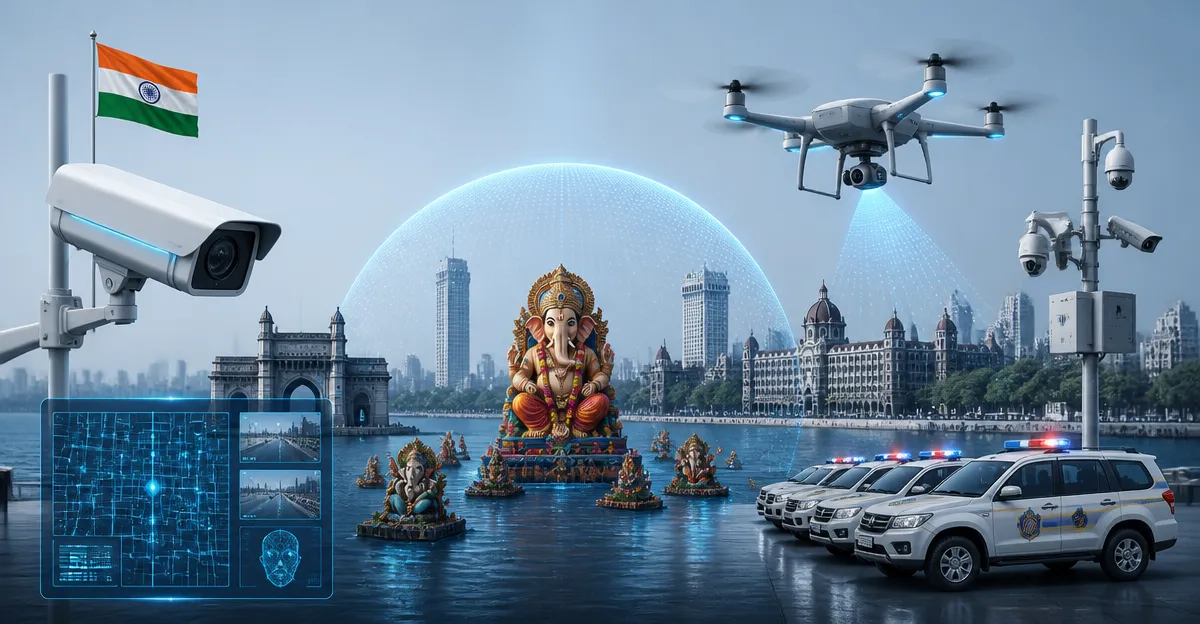
September 24, 2026, (Inside AI) — Mumbai will deploy more than 23,000 police personnel and 10,000 CCTV cameras, including AI-powered facial-recognition systems, to secure Anant Chaturdashi on Friday, September 25. The annual Ganpati immersion festival draws lakhs of devotees across the city and is one of the largest crowd-management operations in India.
The force includes 3,213 police officers, 18,940 personnel, and 1,050 trainees. Six Joint Commissioners, nine Additional Commissioners, 38 Deputy Commissioners, and 66 Assistant Commissioners will supervise the operation. The deployment combines traditional policing with drone surveillance and AI-driven crowd analytics.
Mumbai has roughly 7,000 household Ganpati idols and 9,000 mandals, including 132 major pandals. Civic authorities have prepared 341 immersion ponds, both natural and artificial. The scale explains why the city is turning to automated monitoring tools.
Facial Recognition Meets Festival Crowds
AI-enabled cameras will be active at major immersion locations including Girgaon, Juhu, Bandra, Versova, Powai, and Madh-Marve. The city police control room and five regional control rooms will monitor feeds, while temporary control rooms operate at key immersion points. Drones will track crowd density in real time.
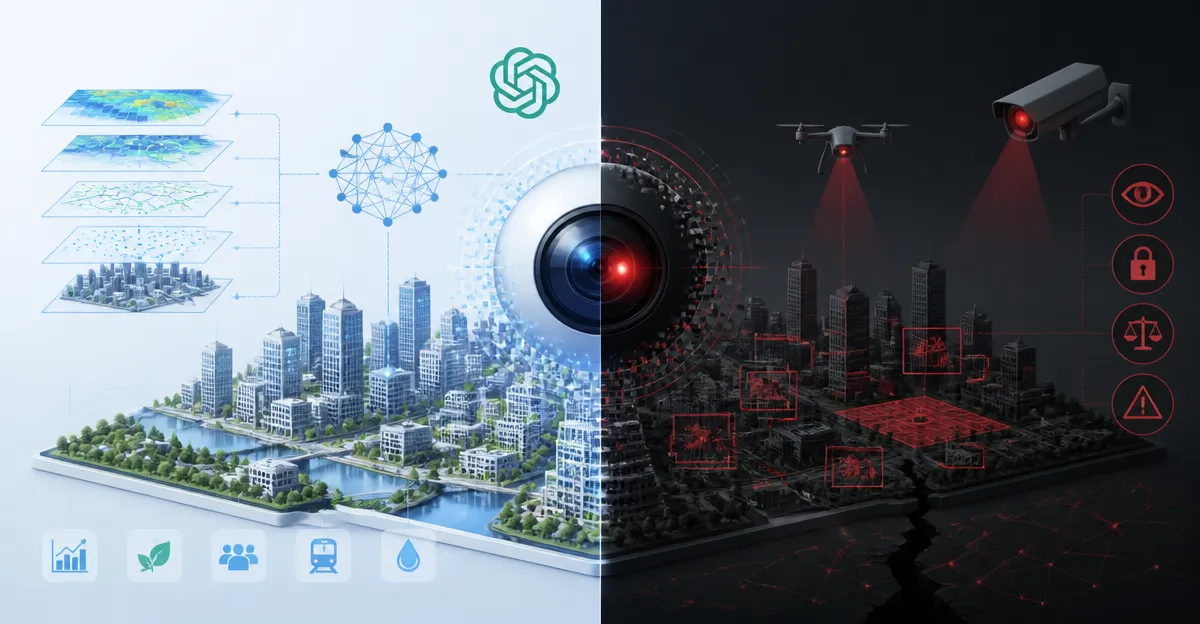
Read: MIT Researchers Warn Visual AI Can Transform Cities But Threatens Privacy and Fairness
"Along with the existing CCTV network, we are using 10,000 cameras at major immersion spots, including advanced AI cameras with facial-recognition technology. Drones will also be used to monitor crowd density. If a particular location becomes overcrowded, additional forces will be mobilised as required," said Joint Commissioner of Police Manoj Kumar Sharma.
The use of facial recognition at public religious gatherings raises unresolved questions about consent and data retention. Indian law currently lacks a comprehensive data protection framework specifically governing real-time biometric surveillance at mass events. The Digital Personal Data Protection Act, 2023, sets broad rules but leaves operational specifics to future regulations. Civil liberties groups have repeatedly flagged the risk of misidentification, especially in dense, diverse crowds.
Mumbai Police have not disclosed how long facial-recognition data will be stored or which vendor supplies the AI cameras. Inside AI could not independently verify these details. Similar deployments in other Indian cities have faced legal challenges, though none have halted festival security operations.
Specialised units are also on the ground. These include the Rapid Action Force, State Reserve Police Force, Force One, Quick Response Teams, riot-control teams, Delta and Combat teams, and the Anti-Drone Squad. Home Guards will assist the police. The Anti-Drone Squad is a notable addition, reflecting growing concern over unauthorized drone flights near crowded areas.
Traffic, Transit, And The Night After
Traffic police will deploy more than 3,500 personnel, including around 250 officers, along major procession routes and immersion points. Heavy vehicle movement will be restricted across Mumbai on Friday. Parking has been arranged at BPT ground and other designated grounds.
"Ensuring the safety of women, girls and senior citizens, as well as devotees visiting crowded public places, will be the top priority of the traffic police during the immersion processions," said Joint Commissioner of Police (Traffic) Satya Narayan Chaudhary.
The police have coordinated with Railways and Metro authorities for extended services through the night. Central Railway will run 22 special night local trains. The move aims to help devotees return home and reduce road congestion after midnight.
Anant Chaturdashi marks the final day of the Ganesh festival. The immersion processions often continue past midnight, creating prolonged security challenges. Mumbai Police have managed this event for decades, but the addition of AI surveillance marks a shift toward predictive, data-driven crowd control.
Other Indian cities, including Pune and Hyderabad, have tested similar AI camera networks during festivals. Mumbai's deployment is among the largest single-day applications of facial recognition for event security in the country. The outcome could influence how other states approach religious gatherings and public safety.
For now, the focus remains on Friday. The city will watch its cameras, its drones, and its crowds. The data collected will outlast the festival, and the questions about its use will remain unanswered.