September 9, 2026, (Inside AI) — A mathematical breakthrough announced by OpenAI has ignited a priority dispute with two academic researchers who claim the company built on their unpublished work without proper credit.
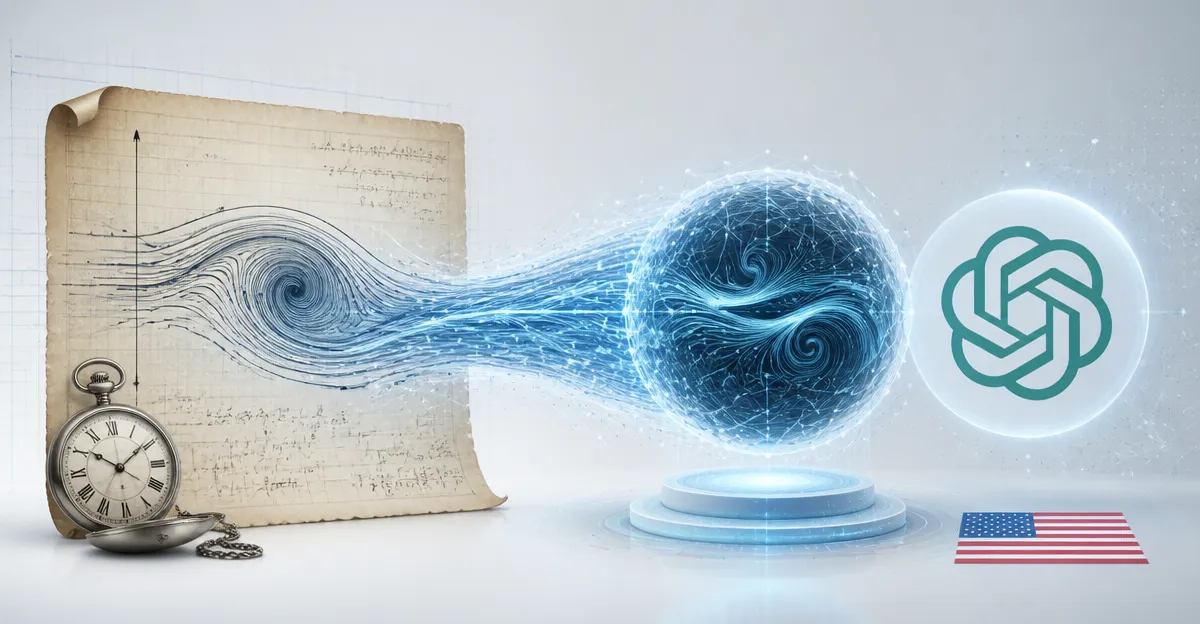
OpenAI said its internal model solved the Navier-Stokes equations problem, one of seven Millennium Prize Problems carrying a $1 million award from the Clay Mathematics Institute. The announcement came on September 8.
The problem, unresolved for roughly 90 years, asks whether smooth three-dimensional fluid motion can mathematically break down. OpenAI claimed its model proved the equations can "blow up," reaching impossible infinite speeds.
The computational effort was extraordinary. OpenAI deployed about 10,000 concurrent AI agents that reached a resolution within 88 hours. The GPT-6 Astra model then verified the proof using the Lean formal verification language.
Within hours, NYU professor Tristan Buckmaster raised pointed questions. He and Anthropic researcher Levent Alpöge had been working on the related Euler equations. Buckmaster alleged OpenAI learned of their unpublished progress last week.
He claimed the pair shared drafts inside OpenAI's Codex tool and discussed their approach with an OpenAI researcher. Consequently, he suggested OpenAI adopted their method for the full proof.
The allegations escalated. Buckmaster said OpenAI proposed a joint release excluding Alpöge. Most strikingly, he alleged OpenAI scientists threatened his career. He also said he asked about training data but received no answer.
OpenAI denied all allegations as false. Researcher Sébastien Bubeck led the press briefing. He insisted the internal model solved the Euler problem independently. Furthermore, he said no user prompts or proofs were accessed.
However, OpenAI acknowledged one important nuance. Its full Navier-Stokes solution followed a similar method to the pair's. Additionally, it admitted de-identified usage data might have helped models. The company said it recognizes the priority of their Euler work.
The dispute raises broader questions about AI-assisted mathematical discovery. Formal verification tools like Lean can check proofs mechanically, but they cannot resolve questions of intellectual provenance. The Clay Mathematics Institute has not commented on whether an AI-generated proof would qualify for the prize.
Historical precedent is thin. In 2003, Grigori Perelman solved the Poincaré conjecture, another Millennium Prize Problem, but declined the award. No AI system has previously claimed a solution to any of the seven problems.
The Navier-Stokes problem is not merely academic. Its resolution could affect fluid dynamics modeling in engineering, weather prediction, and aerodynamics. A proof of blow-up would show that the equations sometimes fail to describe physical reality.
OpenAI's use of 10,000 concurrent agents also signals a shift in how AI companies approach hard scientific problems. The approach mirrors distributed search techniques used in cryptography and combinatorial optimization, but applied to continuous mathematics.
Independent verification will take time. Mathematicians must check the proof's logical structure and ensure the Lean formalization matches the claimed theorem. Buckmaster and Alpöge have not yet published their Euler work, complicating priority assessment.
The controversy echoes past disputes in mathematics, such as the Newton-Leibniz calculus priority fight. But the involvement of commercial AI labs introduces new dynamics around data access, model training, and credit attribution.
OpenAI has not released the full proof publicly. The company said it will submit the work for peer review. Whether the mathematical community accepts the result may depend less on the proof's validity than on the transparency of its origins.