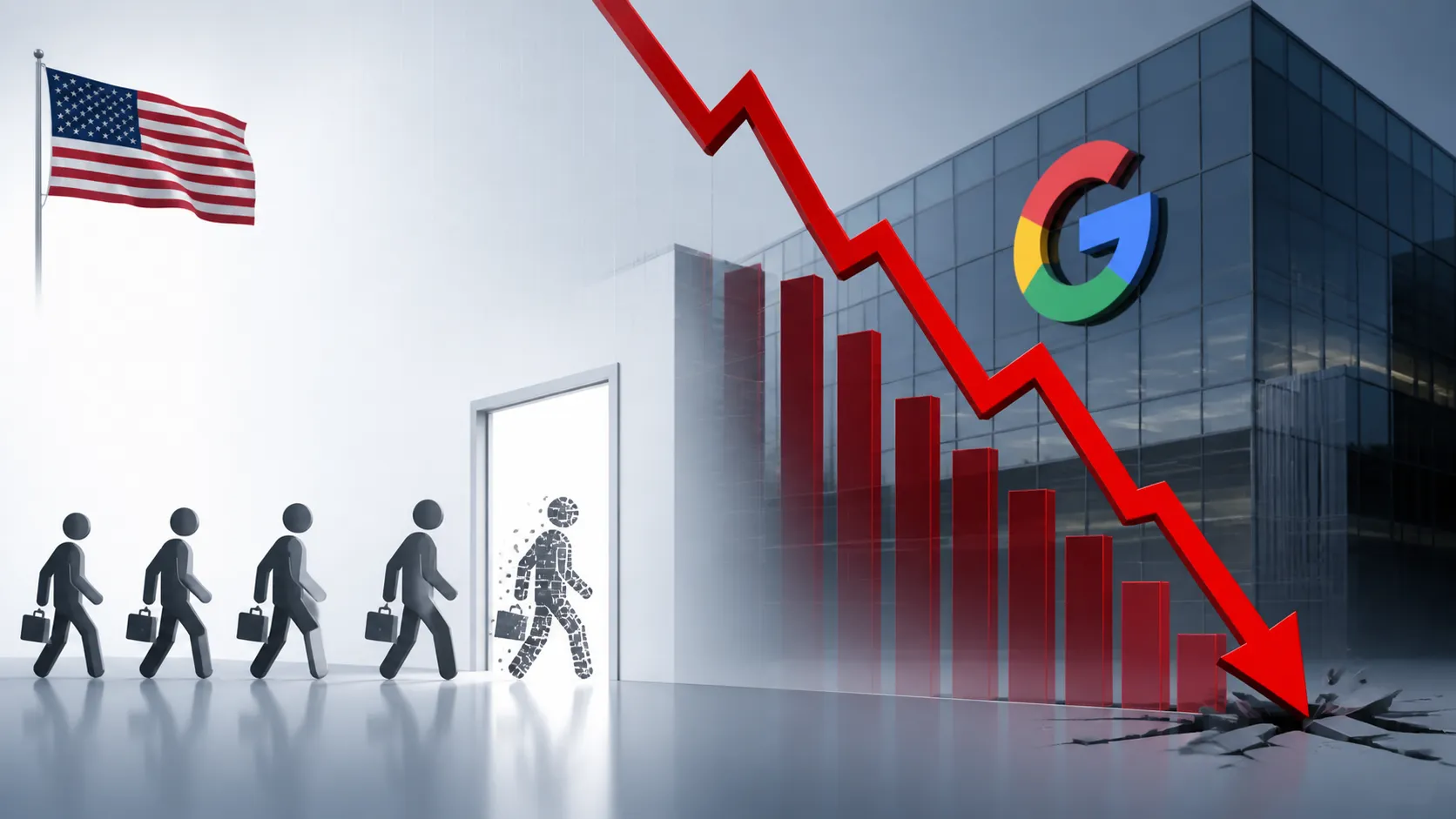
June 23, 2026, (Inside AI) — Alphabet’s stock tumbled on June 22, erasing roughly $225 billion in market value, after two top AI researchers departed for rivals. The sell-off, a 7% intraday drop that closed down 5%, marked the company’s steepest one-day percentage decline in over a year and its largest single-day market-cap loss ever, according to MarketWatch.
The exits of Noam Shazeer, co-lead of Gemini, and John Jumper, a Nobel laureate who led the AlphaFold team, have intensified concerns about Alphabet’s ability to retain elite AI talent. Shazeer joined OpenAI, while Jumper announced on June 19 that he is moving to Anthropic after nearly nine years at DeepMind.
Jumper, who won the 2024 Nobel Prize in Chemistry alongside Demis Hassabis and David Baker, posted on X:
“After nearly 9 years, I have decided to leave Google DeepMind and join Anthropic (after taking some time to recharge). I am incredibly grateful for my time…”
He credited Hassabis for trusting him to lead AlphaFold just six months after his PhD, adding, “The entire GDM team taught me so much about how to do great science. GDM is a special place, and I’ll still be excited to hear about what amazing things they discover next.”
The departures strike at two pillars of Google’s AI strategy. Shazeer is renowned for his seminal work on the transformer architecture, while Jumper pioneered the use of AI for scientific discovery, notably AlphaFold’s breakthrough in predicting protein structures.
A Google spokesperson told Business Insider that AI talent is a competitive space and the company remains confident in its ability to attract and retain people, including from rivals. Yet the market reaction suggests investors see a deeper vulnerability. The sell-off was not solely due to the resignations, but the timing amplified existing fears about a talent exodus.
These exits follow a pattern of high-profile moves. Shazeer’s departure to OpenAI came days before Jumper’s announcement, underscoring the fierce competition for researchers who specialize in model architecture, scientific AI, and training strategy. The rise of well-funded labs like OpenAI and Anthropic has multiplied opportunities for top-tier talent.
Despite the losses, Google DeepMind remains one of the world’s most advanced AI labs, employing thousands of researchers across Search, Android, YouTube, and Cloud. Alphabet also has a structural advantage: its profitable businesses can fund years of infrastructure investment without relying on external capital rounds, unlike its rivals.
Still, the talent war is intensifying. As one expert noted, the AI race is fundamentally a talent race, with countries like China outpacing the US in researcher numbers. For Google, retaining its stars may prove as critical as any technical breakthrough.