July 5, 2026, (Inside AI) — The global banking industry is navigating two simultaneous AI races that will define its future, according to Jane Fraser, CEO of Citi, the third-largest U.S. bank. In an interview with the South China Morning Post, Fraser outlined a dual imperative: harnessing AI for revenue growth while defending the financial ecosystem against escalating cyber threats.
Fraser’s comments come as banks worldwide invest billions in AI, with McKinsey estimating the technology could add up to $340 billion annually to the sector’s value. Yet this promise is shadowed by a surge in AI-powered fraud. A 2026 Federal Reserve report noted a 40% year-over-year increase in synthetic identity fraud, often driven by generative AI.
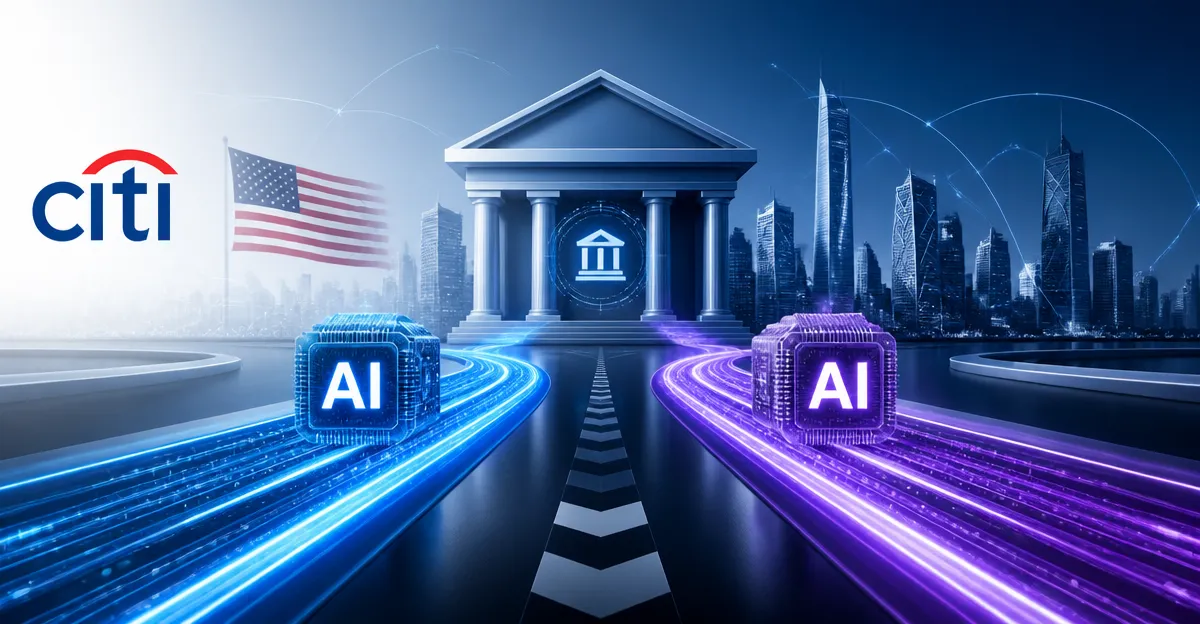
“There are two races in AI at the moment,” Fraser said. “One is to apply AI to the business models, which we all have to do as that will help drive revenue growth.”
She detailed how AI is compressing product development cycles and unlocking new revenue streams. At Citi, machine learning models now analyze transaction data to personalize offers in real time. The bank reported a 15% uptick in credit card conversions from AI-driven campaigns in its latest quarterly filing.
Fraser also highlighted operational gains: “There are a lot of different elements of it that are helping drive growth,” she said, adding that AI was helping to “make the bank more efficient and make customer service better.”
Citi’s internal chatbots, for instance, handle over 2 million customer queries monthly, resolving 80% without human intervention. This mirrors an industry trend—JPMorgan Chase claims its AI saves 360,000 hours of manual work annually.
The second race, Fraser stressed, is defensive. “These AI models are very powerful, and our job is to make sure the financial system, the bank, our customers and the ecosystem we operate in are secure,” she said.
This reflects a growing arms race. The Financial Stability Board warned in 2025 that adversarial AI could manipulate market data or bypass biometric security. Citi has responded by deploying adversarial training for its fraud detection models and joining the FS-ISAC threat-sharing consortium.
Fraser acknowledged AI’s impact on jobs, noting that while some roles will be displaced, new ones will emerge—though the transition may be uneven. This aligns with a 2026 World Economic Forum report projecting that AI will create 12 million more jobs than it eliminates by 2030, but retraining remains a bottleneck.
Competing viewpoints exist. Goldman Sachs CEO David Solomon recently cautioned that AI’s revenue impact is “years away” for most banks, while Bank of America has been more bullish, citing $4 billion in annual tech savings. Fraser’s dual-race framing underscores a strategic divide: offensive versus defensive AI priorities.
Historically, banking has weathered tech shifts—from ATMs to online banking—each time adapting rather than collapsing. Yet the speed of generative AI, exemplified by models like GPT-4, compresses timelines. Citi’s own 2025 AI ethics framework, publicly available, mandates human oversight for high-stakes decisions, a nod to regulatory pressure.
What’s missing from Fraser’s narrative is the regulatory dimension. The EU AI Act, fully enforced in 2026, classifies credit scoring as high-risk, requiring transparency. In the U.S., the OCC has yet to issue binding AI rules, leaving banks to self-regulate. This patchwork could slow the first race while complicating the second.
Looking ahead, Citi plans to expand its AI workforce by 20% this year, focusing on cybersecurity and data science. Fraser’s vision, while optimistic, hinges on execution—and the industry’s ability to outrun both competitors and criminals in the AI era.