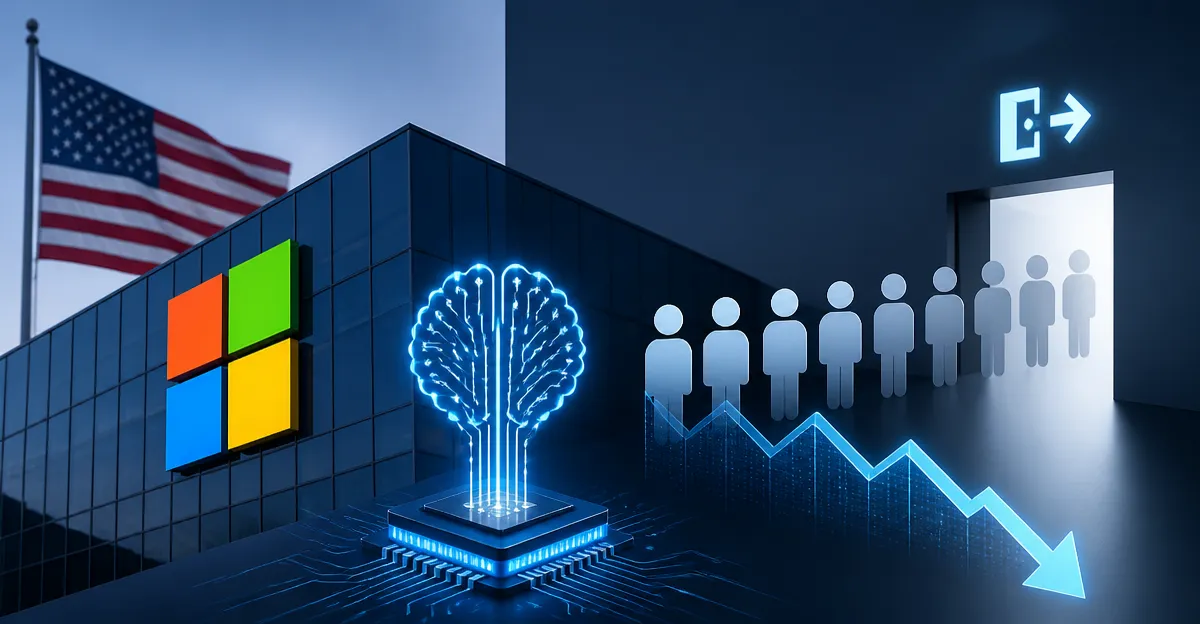
July 6, 2026, (Inside AI) — Microsoft is laying off roughly 4,800 employees, or 2.1% of its workforce, joining a mounting wave of tech industry cuts driven by massive artificial intelligence investments and efficiency drives. The reductions were announced Monday after a punishing first half that saw shares tumble nearly 23%, their worst start since 2022.
The layoffs land as Big Tech’s historic AI spending spree—projected to exceed $700 billion this year—intensifies pressure to deliver returns. Amazon and Meta have already slashed thousands of jobs in 2026, signaling a sector-wide reckoning over ballooning costs.
Microsoft’s move follows an earlier voluntary buyout offer to about 7% of its U.S. staff, roughly 9,000 employees. The company routinely trims headcount near its June fiscal year-end, but the scale reflects deeper strains. While AI demand has supercharged Azure cloud growth—Microsoft was OpenAI’s exclusive model seller until April—the capital required for data centers is squeezing cash flows.
In April, the company forecast Azure revenue above Wall Street targets but also dropped a staggering $190 billion spending projection for 2026, far exceeding expectations. That outlay is fueling a double-edged sword: AI tools that automate routine tasks now threaten Microsoft’s own lucrative software business, while memory chip price surges—driven by data center demand—forced Xbox console price hikes amid already soft sales.
Gaming division head Asha Sharma last month declared the business needed a “reset,” revealing profit margins had dwindled to 3%. In a blunt memo published on Microsoft’s site, she wrote:
“Excluding Activision Blizzard King, over the past five years, we have spent over $20 billion on ongoing investments in our content, platform and hardware subsidy, but our annual revenue has declined nearly half a billion during that time. Going forward, this cannot continue.”
The Information reported Microsoft is weighing options for Xbox, including a spinoff or restructuring as a wholly owned subsidiary. The gaming unit’s struggles highlight how AI’s ripple effects are reshaping even non-cloud segments.
The AI Spending Paradox
Microsoft’s cuts mirror a broader industry paradox: AI promises efficiency but demands unprecedented upfront investment. The $700 billion Big Tech outlay this year rivals the GDP of mid-sized nations, yet returns remain elusive. Amazon’s layoffs earlier in 2026 targeted Alexa and cloud teams, while Meta slashed roles in Reality Labs and infrastructure groups.
Analysts note that AI-driven automation is cannibalizing traditional software revenue. Microsoft’s Office and Windows divisions, long cash cows, face disruption from generative AI tools that reduce the need for full-featured suites. Meanwhile, Azure’s AI workload margins are thinner than legacy cloud services, given the compute intensity of training and inference.
Memory chip dynamics add another layer. Data center GPU demand has sent high-bandwidth memory prices soaring, inflating hardware costs across Microsoft’s product lines. The Xbox price increase, announced in May, was a direct response—but it collided with a console market already in decline, as gamers shift to cloud streaming and mobile.
Historical Echoes and Future Shifts
This isn’t Microsoft’s first post-acquisition reckoning. After the 2014 Nokia deal, it wrote off $7.6 billion and cut 7,800 jobs. The Activision Blizzard purchase, closed in 2023 for $69 billion, was meant to bolster gaming—yet Sharma’s memo suggests the integration has yet to yield sustainable margins. The $20 billion spent on content and hardware over five years, excluding Activision, underscores a structural challenge.
Competing viewpoints emerge. Some analysts argue the layoffs are prudent rebalancing, not distress. Microsoft’s overall headcount still grew 12% year-over-year before the cuts, fueled by AI hiring. Others see a warning: if Azure’s AI growth can’t offset legacy declines and Xbox losses, the $190 billion capex could become a millstone. The company’s upcoming earnings report will be scrutinized for clues on whether AI revenue is accelerating fast enough.
What’s missing from the narrative is the human toll. Microsoft’s buyout offer to 9,000 U.S. employees earlier this year signaled a softer approach, but the latest cuts are involuntary. As AI reshapes workflows, reskilling programs remain underfunded across the industry. Microsoft has pledged to train 10 million people in digital skills by 2025, but the pace of displacement is outstripping those efforts.
Looking ahead, the Xbox decision looms large. A spinoff could unlock value but would sever a key consumer touchpoint. A subsidiary structure might preserve synergies while insulating the parent from margin pressure. Either way, the gaming reset will test CEO Satya Nadella’s willingness to prune non-core assets. For now, the layoffs confirm that even AI’s biggest beneficiaries must cut deep to fund the future.