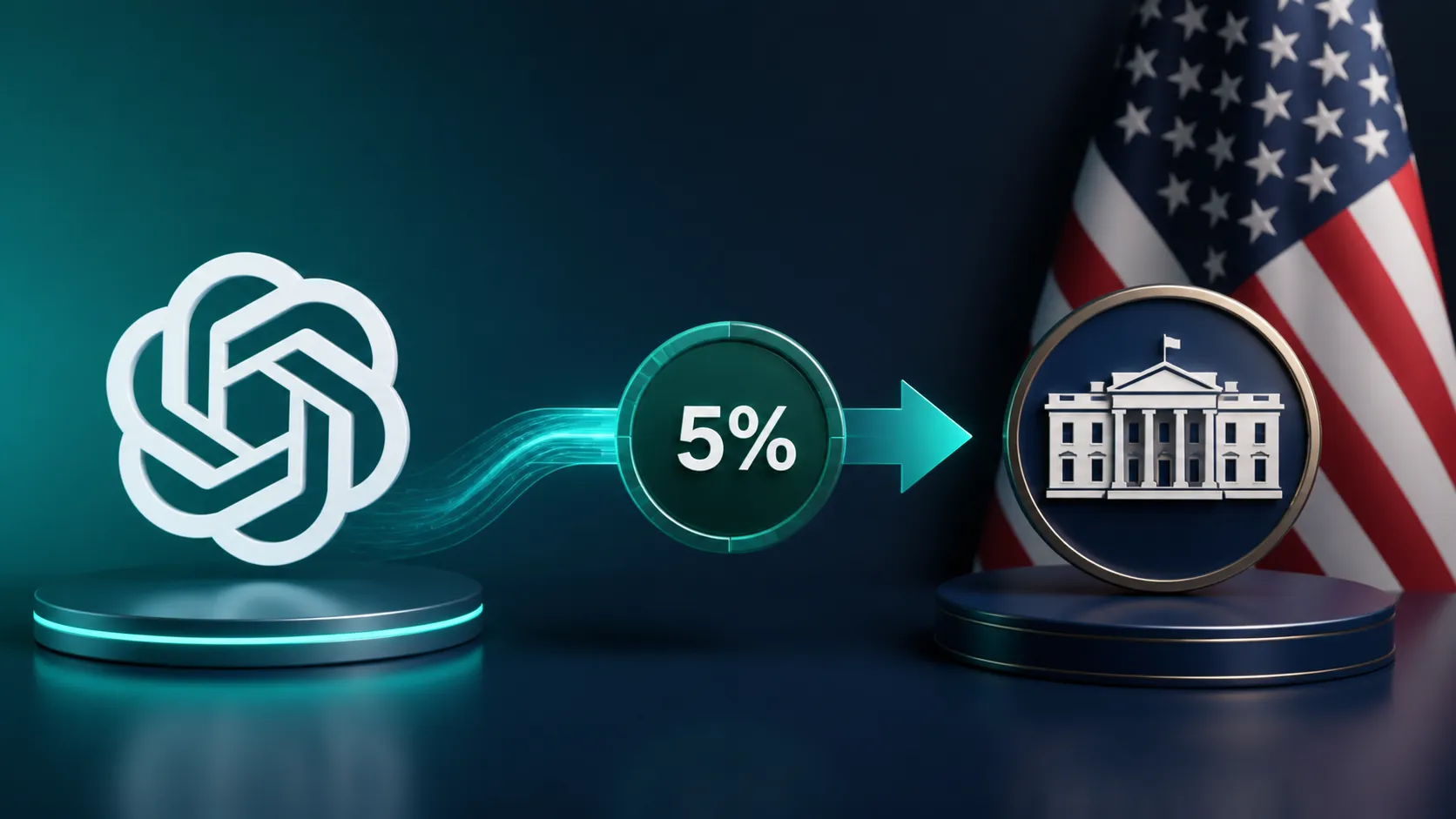
July 2, 2026, (Inside AI) — OpenAI has discussed handing a 5% equity stake to the U.S. government, according to a report by the Financial Times published Thursday. The proposal would require other American AI firms to contribute a similar stake, though their willingness remains uncertain.
The talks signal an extraordinary step toward formalizing the relationship between leading AI developers and the state. Sources familiar with the discussions told the FT that the plan is still in early stages, with no final agreement reached. OpenAI and the White House did not immediately respond to requests for comment.
A Stake in the Future: Why Equity, Not Regulation?
The 5% figure is not arbitrary. It mirrors the equity stakes that major investors like Microsoft hold in OpenAI’s for-profit arm. By seeking a direct ownership position, the Trump administration appears to be pursuing influence through financial entanglement rather than traditional regulatory oversight.
The proposal comes as Washington grapples with how to govern artificial intelligence without stifling innovation. An equity stake would give the government a seat at the table—perhaps literally—inside the companies building the most powerful AI systems. This could allow real-time insight into safety practices, strategic decisions, and resource allocation.
Yet the move raises immediate legal and ethical questions. Can the government hold equity in private companies without creating conflicts of interest? How would classified national security concerns be balanced against fiduciary duties to other shareholders? These tensions are not new: the government’s bailout of General Motors in 2009 involved a temporary equity stake, but that was a rescue, not a strategic investment in a thriving sector.
For OpenAI, the calculus is complex. The company has long positioned itself as a responsible steward of artificial general intelligence. Accepting government ownership could bolster its public-interest credentials. But it might also alienate commercial partners and international customers wary of U.S. government influence.
The Industry’s Dilemma: Collective Action or Competitive Disadvantage?
The FT report notes that the plan would involve multiple U.S. AI companies handing over similar stakes. This collective approach is critical—if only one firm participates, it could be seen as a de facto national champion, distorting competition. But getting rivals like Anthropic, Google DeepMind, or Meta to agree is a tall order.
Each company has a distinct corporate structure and risk appetite. Anthropic, a public benefit corporation, might find alignment easier than a publicly traded giant like Google. Meta, which open-sources many of its models, could argue that transparency already serves the public interest without government equity.
Historical parallels are scarce. The closest analogue might be the Committee on Foreign Investment in the United States (CFIUS), which reviews foreign acquisitions for national security risks. But CFIUS is a gatekeeper; an equity stake would make the government an active participant. Some legal scholars have floated the idea of a “public interest board seat” for critical technologies, but no formal framework exists.
What’s missing from the FT’s account is detail on valuation. A 5% stake in OpenAI—last valued at $300 billion in a tender offer—would be worth $15 billion. The government would need to pay fair market value, or the transaction could be challenged as an unconstitutional taking. Congress would likely need to appropriate funds, adding a political dimension.
Beyond the financials, the proposal could reshape global AI governance. If the U.S. government becomes a shareholder, it may push for export controls or data localization requirements that align with national interests. Competitors in China and Europe would likely respond with their own state-backed initiatives, accelerating a fragmentation of the AI landscape.
For now, the talks remain preliminary. But the very fact that OpenAI is entertaining such a discussion underscores the growing recognition that AI is too consequential to be left to market forces alone. Whether this leads to a new model of public-private partnership or collapses under its own complexity remains to be seen.