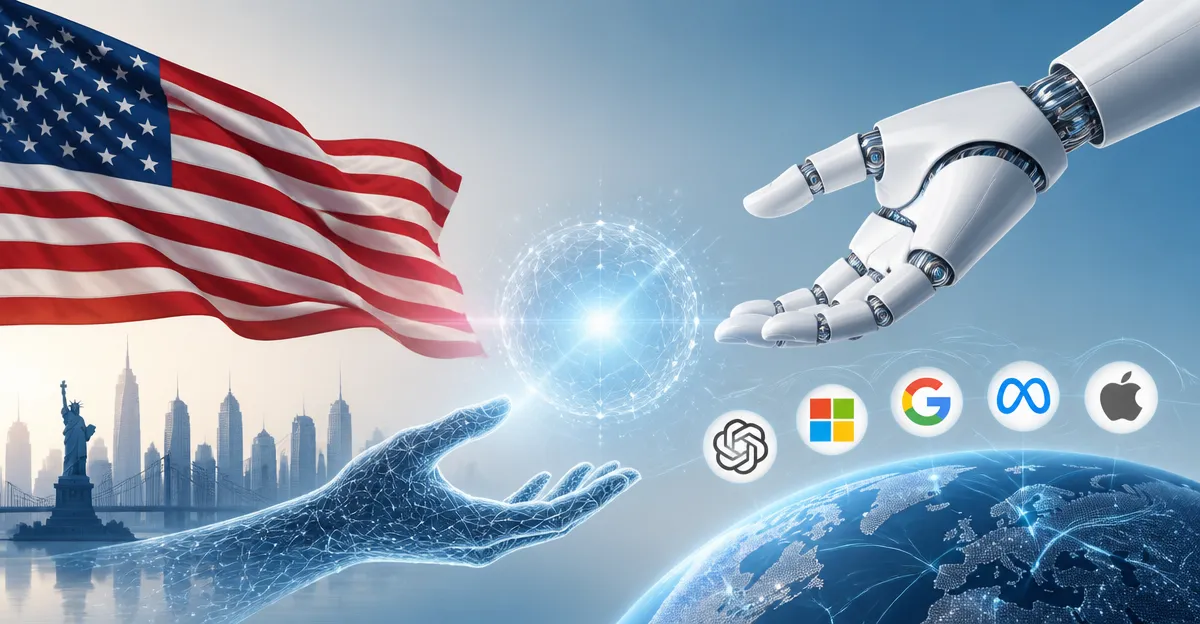
July 6, 2026, (Inside AI) — As the United States marks 250 years of independence, a prominent voice from the tech world is calling for a fundamental shift in how the nation approaches its global role in the age of artificial intelligence. Sam Pitroda, a telecom inventor and entrepreneur with five decades in IT, argues that America must lead not through dominance but through a renewed spirit of generosity, leveraging AI to uplift all of humanity.
Pitroda, who arrived in the US from India 62 years ago, credits the country with giving him education, opportunity, and freedom. In a reflective piece, he writes that America’s true greatness lies not in its military or economic might but in its optimism, openness, and innovative spirit. These qualities, he suggests, are exactly what the world needs as AI reshapes every facet of society.
“America helped invent the modern world,” Pitroda notes, citing breakthroughs from electricity to the internet. He points to the post-World War II era, when the US rebuilt Europe and Japan through the Marshall Plan, as a model of moral imagination. “Rather than celebrating victory, it helped rebuild Europe and Japan. It invested in alliances, institutions and understood that a stronger world would also make America stronger.”
But Pitroda is candid about America’s flaws, referencing colonization, slavery, and inequality. He frames the nation’s genius as its capacity for self-renewal and confrontation with its contradictions. Today, he sees a similar inflection point, with AI, climate change, and democratic erosion demanding collective action. “No nation can solve these problems alone,” he warns.
Read: US and China’s Outdated AI Arms Race Mindset Ignores the Real Bottleneck
Central to his argument is a rejection of framing the future solely as a competition with China. While acknowledging the rivalry, Pitroda insists that America’s exceptionalism was never rooted in fear of another power. “It became exceptional because it imagined a better future,” he writes. Instead, he proposes a new American pledge centered on equal dignity, shared prosperity, and technology that serves people and the planet.
Pitroda envisions AI as a tool for global good: personal tutors for every child, remote healthcare, smarter agriculture, and more responsive governments. Yet he cautions that without ethical guardrails, AI could also “concentrate power, destroy trust, deepen inequality and manipulate minds.” His solution ties back to America’s founding ideals—liberty, justice, and equality—which he believes can anchor the AI age.
The Marshall Plan Blueprint for AI Leadership
Pitroda’s call echoes historical precedents where technological leadership was paired with humanitarian investment. The Marshall Plan, which funneled over $13 billion (equivalent to roughly $150 billion today) into European recovery, wasn’t just altruism—it created stable markets and allies. Similarly, the Green Revolution of the 1960s, driven by American agronomists like Norman Borlaug, averted famine in India and Mexico, demonstrating how tech transfer can yield geopolitical goodwill.
In the AI context, this could mean open-sourcing foundational models for developing nations, funding AI literacy programs globally, or establishing international AI ethics bodies. Pitroda’s own background—he led India’s telecom revolution in the 1980s—gives him unique insight into how technology can leapfrog development. His vision aligns with recent proposals from the UN’s AI Advisory Body, which advocates for a global AI fund to bridge the digital divide.
However, critics argue that such idealism clashes with current political realities. The US has increasingly restricted chip exports and AI collaborations with China, while the EU pushes its own regulatory framework. Dr. Sarah Chen, a tech policy analyst at the Brookings Institution, notes, “Generosity is noble, but it requires trust. In a world of cyber espionage and IP theft, how do you share without compromising security?” Pitroda doesn’t directly address this tension, but his emphasis on alliances and institutions suggests a multilateral approach.
From American Dream to Human Dream
Pitroda’s essay culminates in a bold reimagining of the American Dream. “The first 250 years were about building a nation,” he writes. “The next 250 should be about helping humanity dream bigger — with equal respect, equal dignity, equal opportunity and equal possibility for all.” It’s a sweeping statement that reframes patriotism as a global responsibility.
This perspective resonates with ongoing debates about AI’s dual-use nature. While companies like OpenAI and Google tout AI’s potential to solve grand challenges, watchdogs highlight risks of bias, job displacement, and surveillance. Pitroda’s call for a humane AI mirrors the “human-centered AI” movement championed by Stanford’s Fei-Fei Li and others, but adds a distinctly American moral imperative.
Read: UN’s First Scientific AI Report Urges Governments to Act Before It’s Too Late
Ultimately, Pitroda’s message is both a celebration and a challenge. As America reflects on its past, he urges it to look outward, using AI not as a weapon in a new cold war but as a bridge to a more equitable world. Whether policymakers heed this advice remains to be seen, but in an era of rising nationalism, his voice is a rare plea for enlightened self-interest.