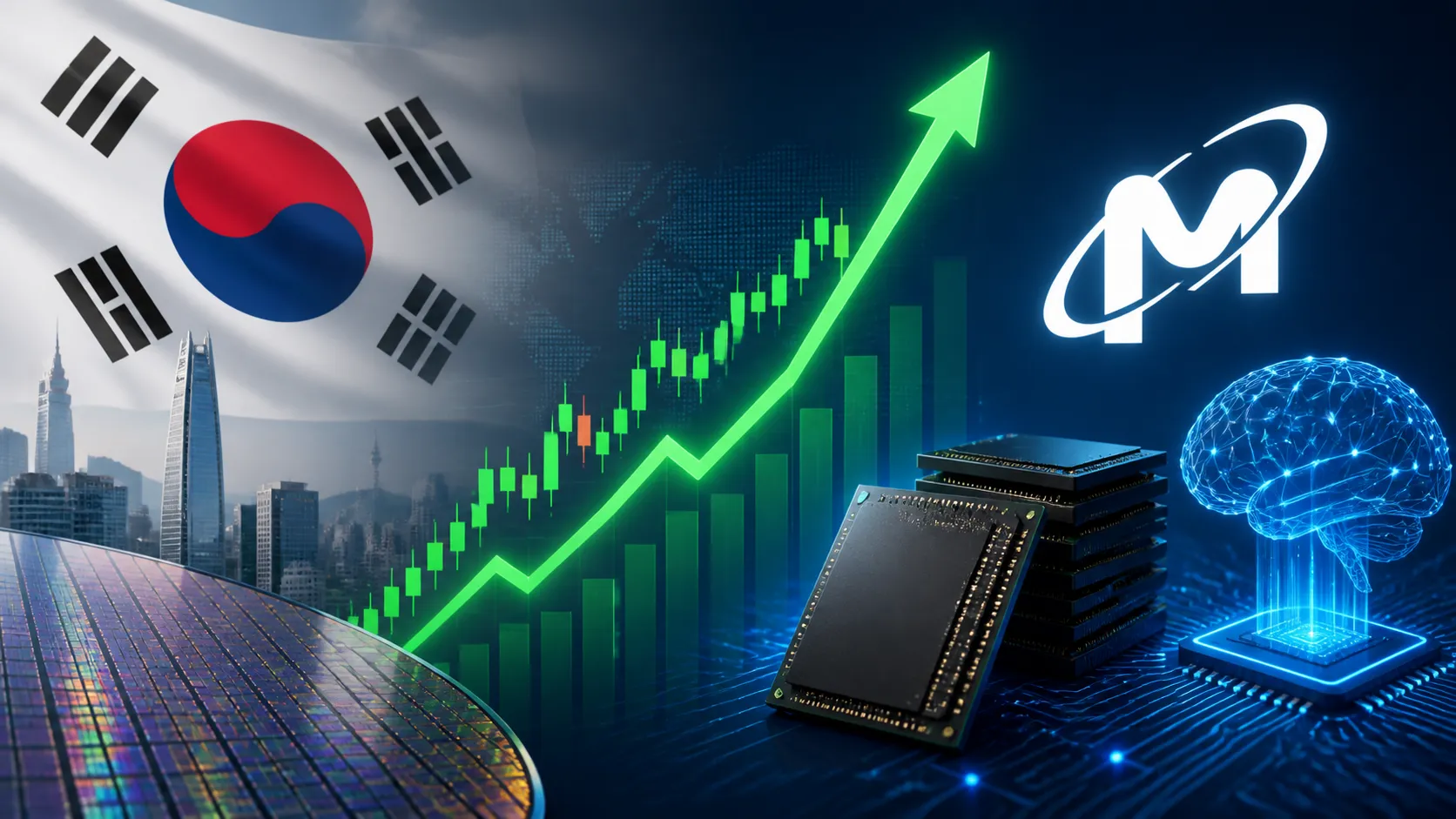
June 25, 2026, (Inside AI) — South Korean semiconductor stocks surged on Thursday after U.S. memory chipmaker Micron Technology reported quarterly results and forecasts that beat expectations, signaling robust AI-driven demand. Shares of SK Hynix jumped as much as 11.6%, while Samsung Electronics rose up to 6.2% in early trading, mirroring a rally in U.S. chip stocks.
The gains came a day after Micron, a key supplier for Nvidia’s AI processors, projected profit and revenue well above Wall Street estimates. The company disclosed that customers have committed $22 billion to secure memory chip supplies, sending its shares up 12% in after-hours trading.
The benchmark KOSPI index, heavily weighted by Samsung and SK Hynix, climbed 5.3% as of 0019 GMT. The rally also followed SK Hynix’s announcement of plans to raise up to 45.45 trillion won ($29.52 billion) through a secondary listing on Nasdaq, capitalizing on investor appetite for AI stocks.
Micron’s outlook, combined with strong forecasts from Qualcomm, added over $400 billion in market value to U.S.-listed chipmakers late Wednesday. The news revived Wall Street’s AI stock rally, which had recently lost momentum.
Industry analysts note that AI-driven shortages are reshaping the memory market, forcing large-scale data center customers to fund capacity expansion. Micron’s results highlight how the memory sector is becoming a critical bottleneck in the AI supply chain, with demand outstripping supply for high-bandwidth memory used in advanced AI systems.
The surge in South Korean chip stocks reflects their central role in the global semiconductor ecosystem. Samsung and SK Hynix together control a dominant share of the DRAM and NAND flash markets, essential for AI training and inference workloads. Their rally underscores how AI infrastructure spending is creating ripple effects across Asian markets.
Historical context reveals that memory chip cycles have often been volatile, but the current upswing is distinct. Unlike past cycles driven by consumer electronics, this boom is fueled by enterprise AI investments, which tend to be stickier and more predictable. Still, some analysts caution that geopolitical risks and potential oversupply could temper long-term gains.
SK Hynix’s Nasdaq listing plan signals its ambition to tap deeper capital pools and compete more directly with global tech giants. The move could also attract a broader investor base, but it exposes the company to heightened regulatory scrutiny and currency fluctuations.
The broader implications for the AI industry are significant. As memory becomes a strategic asset, chipmakers with advanced packaging and high-bandwidth memory capabilities will likely command premium pricing. This dynamic could accelerate consolidation and innovation in the sector.