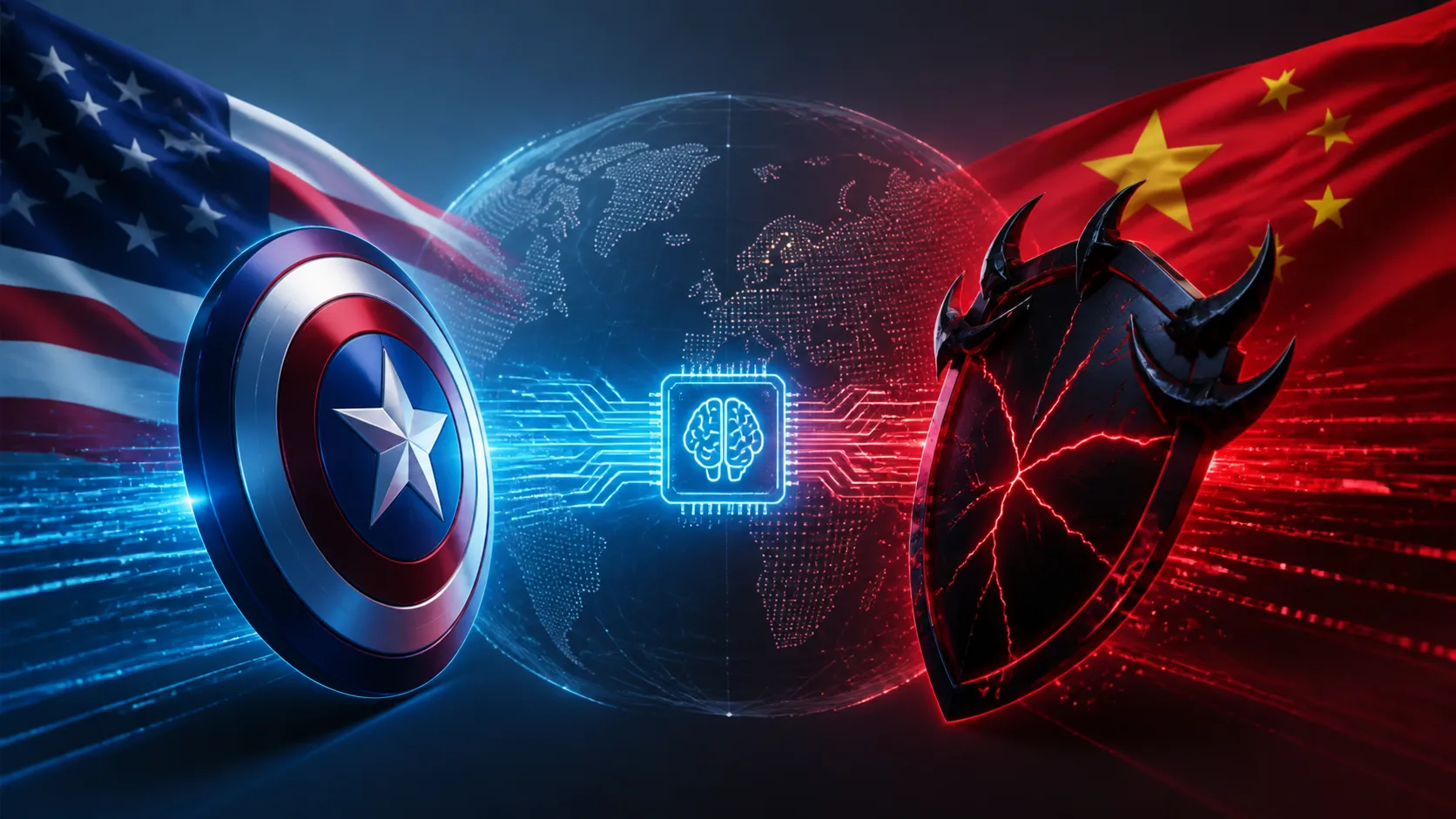
June 26, 2026, (Inside AI) — Top U.S. lawmakers framed the global artificial intelligence race in stark moral terms this week, with House Foreign Affairs Committee Chairman Brian Mast calling America the “superhero” and China the “supervillain.” The remarks, delivered at a Hudson Institute event on Thursday, came just two days after Treasury Secretary Scott Bessent warned that China surpassing the U.S. is the “biggest risk” in AI.
Senator Jim Banks, a Republican from Indiana, reinforced the urgency, stating the contest transcends economics and security. “The AI race is not just an economic race, national security race, but I think it’s a moral race for our country,” he said, adding the U.S. cannot lose to its “biggest adversary.”
The bipartisan framing at the event titled “Securing America’s AI Advantage: a Discussion on US Export Control Policy with Senator Jim Banks and Chairman Brian Mast” signals a hardening consensus in Washington. Both officials stressed that AI will define the U.S.-China relationship, with Mast likening the technology to the spider that transformed Peter Parker into Spider-Man, capable of creating either a hero or a villain based on actions taken.
The Export Control Frontier
Banks and Mast zeroed in on export controls as the primary lever to maintain U.S. dominance. The Biden administration’s October 2022 chip restrictions have been expanded under Trump, but lawmakers argue loopholes persist. Chinese firms access advanced semiconductors through third countries and cloud services, eroding the intended chokehold.
Mast urged closing these gaps, noting that AI chips are a “force multiplier” for China’s military modernization. The Commerce Department’s Bureau of Industry and Security has flagged over 50 Chinese entities for sanctions since 2019, yet enforcement remains uneven. Banks called for secondary sanctions on intermediaries, mirroring tactics used against Iran.
Bessent’s New York speech added economic weight. He cautioned that AI leadership determines future productivity and fiscal health, framing China’s state-backed AI push as a direct threat to U.S. debt sustainability. His remarks align with a Treasury report forecasting AI could widen the U.S.-China GDP gap by $2 trillion by 2030 if leadership is maintained.
Competing Narratives and Missing Pieces
Critics note the superhero-villain binary oversimplifies a complex landscape. China’s AI ethics guidelines emphasize “controllability” and alignment with socialist values, but its researchers lead in key areas like facial recognition and autonomous systems. The U.S. still dominates in foundational models and venture funding, with private AI investment hitting $67 billion in 2025 compared to China’s $12 billion.
Absent from the Hudson discussion was any mention of allied coordination beyond export controls. The EU’s AI Act and Japan’s Hiroshima Process suggest a fragmented regulatory environment that could disadvantage U.S. firms if not harmonized. Additionally, the event sidestepped domestic AI safety concerns, such as election deepfakes, which a 2025 Stanford report found had doubled year-over-year.
Banks acknowledged the race’s long arc, saying, “This is a marathon, not a sprint.” Yet the urgency in his voice reflected a timeline compressed by China’s rapid advances. The senator pointed to the People’s Liberation Army’s integration of AI into over 30 weapon systems as proof that moral stakes are not abstract.
The Hudson event ended with a closed-door briefing on classified threats, underscoring the gap between public rhetoric and operational reality. As the U.S. and China accelerate their AI ambitions, the superhero narrative may serve domestic mobilization, but its global reception remains untested.








