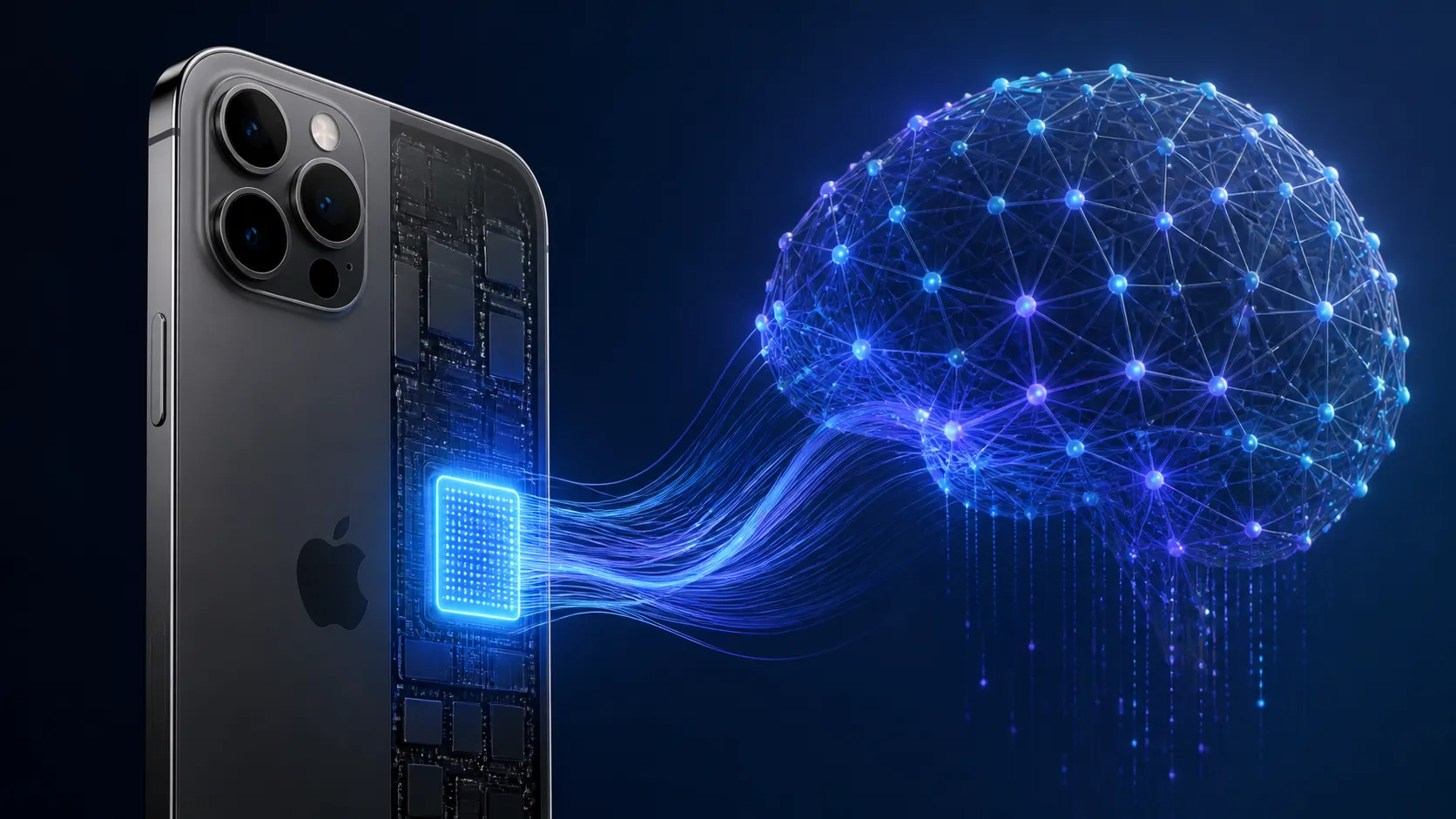
June 22, 2026, (Inside AI) — Apple has unveiled Core AI, a new on-device framework that lets iPhones, iPads, Macs, and Vision Pro run large language models up to 70 billion parameters locally, with no cloud costs and full data privacy.
The Engine Behind Apple Intelligence Goes Public
Core AI is the official successor to Core ML and the unified framework powering Apple Intelligence. It gives developers a single API to deploy generative AI across Apple silicon, automatically routing workloads across the CPU, GPU, and Neural Engine.
Apple’s blog post states the framework handles everything from 3-billion-parameter vision models to 70-billion-parameter reasoning models. A memory-safe Swift API offers zero-copy data paths and fine-grained memory control, while ahead-of-time compilation shifts heavy processing off the device for near-instant load times after caching.
How Apple Squeezed 70B Models Onto a Phone
Developers convert existing PyTorch models using the Core AI PyTorch library or use pre-optimized open-source models from Apple. Custom Metal kernels allow lower-level hardware tuning. Model compression via quantization and palettization slashes memory footprint, latency, and power draw simultaneously.
Read: Microsoft and NVIDIA Unveil RTX Spark: 1 Petaflop AI Chip for Windows PCs
The framework’s unified API eliminates manual hardware management. This abstraction lets apps tap the full power of Apple silicon without per-token cloud fees, a direct challenge to API-based AI services that charge by usage.
Three Frameworks, Three Missions
Apple clarified the division of labor among its on-device AI tools. Core ML remains for classical machine learning like decision trees and tabular feature engineering. Core AI now owns neural networks, transformers, and generative models.
MLX Swift targets researchers needing custom model weights and flexibility, though it may deliver lower performance than Core AI’s hardware-optimized pipeline. This segmentation prevents overlap and gives developers clear guidance on which tool fits their task.
Developer Reaction and Open Questions
Early community feedback notes Core AI dramatically simplifies adding high-performance LLMs to apps. However, its long-term value hinges on how quickly Apple and third-party developers expand official and community model support.
Missing from the announcement are details on battery impact during sustained inference, thermal throttling thresholds, and how the framework handles concurrent model requests. Privacy claims also need third-party audits to verify that no data leaves the device unexpectedly.
What This Means for On-Device AI
Core AI positions Apple as a leader in private, local AI inference. By removing server dependencies, it undercuts competitors relying on cloud-based models that incur recurring costs and raise data sovereignty concerns.
Read: Apple Intelligence AI Service Registered in China with Baidu and Alibaba Integration
Still, the framework’s success depends on developer adoption. If Apple can cultivate a rich ecosystem of optimized models, Core AI could redefine what users expect from mobile AI. For now, the promise of a 70B model running entirely on an iPhone marks a significant technical milestone.