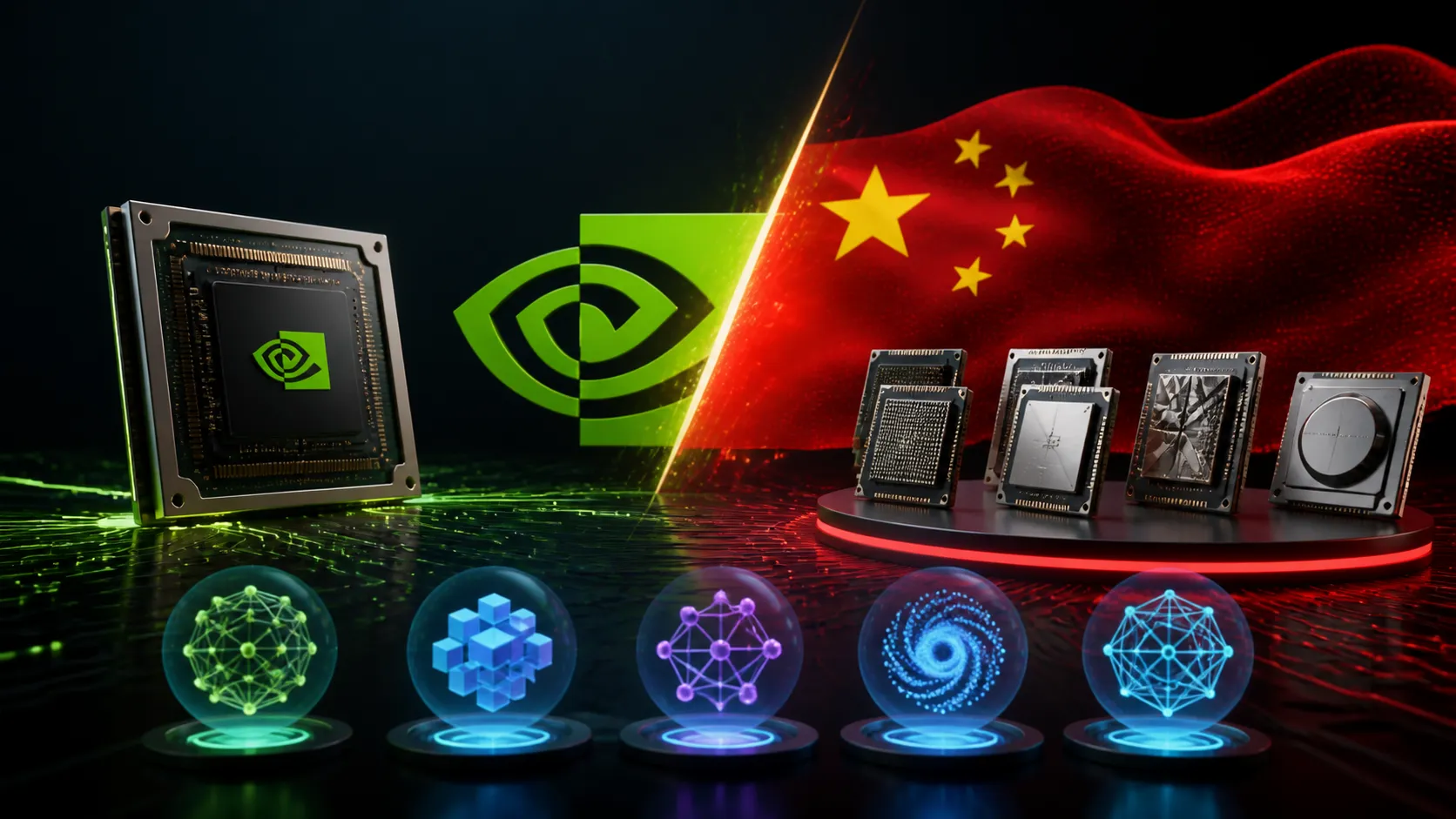
June 17, 2026, (Inside AI) — Chinese AI labs are moving early training phases onto domestic chips, a strategic pivot driven by US export controls and Beijing’s self-sufficiency push. No top Chinese model has yet been fully pre-trained on homegrown silicon, but experiments are accelerating across the AI development pipeline.
The Three-Stage Shift No One Is Talking About
AI model development splits into three distinct stages: pre-training, post-training, and inference. Pre-training is the most computationally hungry phase, where models ingest massive datasets to learn foundational patterns. Post-training fine-tunes behavior with human feedback, demanding less compute. Inference—the everyday act of running a model—is the lightest lift.
Chinese firms widely use domestic chips for inference today. But moving pre-training and post-training onto local hardware marks a new frontier. Washington’s tightening chip bans and Beijing’s self-reliance mandates are forcing labs to test indigenous alternatives in these heavier workloads.
Five Models Redrawing the Hardware Map
Multiple Chinese AI efforts now lean on domestic silicon for training. DeepSeek’s latest model used Huawei Ascend 910B chips for part of its post-training phase, according to company engineers. Baidu’s Ernie 4.0 reportedly ran early pre-training experiments on Kunlun 3 accelerators before scaling on Nvidia GPUs.
Zhipu AI’s GLM-4 completed a full pre-training run on Moore Threads MTT S4000 GPUs, though performance lagged behind Nvidia equivalents. SenseTime’s SenseNova 5.0 mixed Biren BR100 chips with legacy Nvidia hardware during post-training. iFlytek’s Spark 4.0 model used Cambricon Siyuan 590 cards for distributed pre-training trials.
These efforts remain experimental. No lab has disclosed a top-tier model trained entirely on Chinese silicon from scratch. The gap in chip performance and software ecosystem maturity still forces hybrid approaches.
Why the Ecosystem, Not Just the Chip, Decides the Race
Hardware is only half the battle. Nvidia’s CUDA platform locks in developers with a mature software stack, while Chinese chipmakers struggle with fragmented toolchains. Adapting training code for domestic GPUs often requires months of engineering work, slowing iteration cycles.
Natixis economist Gary Ng noted the long-term trade-off.
“While relying on indigenous suppliers meant Chinese AI labs may not develop as quickly and efficiently as their US counterparts, in the long run, the country was building an entire domestic AI supply chain, which was quite rare worldwide.”
That supply chain spans chip design, fabrication, and software frameworks. Companies like Huawei, Biren, and Moore Threads are racing to close the software gap with CUDA-compatible translation layers and custom compilers.
The Sanctions Backfire No One Predicted
US export controls aimed to freeze China’s AI progress. Instead, they accelerated domestic chip adoption. Before 2022, Chinese labs saw little reason to abandon Nvidia. Now, procurement risks and patriotic incentives make local chips a strategic necessity, even if performance trails.
Inference workloads already run on domestic silicon at scale—Alibaba, Tencent, and ByteDance deploy thousands of Huawei Ascend and Cambricon cards. Training shifts are harder but gaining momentum as labs accept slower progress in exchange for supply chain control.
What Comes After the Hybrid Era
Full pre-training on Chinese chips remains a milestone no one has reached publicly. But the direction is clear. As domestic GPUs improve and software ecosystems mature, the hybrid approach will tilt toward local hardware. The next generation of models—likely debuting in 2027—may cross that threshold.
For now, Chinese AI labs walk a tightrope: matching US model quality while swapping out the silicon underneath. The experiment is reshaping global AI supply chains in real time.