June 19, 2026, (Inside AI) — A new Chinese AI system is sharpening typhoon intensity forecasts as Hong Kong braces for up to seven storms this season, with some expected to explode into super typhoons under El Niño’s influence.
When Storms Surge Without Warning
The Hong Kong Observatory warns that four to seven typhoons may strike between now and October. The threat is compounded by rapid intensification, where a cyclone’s maximum sustained winds spike by 15 metres per second within 24 hours, or 10 m/s in just 12 hours. This phenomenon has long confounded meteorologists.
Recent chaos from Typhoon Jangmi, which hit Japan on June 3, forced Cathay Pacific and Hong Kong Airlines to cancel or reschedule flights. Such disruptions underscore the cost of forecasting gaps.
Why Traditional Models Fail the Intensity Test
Conventional numerical weather prediction cannot reliably track how typhoon strength evolves, according to Li, a researcher at the Shenzhen Institute of Advanced Technology (SIAT) under the Chinese Academy of Sciences. In a statement last week, she noted that statistical-dynamic methods miss the non-linear behavior of intensity changes.
“Rapid intensification rarely happens, and is highly unpredictable, making preventive measures and responses extremely likely to be delayed,” Li said.
This unpredictability leaves coastal cities vulnerable, with evacuation orders and port closures often coming too late.
Inside the AI That Learns From Chaos
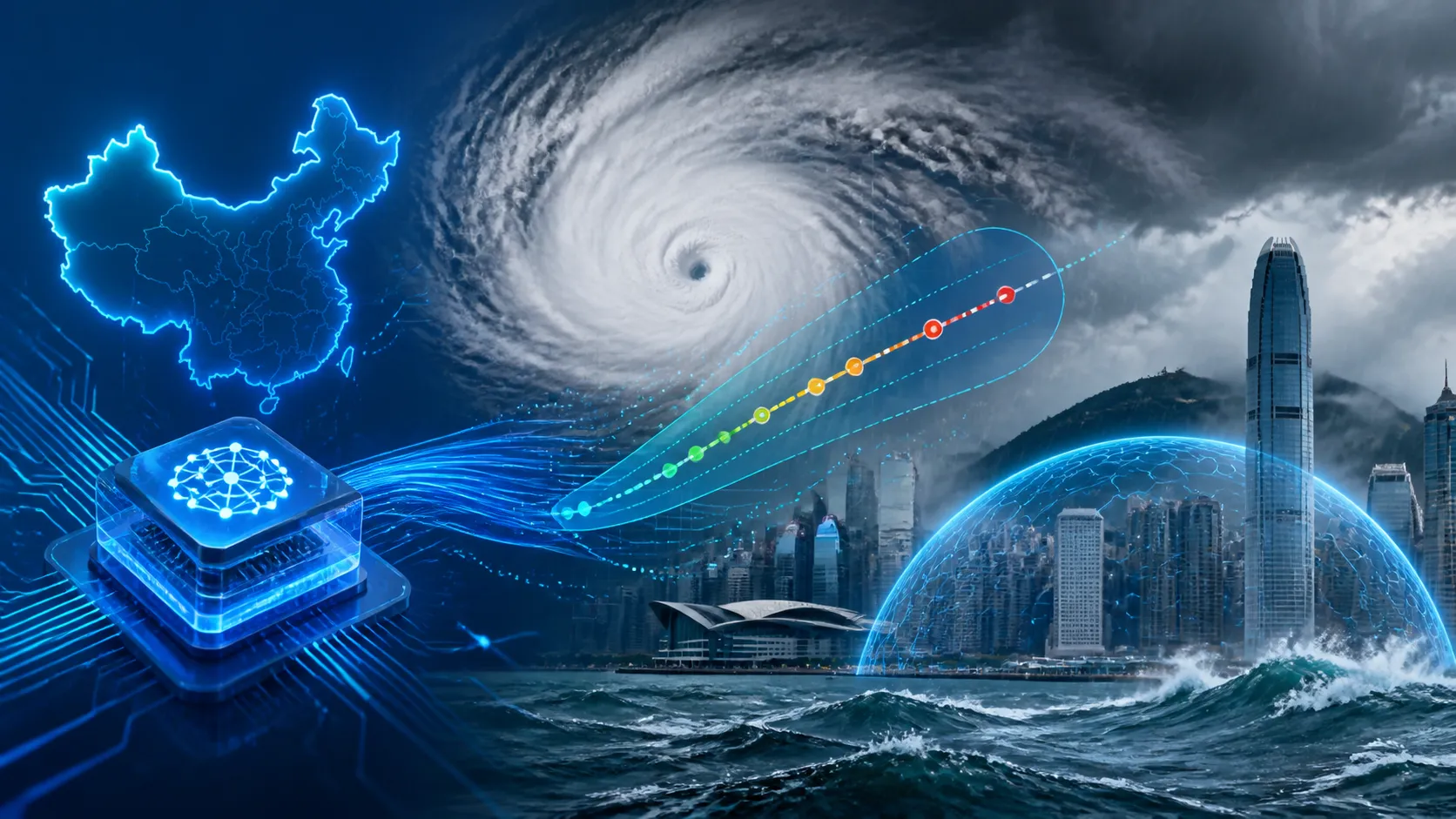
The new model uses deep learning to decode complex atmospheric patterns that older systems overlook. By training on decades of satellite and ocean data, it identifies subtle precursors to rapid intensification. Early tests show a marked improvement in forecasting accuracy, though exact metrics remain under review.
The system runs on high-performance computers at SIAT, blending real-time sensor feeds with historical storm tracks. Its neural networks detect non-linear relationships between sea surface temperatures, wind shear, and humidity that rule-based models cannot grasp.
Hong Kong’s Race Against the Clock
With El Niño warming Pacific waters, the observatory’s super typhoon warning is not theoretical. A single misjudged forecast can paralyze one of the world’s busiest ports and airports. The AI tool is being tested in parallel with existing systems, offering a second opinion that could shorten response times.
Local authorities are cautiously optimistic but stress that no model is perfect. Emergency planners still rely on layered defenses, from storm surge barriers to public alerts. Yet as climate change fuels more volatile storms, the margin for error shrinks.
What Lies Beyond This Season
Researchers plan to expand the AI’s scope to other basins, including the South China Sea, where rapid intensification is common. Collaborations with regional meteorological agencies could follow. For now, the focus is on proving reliability during the peak typhoon months.
While the technology does not replace human forecasters, it offers a critical edge. In a region where minutes matter, that edge could save lives and billions in economic losses.