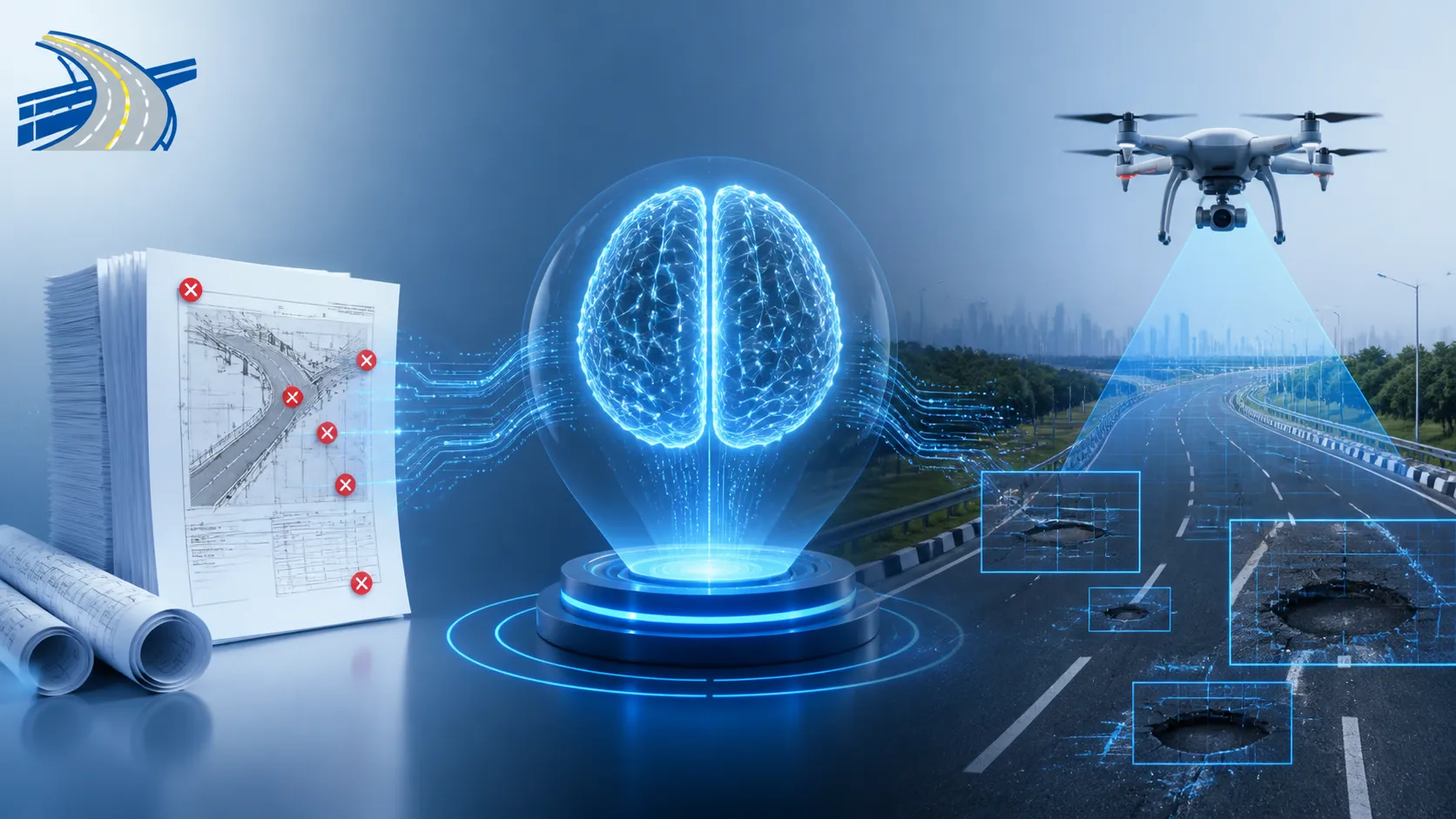
June 18, 2026, (Inside AI) — The National Highways Authority of India has deployed an in-house AI system to scrutinize Detailed Project Reports for errors and identify road defects from uploaded images. The tool, built on NHAI’s own document repository, does not access the open internet.
The Core Problem: Faulty DPRs and Overwhelmed Engineers
Faulty DPRs have long plagued highway projects, leading to cost overruns and delays. Union Minister Nitin Gadkari has repeatedly blamed poor civil engineers and substandard DPRs for rising road accidents. NHAI Chairman Santosh Kumar Yadav noted that a Rs. 2,000 crore project often sees variations of Rs. 200–300 crore due to DPR errors.
Last year’s workflow study revealed project directors and regional officers spent excessive time on tasks AI could handle. The new system aims to free them for higher-value work.
How the AI Works: A Closed-Loop Technical Analyzer
The system includes a Technical Schedule Analyzer that reviews DPR’s Schedule B and C documents—core annexures defining a project’s physical scope. It flags findings by severity and scores completeness against IRC codes, MoRTH circulars, and policy standards.
Read: Maharashtra Bets on AI
“Now, we have to just upload the DPR of any project and the AI system will find the errors against IRC codes, MoRTH and standard policy circulars. Thus, these problems can be fixed in advance,” said Yadav.
Another tool, Margsarthi, is a chat-based AI agent connected to NHAI’s datalake. A field engineer can photograph a site condition and ask Margsarthi for guideline-based next steps. It maps the end-to-end road construction cycle.
Early Adoption and Guarded Access
Margsarthi went live on April 18 and has handled over 50,000 queries from about 1,100 users. Over 40% of questions concerned circulars and documents. Currently, only NHAI officials have access, but Yadav said consultants and contractors will gain entry once misuse risks are mitigated.
“This system was needed because when we did the workflow study … we found that they have to be unnecessarily involved in a number of work, which can be easily done through AI tools. With this system in place, any official can check the defect of a highway by just uploading a photo,” Yadav explained.
Beyond DPRs: Tracking Meetings and Monthly Reports
Additional tools, Kick-Off and MPR Insights, track issues from kick-off meetings and monthly progress reports. They flag critical bottlenecks, surface overdue items, and provide recommended actions with direct citations to source documents.
A senior engineer noted that officials previously kept personal folders of circulars and acts, making it hard to track the vast regulatory volume. “With this system, they can get it in just one query,” he said.
Read: Google DeepMind Maps Farms
The Bigger Picture: AI as Infrastructure Gatekeeper
NHAI’s approach reflects a broader shift toward embedding AI in public infrastructure governance. By constraining the system to its own datalake, NHAI avoids hallucinations and data leakage risks common with open-internet models. The move could set a precedent for other government bodies managing large-scale projects.
As the system opens to external stakeholders, its impact on reducing arbitration and project delays will be closely watched.