July 13, 2026, (Inside AI) — A coalition of more than 200 leading economists and AI researchers, including 15 Nobel laureates and top figures from OpenAI, Anthropic, and Google DeepMind, issued an urgent joint statement on Monday, calling for immediate policy action to address the profound economic disruptions expected from artificial intelligence.
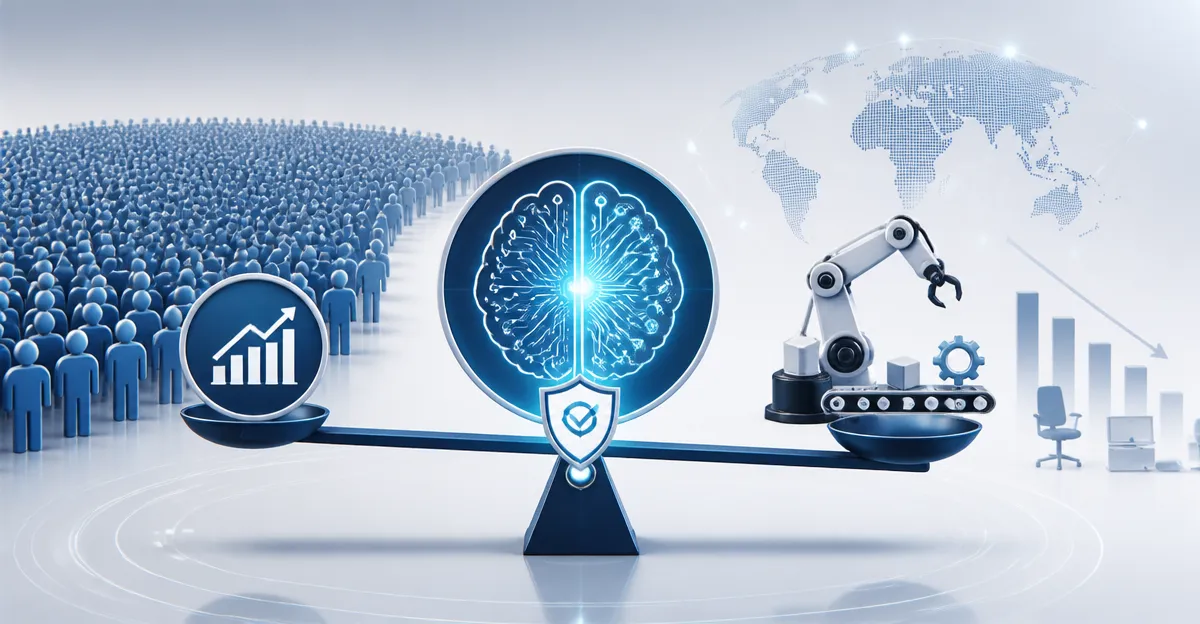
The signatories warn that AI could trigger an economic transformation larger than the Industrial Revolution, but compressed into a fraction of the time. They argue that governments and technology leaders must act now to build institutions and policies that ensure the benefits of AI are broadly shared and its risks—especially large-scale job displacement—are managed.
The statement, organized by economist Anton Korinek of the University of Virginia—who joined Anthropic's economic research team in March—along with Erik Brynjolfsson, Ajay Agrawal, and Tom Cunningham, reflects a rare consensus across academia and industry. It demands deeper research into AI's economic impacts and the rapid construction of governance frameworks.
Korinek underscored the unprecedented speed of change:
“Steam, electricity, and computers each gave societies decades to adapt. AI may give us only a few years.”
He added:
“We cannot improvise our strategy and institutions in the middle of the transformation; waiting for certainty means arriving too late.”
The signatory list bridges the often-divided worlds of AI development and economic policy. It includes OpenAI finance chief Sarah Friar, Google DeepMind Chief Scientist Jeff Dean, and Anthropic co-founder Jack Clark. Nobel laureates such as Michael Spence, Daron Acemoglu, and Simon Johnson also signed, lending weight to the call for urgent action.
Why This Warning Carries Unusual Weight
The statement's significance lies in its signatories' diversity. It is not merely an academic plea; it includes executives and researchers at the very companies building the most advanced AI systems. This alignment suggests that even those profiting from AI's rapid advance recognize the need for external governance to prevent societal backlash.
Historically, technological transitions like the Industrial Revolution unfolded over generations, allowing labor markets and social contracts to adjust gradually. The statement argues that AI's pace—driven by exponential improvements in models like GPT-5 and Claude 4—could compress similar disruptions into a single decade. This acceleration leaves no time for the trial-and-error policy approaches that characterized past eras.
The economists involved have long studied automation's effects. Daron Acemoglu and Simon Johnson, co-authors of Power and Progress, have argued that technology's benefits are not automatic; they require deliberate institutional design. Their inclusion signals a focus on steering AI toward augmenting workers rather than simply replacing them.
Yet, the statement stops short of proposing specific mechanisms. It calls for "deeper research" and "building policies and institutions," but leaves open whether that means universal basic income, job retraining programs, AI taxes, or new regulatory agencies. This vagueness may reflect the challenge of uniting such a broad coalition behind concrete prescriptions.
Competing Visions for AI's Economic Future
Not all experts agree on the urgency or the nature of the threat. Some economists, like David Autor of MIT, have argued that AI could create new types of work and enhance productivity without mass unemployment. Others point to historical patterns where technology created more jobs than it destroyed, albeit after painful transitions.
However, the statement's emphasis on the compressed timeline distinguishes this moment. Erik Brynjolfsson, a signatory and director of the Stanford Digital Economy Lab, has previously warned that the current wave of AI is different because it substitutes for cognitive tasks, not just physical ones. His research suggests that without intervention, AI could exacerbate inequality even as it boosts GDP.
The involvement of industry insiders like Jack Clark and Sarah Friar may also reflect a strategic calculation. Companies like Anthropic and OpenAI face growing regulatory scrutiny and public anxiety. By endorsing a call for proactive governance, they may hope to shape the rules rather than have them imposed abruptly.
Still, the statement's lack of binding commitments from its corporate signatories raises questions. Will these companies voluntarily slow deployment to allow for adjustment? Will they fund the transition programs they advocate? The statement does not say.
As AI capabilities advance, the window for thoughtful policy narrows. The signatories' core message is that the cost of inaction could be measured in lost livelihoods and social instability. Whether their call translates into concrete action remains to be seen, but the breadth of support suggests that the debate over AI's economic impact has entered a new, more urgent phase.