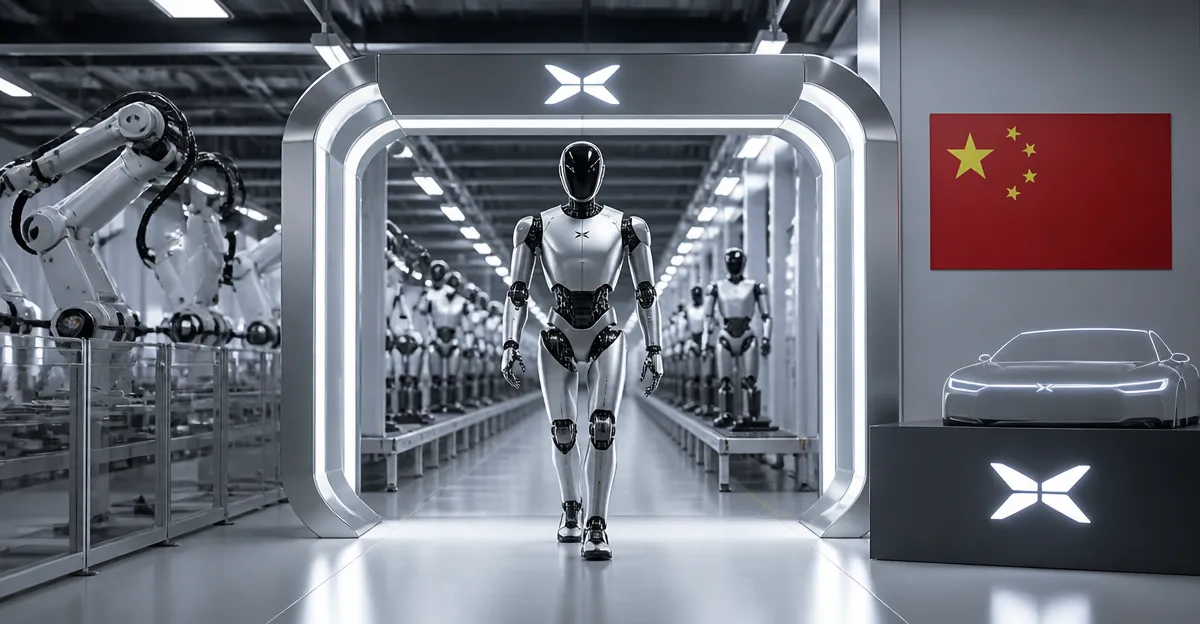
September 9, 2026, (Inside AI) — XPeng has activated an automated production line for its IRON humanoid robot. The first unit finished final assembly and walked off the line without human assistance on Tuesday.
The event signals a shift from research and development toward mass production. It also raises a practical question: can automotive manufacturing techniques truly scale for bipedal machines?
XPeng claims IRON is the world's first high-level general-purpose humanoid robot built on an automated line. The company designed and constructed the line in-house. More than 80% of core processes are automated, with quality systems adapted from automotive practices.
Humanoid robots remain in early commercialization. Most products still involve heavy manual assembly. Automated lines could improve consistency and output, but precision components and complex joints make direct automotive transfer difficult. Real efficiency and cost remain unproven.
IRON has 76 degrees of freedom, including 21 in its hands. It runs on three Turing AI chips, delivering up to 2,250 TOPS of computing power. The physical AI model runs locally, enabling perception and task execution without remote control.
XPeng positions IRON as a general-purpose platform. The roadmap targets scaled production by late 2026 and commercial deliveries in 2027. Initial use cases focus on dangerous and repetitive tasks, with broader applications to follow.
Funding momentum supports the push. XPeng's robotics unit recently raised more than $900 million at a post-money valuation above $6.3 billion. IDG Capital led the round, with Gaorong Capital participating. Tencent and Alibaba made strategic investments. XPeng Group retains control of the business.
He Xiaopeng, CEO of XPeng, said the company aims to bring humanoid robots into the real world soon. He described the goal as building products that deliver real value, not demonstration units.
"XPeng's robots would be more human-like and safer, require no remote control, support natural interaction and have their own memory," He Xiaopeng, CEO, XPeng
Industry observers note that automated assembly for humanoids is rare. Most competitors still rely on manual processes for complex joints and actuators. XPeng's approach borrows heavily from automotive manufacturing, where tolerances are tight but components are less dynamic.
The IRON robot's local AI processing is a key differentiator. Running the physical AI model on-device reduces latency and cloud dependence. This matters for real-world tasks where connectivity is unreliable or security is critical.
XPeng's robotics unit operates within a broader physical AI strategy. The company wants a unified hardware and software platform. That could allow the same robot to work in factories, warehouses, and eventually homes.
Yet scaling humanoid production is expensive. Precision actuators, sensors, and battery systems cost far more than automotive parts. Automated lines may reduce labor costs, but capital expenditure remains high. Profitability depends on volume, which has not materialized in the humanoid market.
XPeng's timeline is aggressive. Scaled production by end of 2026 leaves little room for supply chain delays. Commercial deliveries in 2027 would put XPeng ahead of many rivals, but only if quality holds.
The company's automotive background provides manufacturing expertise. However, humanoid robots require different testing protocols. Balance, grip strength, and joint wear behave differently than vehicle components. XPeng has not disclosed how it validates these factors on the automated line.
Investor interest in humanoid robotics has cooled since the 2024 hype cycle. Funding rounds now favor companies with tangible production milestones. XPeng's operational line and first autonomous walk-off provide concrete evidence, which may explain the strong valuation.
Competitors include Tesla's Optimus, Figure AI, and Unitree. None have demonstrated fully automated assembly at scale. XPeng's announcement could pressure rivals to accelerate their own manufacturing plans.
The first IRON robot walking off autonomously is symbolic. But the real test is whether the line can produce thousands of units with consistent quality. XPeng has not released yield rates, cycle times, or per-unit costs.
For now, the milestone is real. An automotive company has applied its manufacturing DNA to humanoid robots. Whether that translates into commercial success remains an open question.