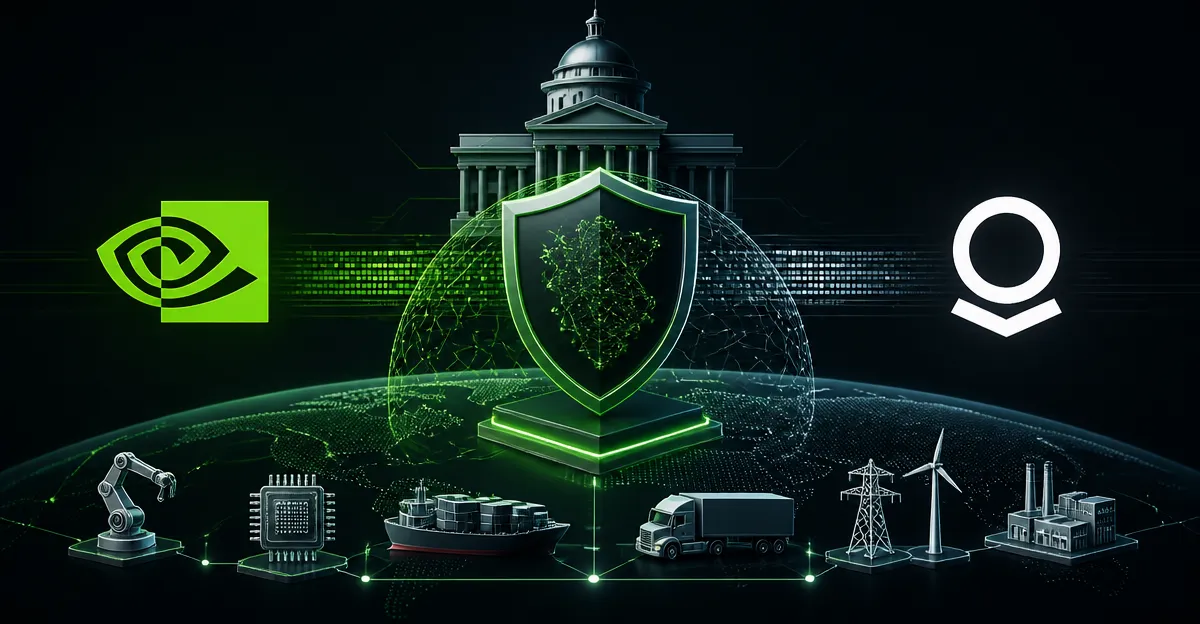
September 10, 2026, (Inside AI) — NVIDIA and Palantir Technologies have joined forces to embed sovereign AI into critical supply chain operations, starting with NVIDIA's own sprawling hardware network. The collaboration combines Palantir's Foundry and AIP platforms with custom NVIDIA Nemotron open models, grounded in Palantir's Ontology, to deliver real-time visibility, constraint detection, and machine-speed decision support.
The first deployment targets NVIDIA's supply chain, which spans millions of parts, thousands of suppliers, and a global manufacturing ecosystem. Each NVIDIA Vera Rubin rack requires coordinated availability of 1.3 million parts, including compute, memory, networking, power, cooling, and mechanical components. The AI stack aims to codify operational intelligence and accelerate the path from wafer to first token.
Organizations in agriculture, manufacturing, pharmaceuticals, retail, technology, and government can adopt the same stack through the Palantir Sovereign AI Operating System Reference Architecture (SAIOS), deployable on cloud or on-premises infrastructure. The system will be showcased at Palantir's AIPCon 11 conference.
The partnership addresses a persistent enterprise challenge: general-purpose AI models cannot capture the unique context of a company's supplier network, operating constraints, or decision criteria. By post-training NVIDIA Nemotron open models with proprietary operational data using Palantir Foundry and AIP, enterprises can build AI that reflects how their business actually operates while retaining control over models, data, and deployment environment.
NVIDIA cuOpt software unlocks optimization and scenario planning within Palantir AIP, enabling teams to model supply constraints, assess tradeoffs, and understand the operational impact of allocation decisions. Post-trained Nemotron models recommend actions, explain tradeoffs, and flag emerging risks, while human supply chain experts retain final decision authority.
Alex Karp, cofounder and CEO of Palantir Technologies, framed the deployment as a strategic advantage. "NVIDIA has arguably the most valuable, intricate and complex supply chain in the world. Our sovereign stack, powered by Nemotron models and Ontology, is delivering capabilities that exceed the frontier while providing alpha protection qualities unavailable otherwise," said Karp. "We are very proud of our partnership and its cornerstone role in the sovereign AI revolution."
Jensen Huang, founder and CEO of NVIDIA, emphasized the economic scale involved. "Supply chains are the operating system of the physical economy, and AI factories are among the most complex systems ever built," said Huang. "From wafers and components to manufacturing, systems and customer delivery, hundreds of companies and trillions of dollars of global economic activity come together to deliver AI infrastructure. NVIDIA and Palantir are transforming this vast operational graph into sovereign intelligence -- combining NVIDIA Nemotron models with Palantir's Ontology to reason, plan and orchestrate the journey from wafer to token."
The system creates a governed learning loop. Each recommendation, planner action, and production outcome feeds back into the models through Palantir Autopilot, integrated with NVIDIA NeMo AutoModel and NeMo RL libraries. This preserves operational knowledge, measures decisions against real-world results, and continuously improves specialized AI models supporting the workflow.
Why Sovereign Deployment Changes the Calculus
Sovereign AI has moved from policy debate to operational reality. Enterprises and governments increasingly demand AI systems that run on their own infrastructure, with proprietary data never leaving their control. The NVIDIA-Palantir stack directly addresses this by supporting on-premises deployment with leading system manufacturers including Cisco and Dell, or in co-location and cloud environments with Rackspace and Nebius.
This flexibility matters because supply chain data is among the most sensitive corporate information. It reveals supplier pricing, capacity constraints, inventory levels, and strategic vulnerabilities. A general-purpose cloud AI model trained on aggregated public data cannot reason about a specific company's bill of materials or allocation tradeoffs. The combination of open Nemotron models and Palantir's Ontology allows organizations to post-train models on their own operational data, creating AI that internalizes institutional knowledge without exposing it to external providers.
The deployment runs on NVIDIA reference architectures and the jointly developed SAIOS, supported by Dell Technologies and Cisco. This hardware-software alignment reduces integration friction and provides a validated path for enterprises that want to replicate NVIDIA's internal deployment.
The Feedback Loop That Rewrites Supply Chain AI
What distinguishes this stack from conventional supply chain analytics is the closed-loop learning mechanism. Traditional systems generate reports and dashboards that humans must interpret. The Palantir-NVIDIA approach creates a shared command center where AI models actively recommend allocation decisions, explain tradeoffs, and flag emerging risks. Supply chain teams evaluate alternatives faster and allocate materials based on end-to-end production impact.
The learning loop is governed, not autonomous. Supply chain experts retain control of final decisions. Each outcome, whether a successful allocation or a missed constraint, becomes training data for the next model iteration. This creates a compounding advantage: the system gets smarter with every production cycle, codifying operational expertise that would otherwise reside in individual employees' heads.
The technology arrives as AI infrastructure demand accelerates. NVIDIA's supply chain complexity has grown in lockstep with its data center ambitions. Securing supply for 1.3 million parts per rack requires coordinating hundreds of companies across the globe. The AI stack aims to reduce time of ownership, beginning with materials allocation decisions that determine how quickly parts move through the supply chain.
For enterprises watching this deployment, the message is clear: sovereign AI is no longer a theoretical option. The reference architecture, validated on one of the world's most complex supply chains, provides a template for organizations that want to turn fragmented operational data into faster, more resilient decisions without surrendering data control.