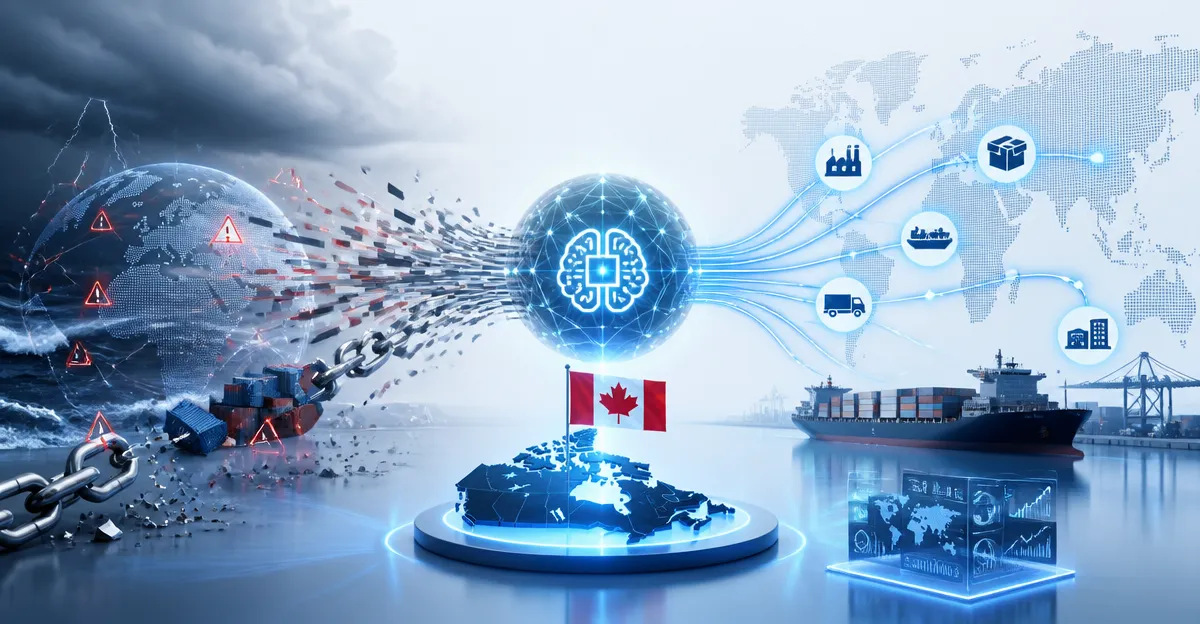
September 10, 2026, (Inside AI) — A Canadian software firm is seeing a surge in demand for its AI-driven supply chain platform as global disruptions force companies to rethink how they manage logistics and risk.
Kinaxis, based in Ottawa, says its Maestro platform uses predictive AI, advanced scenario modeling, and agentic AI to help businesses forecast demand, test possible outcomes, and adjust plans when conditions shift. The company reports that scenario modeling activity jumped more than 120% from pre-conflict levels during the ongoing Strait of Hormuz conflict.
The spike reflects a broader reality. Tariffs, trade disputes, regulatory changes, and military conflicts are no longer rare shocks. They are constant variables. Supply chains built on stable assumptions now need systems that can absorb change in real time.
"What customers need is to be very adaptable and very agile. And that's the way Maestro plays a very critical role," Razat Gaurav, CEO, Kinaxis.
Maestro is an orchestration platform for end-to-end supply chain management. It pulls together data from across a company, including sales orders, product information, production capacity, and inventory. It then combines that with external signals such as weather, market shifts, and breaking news.
The platform is used by automakers, technology giants, energy firms, and shipping leaders. These companies rely on it to manage complex supply chains, respond to shortages, and model the potential impact of tariffs and other disruptions.
Why Scenario Modeling Became a Boardroom Priority
Scenario modeling is not new. What has changed is the speed and scale of uncertainty. A single disruption in one region can ripple through factories, suppliers, inventory, transportation costs, and customer demand within days, not months.
Traditional planning tools often rely on historical data and linear forecasts. They struggle when the future no longer resembles the past. Agentic AI changes that by allowing systems to act on insights, not just display them. Maestro can test hundreds of scenarios and recommend adjustments without waiting for human analysis.
The Strait of Hormuz conflict is a case in point. The strait is a critical chokepoint for global oil and gas shipments. When tensions rise, shipping costs spike, routes change, and lead times stretch. Companies that can model these effects quickly can reroute inventory or shift production before competitors do.
Kinaxis has not disclosed exact revenue figures tied to the surge. But the company has positioned itself as a key player in the growing market for AI-powered supply chain software. Industry analysts note that spending on supply chain AI tools has accelerated since 2023, driven by post-pandemic disruptions and geopolitical instability.
From Reactive Fixes to Continuous Adaptation
The shift is structural. Companies are moving from reactive fixes to continuous adaptation. That requires not just better data but better orchestration across departments, suppliers, and logistics partners.
Maestro's agentic AI capabilities allow the platform to monitor conditions, flag risks, and suggest or execute changes within defined guardrails. This reduces the time between detecting a problem and acting on it.
Competing platforms from major enterprise software vendors offer similar promises. But Kinaxis has carved out a niche by focusing on concurrent planning, where demand, supply, and financial plans are updated together rather than in silos.
The company's customer base spans multiple industries. Automakers use it to manage parts shortages. Energy companies use it to model fuel distribution during conflicts. Shipping leaders use it to adjust routes when ports close or tariffs change.
For many businesses, the question is no longer whether to invest in AI for supply chains. It is how fast they can deploy it before the next disruption hits. The answer may determine who survives the decade.