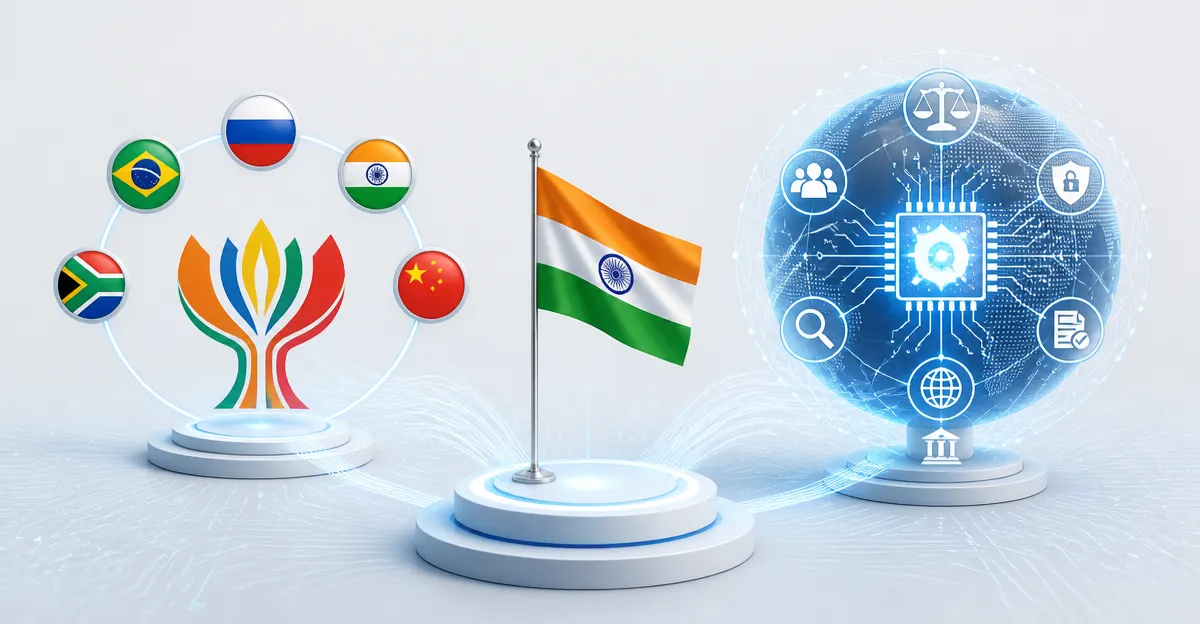
September 10, 2026, (Inside AI) — India will host the BRICS Summit in New Delhi on September 12 and 13, and a concrete proposal is on the table. Sunil Mehta and Richa Roy argue the summit should seed an International Institute for Regulatory Development (IIRD), a global apex body for AI, finance, and climate risk.
The proposal arrives after Demis Hassabis and Bill Gates both called for an AI governance institution in the six weeks before the summit. They stressed international coordination on risks across labor, finance, elections, and health. Yet neither envisioned fast-growing emerging markets as formal participants in such bodies.
That omission is the core tension. Emerging markets are massive users of AI. Their resources, data, and labor power its models. They are also most exposed to its technological, sovereign, financial, and climate risks. The IIRD is framed as a corrective, not a competitor to existing institutions.
What the IIRD Would Actually Do
The proposed body has three core functions. First, research and regulatory capacity building for early warning. A permanent secretariat would produce shared assessments of how AI and other global risks transmit through financial systems and climate exposures.
Data would come from emerging and advanced markets alike. The Financial Stability Board (FSB) is a coordinating umbrella, not a research institute. The IIRD would complement it rather than duplicate it.
Second, an exchange of practice. A living repository of what has worked. AGRORA, a project with 40 private participants including SWIFT and central banks from G7 countries plus Korea and Mexico, shows what global regulators can build together. Project Dunbar, involving central banks of Singapore, Australia, Malaysia, and South Africa, built a shared platform for digital currencies.
Third, proportionate standards. Weighted governance that reflects where growth and users are. A formal channel into the FSB, the Basel Committee, and climate and frontier-AI bodies. Standards calibrated to contexts, not transplanted from the North Atlantic regulatory construct.
Why India Is Pushing This Now
The authors first proposed an IIRD during India's 2023 G20 presidency. Three years on, AI has sharpened the argument. Andrew Bailey, chair of the FSB, warned that leverage, stretched valuations, and AI optimism could amplify a market correction across borders.
India's common law heritage, technological prowess, and Global South convening power allow for a different architecture. The BRICS Chairship is the moment to offer a third draft, with the Global South as co-creators of new rules.
Design choices are critical given geopolitical complexity. The IIRD would be seeded in Delhi but not owned by BRICS. It would be chartered as an open institution, funded by public, private, and multilateral funds. The New Development Bank would be one contributor among several.
Membership would be open to the G20, the OECD, multilateral development banks, and the FSB. The UK's forthcoming G20 presidency is noted as a suitable partner. It hosted the first AI Summit at Bletchley.
The Delhi declaration should mandate a working group, chaired by India and open to non-members. Its task is to bring an IIRD charter to the 2027 summit and present it in parallel to the G20 finance track. The goal is to institutionalize a communique.
Bretton Woods institutions originated in America and Europe for a world that no longer exists. AI governance is currently designed by a handful of companies and governments for a world that does not yet exist. Both exclude countries whose citizens will be AI's largest and most vulnerable stakeholders.
Mehta chairs the Asia Society India Centre and is former chairman of PNB, YES Bank, and IndusInd Bank. Roy is a Chevening Gurukul Fellow at the University of Oxford and partner at Cyril Amarchand Mangaldas. Views expressed are personal.