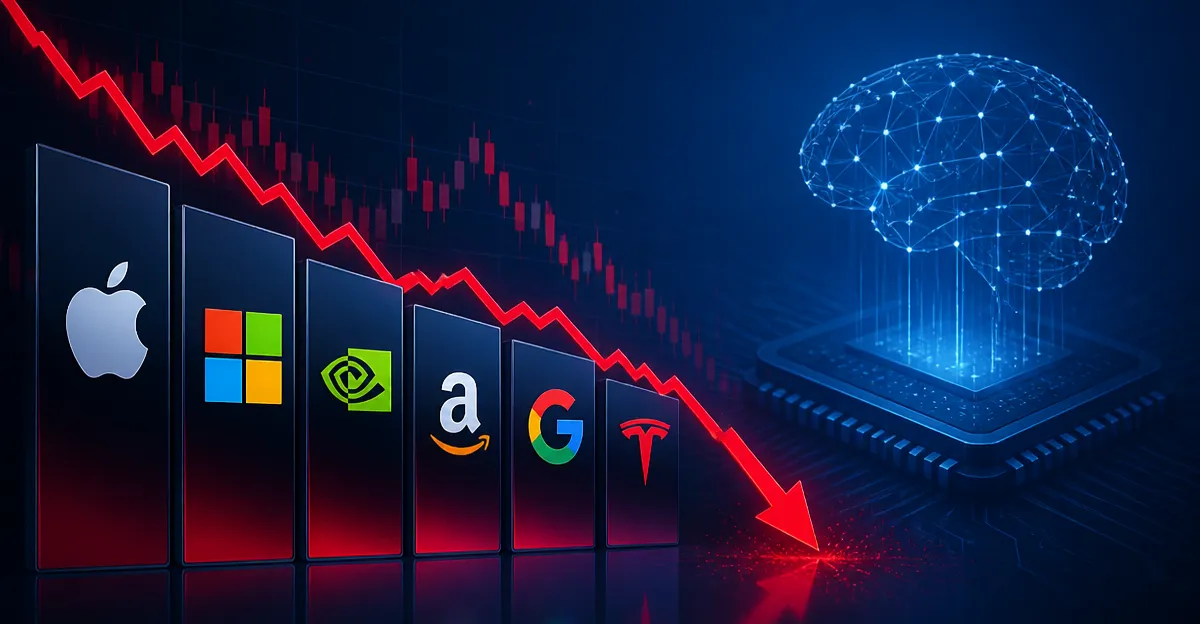
September 14, 2026, (Inside AI) — Global equity markets convulsed on Monday after Dario Amodei, chief executive of AI safety and research company Anthropic, publicly urged the artificial intelligence industry to deliberately slow the pace of its own development. The call, made over the weekend, triggered a sharp selloff in technology stocks from Asia to New York, exposing deep fractures in the investment thesis that has powered the sector's historic run.
South Korea's KOSPI index closed down 3.3%, while the tech-heavy Nasdaq in the United States fell 0.8%. Semiconductor stocks absorbed the heaviest losses, but an unusual divergence emerged: software companies rallied sharply as investors bet that a slower hardware buildout could redirect capital toward applications and services.
The reaction underscores a growing tension between the commercial imperatives of the AI boom and escalating warnings from the very executives leading it. Amodei's intervention is the latest in a series of cautions from industry leaders about the safety and sustainability of rapid AI advancement, but it is the first to visibly rattle public markets at this scale.
Analysts were divided on whether the selloff reflected genuine structural change or a temporary spasm of anxiety. Several noted that the spending commitments of major cloud providers remained intact, and that the market's reaction may have been amplified by thin liquidity and pre-existing valuation concerns.
"If people really thought that AI spending was going to come grinding to a halt, you would see stock futures much lower. You might see bond yields a bit lower than they are this morning as well," said Steve Sosnick, chief market analyst at Interactive Brokers in Greenwich, Connecticut. "If this is true and does lead to sort of a slowdown and a rethink of AI spending, that will have ramifications for the economy and some important sectors of the stock market because essentially, we've been running hot based on AI spending."
Sosnick also pointed to a telling split in the session's trading. "It's fair to ask whether this is actually occurring or not. It may buy them some time politically as well. You're seeing the spenders up. So Alphabet's up, Meta's up and Microsoft's up despite all this. Some other companies that are very reliant on that spending are down. You're seeing chips down, but I don't think anybody really thinks that this is slamming on the brakes."
The divergence between chipmakers and software firms became the day's defining feature. Dennis Dick, founder and market structure analyst at Triple D Trading in Ontario, described the rotation as unusually violent. "This is probably a hiccup more for the AI stocks as opposed to an eye-opener here. If AI starts to slow down and they put speed bumps in place, that's going to be good for the software names. We're seeing a clear sell-off in hardware names and a clear buy in some of the software names. Violent, violent rotation here this morning."
The selloff spread across asset classes and geographies. Nic Puckrin, cross-asset analyst and founder of Coin Bureau in Dubai, framed the moment as a philosophical reckoning for the market. "What's good for humanity may not be good for the AI bull market. That's the message markets are getting loud and clear this morning, after Anthropic CEO Dario Amodei called for a slowdown in AI development over the weekend."
Puckrin added that the pain would not be evenly distributed. "The interesting thing here is that it's not the frontier labs that are most affected. They may have to slow spending and postpone their IPOs, but they will still thrive. Everyone whose business is dependent on that spending going up exponentially may not be so lucky." He suggested the AI trade might not end in a dramatic crash. "The AI trade may not end with a dotcom-style crash. It may simply be a gradual slowing down of the AI arms race that's good for humanity, but bad for short-term valuations."
Not everyone accepted the premise that a slowdown was underway. Peter Andersen, founder of Andersen Capital Management in Boston, dismissed the reaction as an overreaction without evidentiary support. "It's a knee-jerk reaction and I can't see that there is any data to back it up. We are far, far away from AI taking over the world."
Andersen was blunt about the likelihood of the industry heeding Amodei's call. "I do not think there will be a slowdown. It's ridiculous to think that a handful of 30-year-olds that have at most 10 years of experience are going to slow down any of this technology." For investors with leverage, he warned of forced selling, but for others he saw opportunity. "If you're highly levered, as the stock decreases, what I would think is temporarily, their balance sheets could be under pressure and they might have to delever and potentially trim some of these stocks. But for the rest of us, it is a rare buying opportunity triggered by paranoid delusion."
Is The AI Infrastructure S-Curve Finally Bending?
Beyond the immediate market reaction, some analysts saw the episode as a natural inflection point in a maturing technology cycle. Jamie Cox, managing partner for Harris Financial Group in Richmond, Virginia, placed the moment in a broader historical pattern. "It should come as no surprise to people that we're approaching the top of the S-curve in AI infrastructure. This happens in every technology cycle. You have a period of time when infrastructure gets built and people think there's unlimited demand, so supply gets ahead of demand. At some point, supply starts to tail off even as demand is growing."
The S-curve concept, familiar from earlier technology transitions such as cloud computing and mobile telephony, describes a period of rapid adoption followed by a plateau. Cox's comment implies that the AI buildout may be entering that later phase, where returns on infrastructure investment begin to diminish even as the technology itself continues to improve.
Matthew Tuttle, chief executive of Tuttle Capital Management in Connecticut, offered a mechanical metaphor for the moment. "Three rivals now agree that the fastest engine in technology needs a governor. The market still has to learn how hard that governor will press. A governor is not an emergency brake (but) it stops an engine from running so fast that it tears itself apart."
Tuttle emphasized that the debate was not about the disappearance of demand. "The pacing trade is not about whether compute demand vanishes. It is about which demand survives a slower clock."
That distinction matters for investors trying to position themselves. If demand merely decelerates rather than collapses, the companies best insulated would be those with diversified revenue streams and software-centric business models, rather than those whose fortunes are tied directly to the volume of chips and data center capacity sold.
Still, the catalyst for the selloff remained a single executive's public statement, and some analysts cautioned against overinterpreting it. David Morrison, senior market analyst at Trade Nation in the United Kingdom, noted the speculative nature of the market's response. "It could potentially be that the next quarter we do see some kind of slowdown across Nvidia and other chip makers and hyperscalers are going to pull back on their spending and maybe these CEOs are preparing for that. They're doing some of the groundwork, and this is a good opportunity to do so. But unfortunately, this is just supposition at the moment."
Morrison's caution reflects a broader uncertainty about whether Amodei's call represents a genuine shift in industry behavior or a strategic communication aimed at regulators and the public. Anthropic has positioned itself as a safety-focused lab, and its chief executive's willingness to publicly advocate for restraint could serve multiple purposes, from shaping forthcoming legislation to differentiating the company's brand from more aggressive competitors.
The market's next test will come with quarterly earnings reports from major chipmakers and cloud providers, which will reveal whether capital expenditure plans have actually changed. For now, the trading session left more questions than answers, with hardware and software moving in opposite directions and investors forced to reconsider assumptions that had seemed settled only days earlier.