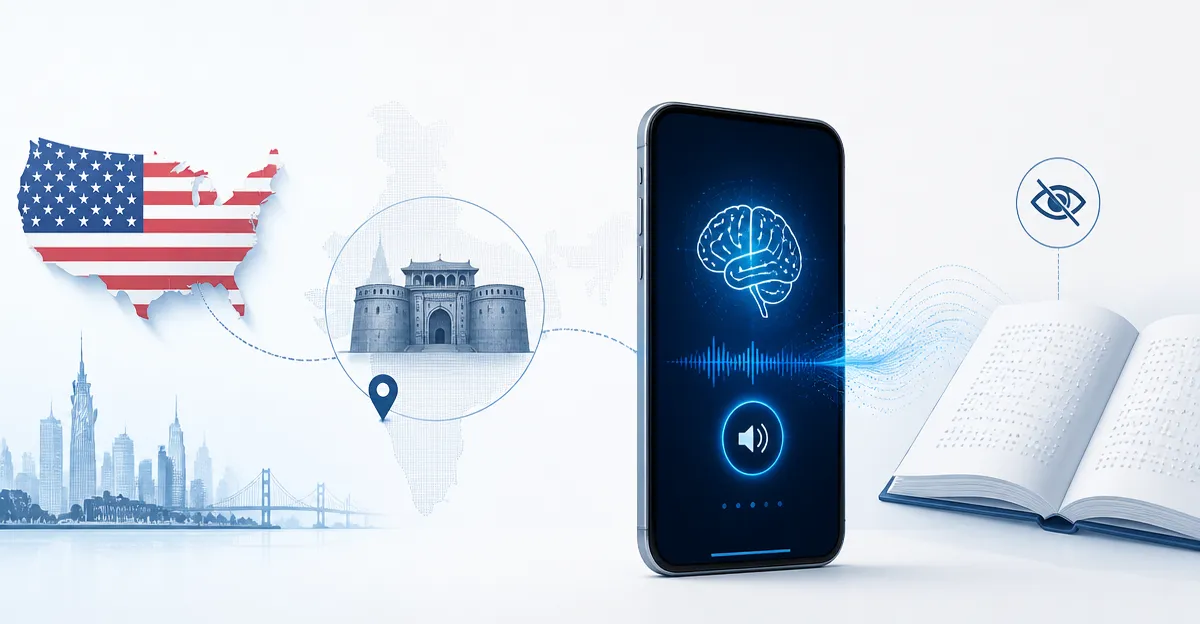
September 16, 2026, (Inside AI) — A visually impaired student in Pune, Seema Kharad, once relied on others to read her textbooks aloud. Today, she has produced 73 audiobooks from her coursework using an Android app built by a family friend in the United States. That app, ListenToMe, converts PDFs, photos, scanned documents, notices, and handwritten notes into natural-sounding audio. It also describes images, charts, and diagrams that conventional text-to-speech tools often skip.
The app launched on Google Play and the Apple App Store in late August 2026. Since then, users have processed nearly 7,000 pages of physical books and PDFs into roughly 280 hours of custom audiobooks. More than 110 registered users have joined, with 30 active creators producing 140 bespoke audiobooks.
The developer, Yogen Prashant Ghodke, graduated in Computer Science from M.E.S. Wadia College of Engineering, Pune, and earned a master's degree from the University of North Carolina at Charlotte in 2024. He built the app over three to four months while working in New York, testing it remotely with Kharad in Pune.
"I was writing code in New York, while Seema was putting the app to the test during her actual daily study routine in Pune. She would test it on actual university reference books, handwritten notes, or complex exam PDFs, and send me honest WhatsApp messages and voice notes flagging bugs and issues. I would debug the issue, rewrite the logic, and push a fix as soon as I had time," Ghodke said.
Read: Blind Egyptian Entrepreneur’s AI App Helps Sister ‘See’ the World
That iterative loop mattered. "Because I developed the software alongside an actual power user at every single step, the app avoided the blind spots that often happen when sighted developers build for visually impaired users in isolation," he added.
Kharad, a school topper in Class X and Class XII, needed higher-education reference books for her studies. Few such books exist in Braille. She depended on others to record chapters or read handwritten notes and PDFs. Her experience mirrors a broader gap: less than 10% of published books are available in accessible formats for people with print disabilities, according to the World Blind Union.
ListenToMe supports English alongside major Indian languages including Marathi, Hindi, Tamil, and Telugu. Users have also created audiobooks in Spanish, Bengali, Punjabi, and Portuguese.
"The app seamlessly supports English alongside major Indian languages like Marathi, Hindi, Tamil, and Telugu. According to Seema and her visually impaired friends, it is the only app they have found that reads Marathi books in such a natural, native cadence," Ghodke said.
Analytics show organic reach across 13 countries on five continents. India leads with 44 active users, followed by the US with 26. Together they account for roughly 84% of engagement. Students in Angola, Chile, Ethiopia, Nigeria, Germany, Ireland, the Netherlands, Indonesia, Thailand, and the Philippines also use the app.
Privacy and security were architectural priorities. "User documents are never stored long-term, never sold and never fed into public AI training datasets," Ghodke said. That stance contrasts with many mainstream AI services that retain user data or use it for model improvement. For students handling sensitive academic materials, such guarantees can influence adoption.
Read: Google Offers Free 1-Year AI Subscription to College Students in India
The app's focus on handwritten notes and diagrams addresses a known weakness in assistive tech. Most screen readers handle digital text well but fail on scanned pages or complex visuals. ListenToMe uses optical character recognition and image interpretation to bridge that gap. The result is audio that sounds natural rather than robotic, a detail that matters for long study sessions.
ListenToMe enters a market with established players like Microsoft Seeing AI, Google Lookout, and Be My Eyes. Those tools offer object recognition and scene description, but few specialize in converting full textbooks into structured audiobooks with vernacular support. Ghodke's app targets a specific niche: higher-education study material in Indian languages.
Kharad is now preparing for a PhD in Political Science. Her 73 audiobooks represent hours of independent study that would have otherwise required human readers. The app's growth remains organic, with no paid marketing. Ghodke continues to push updates from the US while users in Pune and beyond test each build.
For now, ListenToMe remains a solo project. Its trajectory will depend on whether it can scale support, maintain privacy promises, and keep pace with user feedback. But for Kharad and dozens of others, it has already turned inaccessible pages into a voice they can study with.