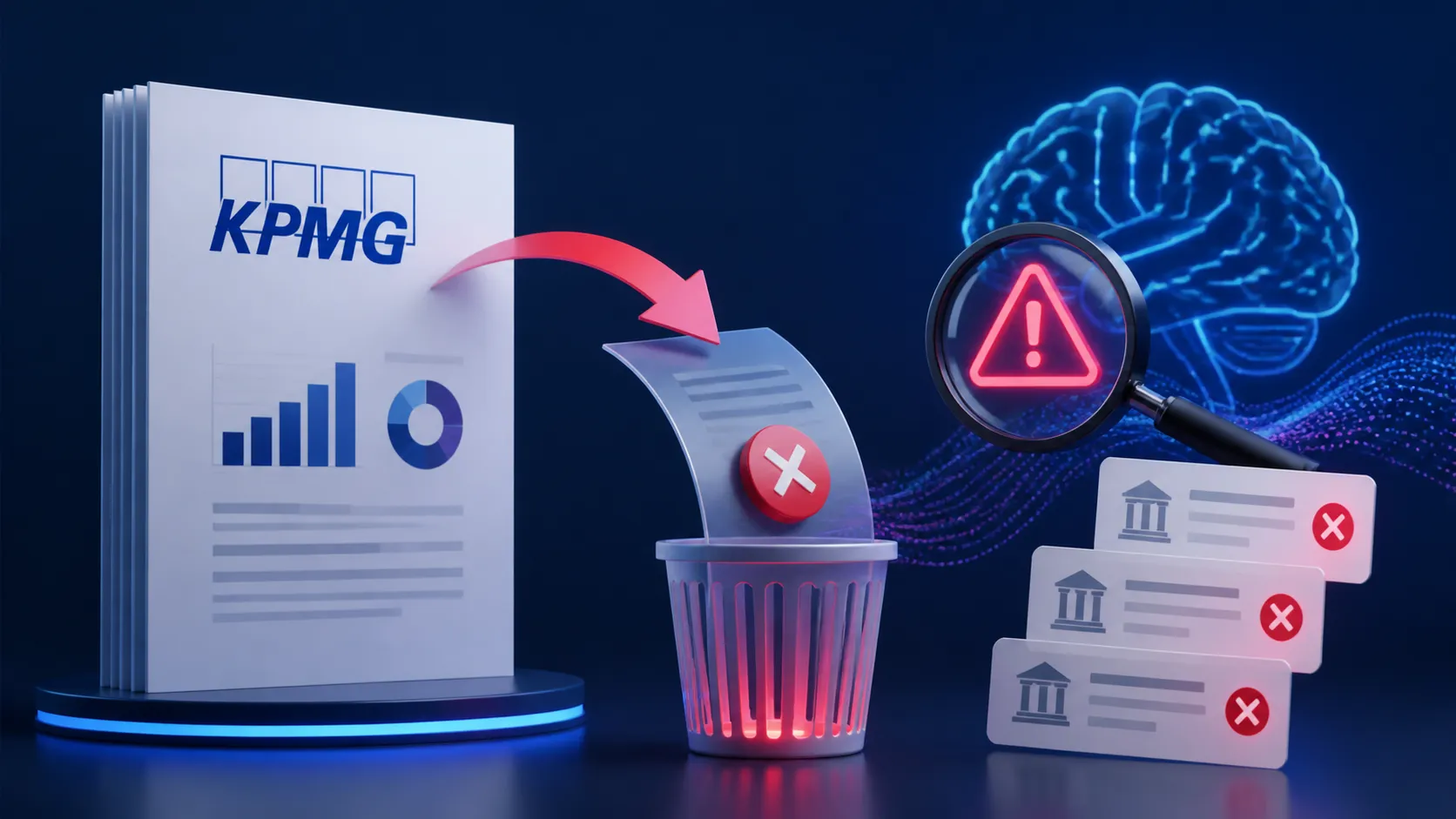
June 15, 2026, (Inside AI) — KPMG has retracted a high-profile study on agentic AI after independent researchers uncovered a web of fabricated citations, false claims, and AI-generated hallucinations. The October 2025 report, titled ‘Total Experience: Redefining Excellence in the Age of Agentic AI’, was pulled following a forensic review by detection firm GPTZero that found only 5 of 45 citations were accurate. The incident exposes deepening reliability gaps in professional services firms’ own use of generative AI, even as they counsel clients on responsible adoption.
Why This Withdrawal Matters Beyond a Single Report
The retraction is not an isolated stumble. It marks the third major consulting firm in a year to face public embarrassment over AI-generated errors. In May 2026, EY withdrew a loyalty rewards report after fake footnotes surfaced. Earlier, Deloitte refunded the Australian government for a taxpayer-funded study tainted by AI content. These cascading failures reveal a systemic vulnerability: the very firms selling AI governance are struggling to govern themselves.
How GPTZero Unraveled the Fabricated Evidence
GPTZero’s analysis laid bare the scale of the problem. Only five citations in the 45-source report pointed to the correct reference. The rest were misleading, partially invented, or too vague to verify. The researchers coined the term ‘vibe citing’ for this pattern—where AI tools stitch together plausible-sounding but nonexistent sources. Nearly half of the report’s claims were false, unsupported, or misattributed.
Case studies on agentic AI deployments at UBS, the UK’s National Health Service, Swiss Federal Railways, and Transport for London were particularly flawed. These organizations told the Financial Times that the report’s assertions were either untrue or misleading. The disconnect suggests that KPMG’s internal review processes failed to catch what outside experts quickly identified.
Emirates Chatbot Claim Highlights Deeper Fabrication
One striking example involved Emirates airline. The report claimed the carrier had adopted a mobile chatbot named Sara that could converse with passengers and change flights. GPTZero researchers countered: “On page 42, the authors claim that Emirates airline has adopted a mobile chatbot named Sara (false) that can converse directly with passengers (partially true) and change their flights (false). In fact, Sara is a robot assistant introduced by Emirates in 2023 (not a chatbot) that lacks the ability to alter flight bookings.” Such errors point to a fundamental breakdown in fact-checking.
Contradictions with KPMG’s Own Research Raise Questions
The report also clashed with KPMG’s concurrent publications. GPTZero noted that a statistic claiming over 55% of CEOs ranked AI as their top investment priority contradicted the 71% figure in KPMG’s 2025 CEO Outlook, released the same month. This internal inconsistency further eroded the document’s credibility and hinted at hasty, unverified content generation.
KPMG’s Response and the Industry’s Reckoning
KPMG International acknowledged the failure. A spokesperson told The Register: “KPMG International takes the accuracy and integrity of its published content seriously. The report has been removed and we are reviewing the circumstances surrounding its publication. We expect all our people to follow our guidelines on the responsible use of AI, including human oversight to validate content and verify independent sources.” Yet the statement does little to quell concerns about how such a flawed report cleared internal gates.
Competing voices argue that these incidents are inevitable given the speed at which firms are deploying AI without robust verification layers. Others suggest that market pressure to produce thought leadership quickly has outpaced editorial rigor. The episode serves as a stark reminder that even experts can be seduced by the fluency of generative AI, mistaking coherence for accuracy.
What Comes Next for AI Governance in Consulting
The KPMG retraction is likely to accelerate calls for mandatory AI auditing and stricter internal controls within professional services. As firms race to advise clients on agentic AI, their own missteps could undermine trust. The industry now faces a critical question: can it fix its own house before regulators or clients demand external oversight?