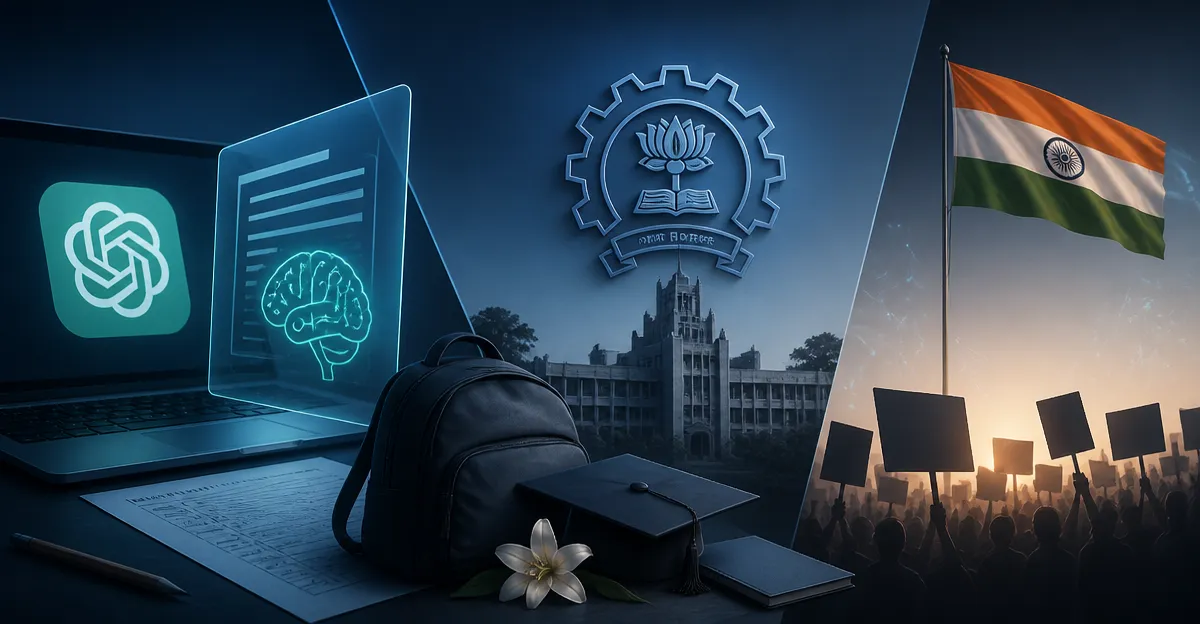
September 19, 2026, (Inside AI) — A second-year B.Tech student at the Indian Institute of Technology Bombay was found dead in his hostel room on the evening of Friday, September 18, hours after an instructor caught him using a mobile phone during an examination and uploading the question paper to ChatGPT for answers. By Saturday night, the death had triggered a large student protest on the Mumbai campus, with demonstrators questioning the institute's handling of the episode and demanding the resignation of Director Prof Shireesh Kedare and Prof Sooryanarayana Doolla of the Department of Energy Science and Engineering, where the student was enrolled.
The institute said in an official statement that no disciplinary action was initiated against the student. The matter was discussed with him by the instructor and the Head of Department, who counselled him and assured him that the incident would not adversely affect his academic career. The student returned to his hostel room after the discussion. He was found dead later that evening. Inside AI could not independently verify the sequence of events or the circumstances of the death.
The death quickly escalated into a broader confrontation over student welfare at one of India's most prestigious engineering schools. While the administration maintained that no disciplinary action had been initiated, students alleged that the student had been threatened with suspension. That contradiction became the flashpoint for the protests.
"It is impossible to believe that the student was exempted of a disciplinary action. We are not saying that there should not be any disciplinary action if a student is actually found in violation of norms. But this has to have been dealt with in a sensitive manner. Professors and staff need to be sensitised in matters related to students. An insensitive remark can definitely have severe impact," a student said.
Read: NTA Restructures Translator Role to Review AI-Generated Exam Translations
By Saturday morning, the student's parents had reached the institute's main gate demanding justice. In a video circulated by the Ambedkar Periyar Phule Study Circle (APPSC), a student collective on the IIT-B campus, his parents blamed the institute administration for their son's death. His father denied that his son could have decided to end his life and alleged caste discrimination.
"This is a case of caste discrimination. We took efforts to put our son in this institute which has failed us. It is because of their torture that we have lost our only child. We demand justice. We will raise our complaint to the national capital," his father said.
The protest continued through the day and intensified late Saturday night. An impromptu open house convened by Kedare at the institute's Convocation Hall gave students an opportunity to raise concerns that went beyond the circumstances of the student's death. Students questioned the lack of adequate representation on committees that formulate policies affecting campus life.
"Barring from one student representative on academic council, there is serious absence of student representation on various other forums and committees constituted by the institute for policymaking which largely impacts students on campus," a student said.
Mental health support was another major concern raised during the meeting. A student who said she had faced mental health issues and was dissatisfied with the support provided by the institute said the available counselling was inadequate and sometimes came with judgement.
"The institute provides mental health support but not only is that inadequate it is also problematic at times when that support comes with judgement. There is already a shortage of counsellors and those on board have not been of great help," she said.
Students also questioned restrictions on access to common spaces on campus, saying these spaces were important for students to unwind.
Read: OpenAI and GSA Announce Free ChatGPT Access for All U.S. Government Levels
"The Student Activity Centre (SAC) is closed by midnight which used to remain throughout night. Lake side area is closed with a leopard warning, other common areas around hostels also need to be shut during nights. These may come across as small things but can have severe impact on students. These common places help students to distress," a student said.
Responding to the protest and the concerns raised by students, Kedare said the institute would constitute a committee to examine not only the circumstances leading to the student's death but also the wider issues raised by students. The committee, he said, would work towards formulating a more effective policy to help students in need.
The incident has renewed scrutiny of how Indian higher education institutions handle academic dishonesty in the age of generative AI. ChatGPT and similar tools have made it easier for students to seek instant answers during exams, but the response from faculty and administrators often lacks clear protocols. At IIT Bombay, the instructor's decision to counsel rather than punish the student was intended as a lenient gesture. Instead, it became the centre of a dispute over what actually happened in that room and whether the student was threatened with suspension.
Student welfare advocates have long argued that mental health resources at elite Indian institutes remain underfunded and understaffed. The shortage of counsellors, combined with academic pressure and caste-related discrimination, creates conditions where a single incident can have fatal consequences. The APPSC's involvement highlights the caste dimension that the family has raised, a charge the institute has not publicly addressed.
The protest at IIT Bombay is not an isolated event. In recent years, students at several Indian Institutes of Technology have staged demonstrations over issues ranging from caste discrimination to restrictions on campus life. The administration's decision to form a committee is a familiar response, but students have expressed skepticism about whether it will lead to meaningful change. The committee's composition, mandate, and timeline have not been announced.
As of Saturday night, the protest had not subsided. Students remained gathered on campus, demanding accountability and systemic reforms. The institute has not commented on the resignation demands. The death remains under investigation, and no official cause has been released. Inside AI could not independently verify the claims made by students or the family.