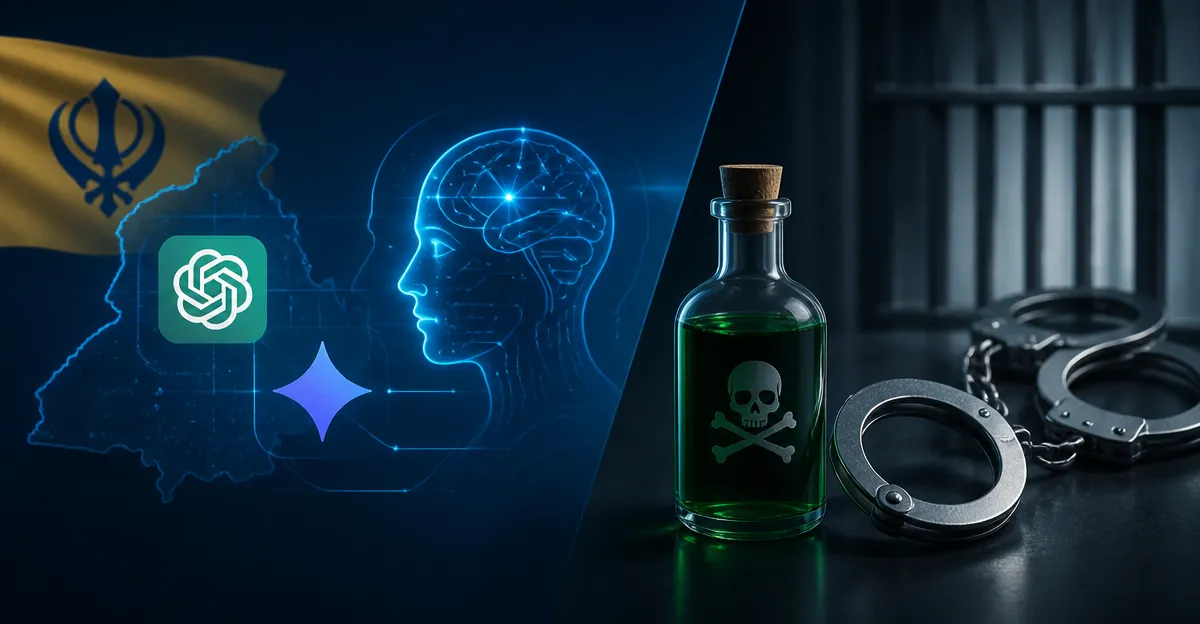
September 23, 2026, (Inside AI) — A university student in Bahawalpur, Punjab, has been arrested for allegedly poisoning his father using chemicals synthesized with instructions from an artificial intelligence system. The National Cyber Crime Investigation Agency (NCCIA) Punjab carried out the arrest after receiving an overseas intelligence tip, according to officials familiar with the case.
The suspect, whose name has not been released, reportedly built a home laboratory after developing an interest in crime dramas. Investigators say he sourced chemical precursors from Australia and Islamabad to prepare the poison. When an initial attempt on his father's life failed, he allegedly returned to AI tools for further guidance.
The case marks one of the first documented instances in South Asia where a generative AI model has been directly linked to a violent crime. It raises urgent questions about how easily widely available chatbots can be repurposed for harm, and whether current safeguards are adequate.
How Did AI Provide Lethal Instructions?
Details remain scarce, but officials indicate the student queried an AI system for chemical synthesis routes. Most commercial AI models, including those from OpenAI, Google, and Anthropic, have policies against generating instructions for weapons or poisons. However, researchers have repeatedly shown that such guardrails can be bypassed through role-playing prompts or by breaking requests into innocuous steps.
In 2024, a study by the Center for AI Safety found that leading models could be tricked into providing detailed bioweapon synthesis instructions with modest effort. The Bahawalpur case suggests those vulnerabilities persist.
The NCCIA acted on a tip from a foreign intelligence agency, though the exact source remains undisclosed. The agency's director ordered the Bahawalpur operation, leading to the discovery of the home lab. Officials described the setup as rudimentary but functional.
Legal experts note that Pakistan's existing cybercrime laws, primarily the Prevention of Electronic Crimes Act (PECA) 2016, do not specifically address AI-generated criminal instructions. Prosecutors may instead rely on attempted murder and poisoning charges under the Pakistan Penal Code.
The suspect's father survived the poisoning, according to sources. His current condition is unknown.
A Pattern of AI Misuse Emerges
This incident is not isolated. In recent months, AI-assisted crimes have surfaced globally. In the United States, a Justice Department report earlier this year noted a rise in cases where suspects used AI to plan attacks. In the United Kingdom, police have warned about AI chatbots being used to source drug recipes.
For Pakistan, the case highlights a broader challenge: regulating AI in a country where digital literacy and oversight vary widely. The NCCIA has ramped up monitoring of online spaces, but resources are limited. The agency has not commented on whether it will pursue charges against any AI provider.
Industry observers point out that most AI companies rely on users to report misuse. Proactive detection of criminal intent remains rare. Some startups are developing classifiers to flag dangerous queries, but adoption is uneven.
The suspect's age and background have not been released. If he is a minor, the case could test Pakistan's juvenile justice system, which is ill-equipped for tech-facilitated crimes.
Local media reported that the student's interest in crime dramas sparked his initial curiosity. That detail underscores how popular culture can intersect with accessible AI tools to produce real-world harm.
As the investigation continues, the Bahawalpur case will likely fuel debates over AI safety, parental monitoring, and the need for international cooperation. For now, it stands as a stark reminder that the same tools promising convenience can also enable violence.