June 15, 2026, (Inside AI) — Ten meters beneath the surface off Hainan’s Wuzhizhou Island, a small robotic inspector weaves silently through branching corals. Its cameras capture hawksbill turtles, parrotfish, and a reefscape that, a decade ago, was nearly dead. The island’s marine ranch once faced coral collapse, but artificial reefs deployed since 2010 have helped restore the habitat. Monitoring that recovery, however, remained a stubborn challenge.
“We used to rely on manual diving. It’s inefficient and risky,” said Wang Aimin, a professor at Hainan University and chief scientist of the Hainan Provincial Engineering Research Center for Modern Marine Ranching. The breakthrough came through a partnership with Robotfish, a marine technology firm based in Qingdao, Shandong Province. Its underwater robot operates for hours with minimal disturbance, capturing close-up, multi-angle images of coral health. Today, seven monitoring stations form a round-the-clock surveillance network, tracking water temperature, salinity, and live reef activity.
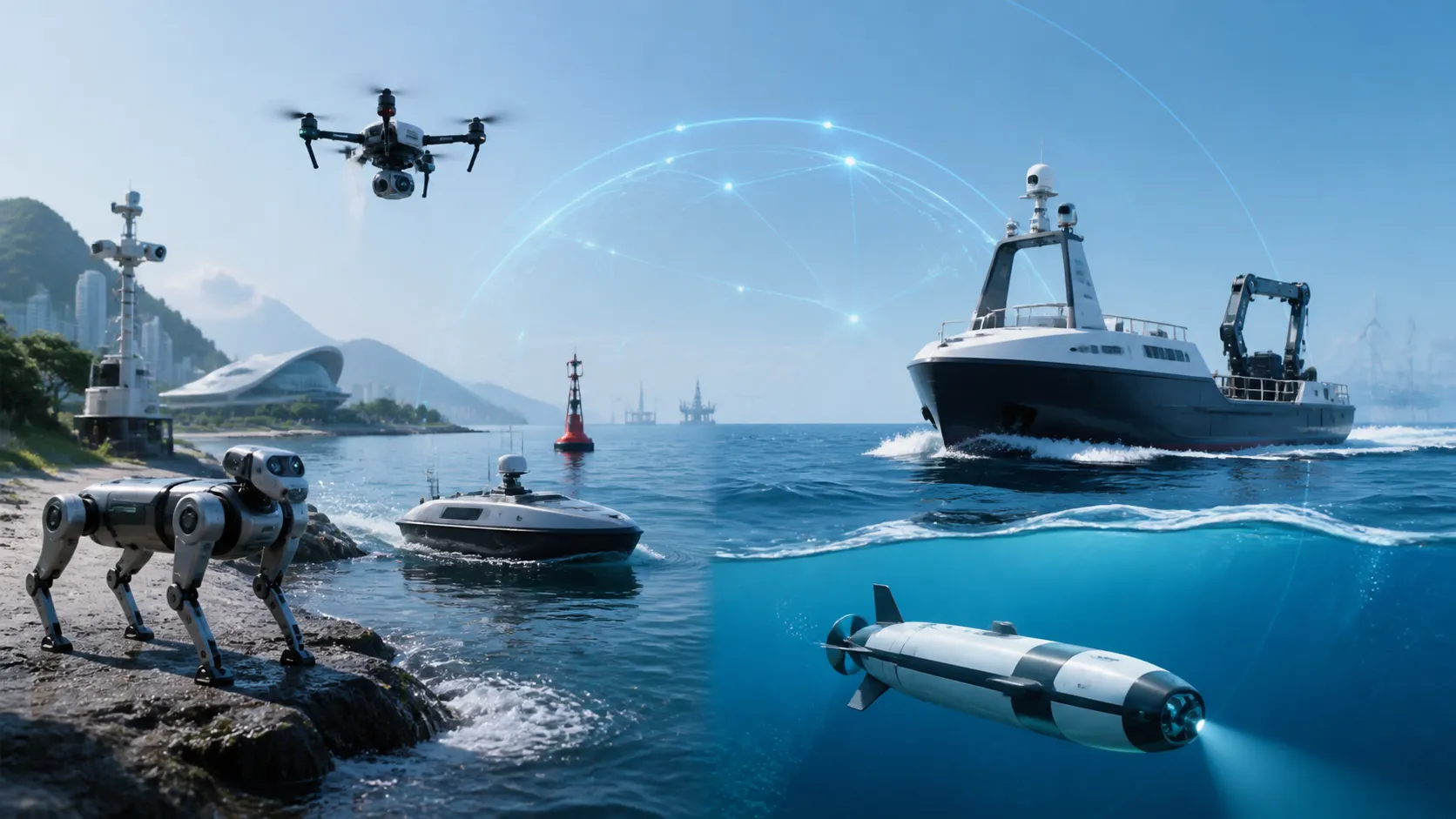
“If something goes wrong, we can act immediately,” Wang said. This deployment is one example of how China’s homegrown marine “black tech” is moving from lab to real-world use. Intelligent robots and ocean AI models are now tackling ecological protection, disaster forecasting, and shipping services. The push aligns with a national strategy to strengthen marine science and accelerate digital transformation across the sector.
Why the Ocean Resists Easy Tech Fixes
Monitoring a coral reef is benign compared to what the ocean can throw at a machine. GPS signals do not penetrate seawater. Pressure rises one atmosphere every 10 meters. Biofouling, corrosion, and unpredictable currents degrade equipment within weeks. One cannot simply adapt land-based tech, but must rebuild it from first principles, said Wang Fan, director of the Institute of Oceanology under the Chinese Academy of Sciences (IOCAS).
Read: China’s Young Innovators Drive AI, Aerospace, and Deep-Sea Tech Breakthroughs
Wang Fan added that the ocean remains one of the least instrumented places on the planet, while marine data is sparse and expensive to collect. This reality is driving a new wave of marine AI models in coastal hubs like Qingdao, often called the “capital of marine science” in China. The city hosts nearly one-third of the country’s high-level marine research institutions.
An AI Model That Predicts Typhoons and More
At a recent Digital Earth conference in Qingdao, the IOCAS on June 6 unveiled LangYa 2.0, an ocean AI model that forecasts typhoons, precipitation, sea ice, storm surges, internal solitary waves, and mesoscale eddies. Its six vertical models turn predictions into forms that policymakers and coastal residents can actually use.
The engineering model behind LangYa 2.0 correctly predicted several sudden-turning typhoons last year, improving 24-hour forecast accuracy by more than 10 percent, said Wang Fan. “With lightweight versions of large models, we can deploy them locally. That offers a low-cost forecasting option for less developed countries and regions,” he said. The IOCAS also plans collaborative research with more countries under the United Nations Decade of Ocean Science for Sustainable Development (2021-2030).
Robots That See and Move Beneath the Waves
If AI helps humans understand the sea, intelligent robots provide sharp “eyes” and dexterous “hands and feet” to see and move beneath the waves. In the Strait of Malacca, one of the world’s busiest shipping lanes, multiple fourth-generation underwater cleaning robots from ZhiZhen Marine Science and Technology (Weihai) Co., Ltd. in Shandong Province are scraping barnacles and algae off vessel hulls.
“Biofouling increases drag and fuel consumption, and can shorten a ship’s lifespan. Traditional manual cleaning is inefficient, risky and no longer fits modern shipping,” said Qin Mingda, head of the company’s cleaning robot project. ZhiZhen’s robots operate at depths of up to 150 meters, cleaning 2,000 square meters per hour, work which would have required four skilled divers. In 2025, these robots cleaned over a thousand ships in Malacca waters, becoming the only type of equipment capable of stable operation there, according to Qin.
“Singapore clients keep ordering as many units as we can make,” he revealed. Such niche breakthroughs, however, demand policy coordination. China’s central government has made marine technology a national strategic priority. The marine economy exceeded 11 trillion yuan (about 1.6 trillion U.S. dollars) in 2025, up 5.5 percent year on year. In March, a senior National Development and Reform Commission official, Yuan Da, said China’s 15th Five-Year plan (2026-2030) dedicates a separate chapter to improving maritime capabilities. Priorities include strengthening marine strategic science and technology and promoting digital and intelligent transformation. The Ministry of Natural Resources echoed this urgency, calling for “using green and digital-intelligent technologies to transform and upgrade traditional marine industries.”
Read: China’s Youth Drive AI, Space, and Deep-Sea Tech Surge, Think Tank Finds
For Qin, ZhiZhen is not resting on its market success. A fifth-generation cleaning robot is now being tested, with optimized designs for better cleaning efficiency and sea-state adaptability. “Innovation is the key to go deeper in the sea,” he said.